
H7 LED Headlight Bulbs: 4 Models Compared by Fit

For an H7 LED headlight bulb in a 1:1 halogen-size design, Marsauto M1S is the closest match, while its fanless construction is the deciding difference. Choose another option if you prefer a different brand or 6500K color temperature; confirm that your vehicle’s headlight housing is designed for an H7 bulb before buying.
We earn a commission if you buy through links on this page. As an Amazon Associate I earn from qualifying purchases. Products are compared on manufacturer specifications, not hands-on testing.
- Best overall: Marsauto M1S H7 Fanless – Its 1:1 halogen-size design and fanless construction distinguish it from the other H7 options.
- Best for compact fit: Termitor H7 Upgraded – The 1:1 mini-size design is intended to avoid a separate adapter.
- Best for powersports: SEALIGHT S3 H7 – The product is specifically positioned for powersports and has a 1:1 size.
| Product | Best for | Color temperature | Design | Pair output | Shop |
|---|---|---|---|---|---|
| Marsauto M1S H7 Fanless | Fanless design | 6000K | 1:1 halogen size, fanless | 130,000 lm | Check Price on Amazon |
| Marsauto M1L H7 | 6500K color | 6500K | 1:1 mini size | 30,000 lm | Check Price on Amazon |
| Termitor H7 Upgraded | Adapter-free fit | 6500K | 1:1 mini size | 100,000 lm | Check Price on Amazon |
| SEALIGHT S3 H7 | Powersports use | 6500K | 1:1 stock size | 60,000 lm | Check Price on Amazon |
H7 LED Headlight Bulbs
Compare the bulb designs and claimed output, then verify that the H7 base and housing fit your vehicle.
Marsauto M1S H7 Fanless

Marsauto M1S is the fanless choice among these H7 bulbs, with a 1:1 halogen-size design and a 6000K color temperature. The maker claims 130,000 lumens per pair and an 80,000-hour lifespan, and gives the shell an IP68 rating. Its compact plug-and-play approach may suit a buyer seeking to avoid an external cooling fan.
Bottom line: Choose this if you want a fanless 1:1 design and 6000K light.
Marsauto M1L H7
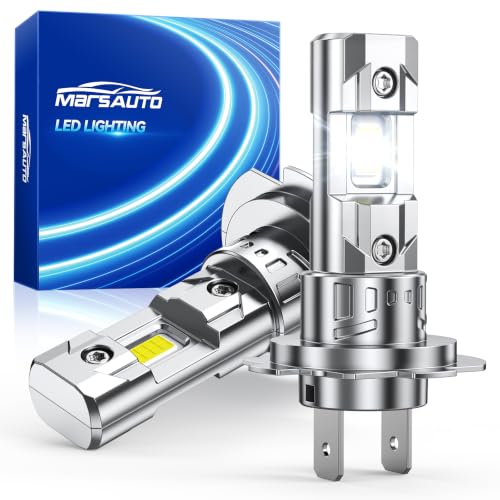
Marsauto M1L differs from the other Marsauto option here with a 6500K color temperature and a 1:1 mini size. The maker claims 30,000 lumens and describes micro-gap chip optics intended to focus the beam. The two-bulb pack is presented as plug-and-play and has an IP68 rating. The maker includes a reference to top-clearance marker assemblies, so buyers should not assume that an H7 base alone guarantees a headlight-housing fit. Confirm the bulb type and available rear clearance before choosing it.
Bottom line: Choose this for a 6500K Marsauto option, after checking housing fit.
Termitor H7 Upgraded

Termitor’s H7 bulb emphasizes a 1:1 mini design and says no adapter is required, making installation footprint its distinguishing point. The maker claims 100,000 lumens per set, 6500K light, and a lifespan of more than 85,000 hours. This two-bulb option may suit buyers looking for a compact all-in-one design without separate wiring or adapters. Its claims of very high output and off-road use do not establish that it is suitable or legal for every on-road headlight; check your vehicle’s requirements and beam pattern.
Bottom line: Choose this if its compact, adapter-free design fits your housing.
SEALIGHT S3 H7

SEALIGHT S3 is the option explicitly aimed at powersports, with a 1:1 stock-size form and non-polar installation. The maker claims 60,000 lumens, 6500K output, an IP68 rating, and an 80,000-hour lifespan. Those performance descriptions do not confirm a safe beam in every reflector or projector; the housing and vehicle fit still matter. Consider this pair when powersports use is the intended application and H7 compatibility is confirmed.
Bottom line: Choose this for a powersports application that takes H7 bulbs.
How to choose H7 LED headlight bulbs
Start with the bulb designation and the headlight housing, not the lumen claim: H7 is a single-filament halogen bulb type, and the vehicle’s manual or existing bulb identifies whether that fit is required. LED replacements place light sources differently from halogen filaments, so an H7 base does not guarantee the original beam shape. Check whether the vehicle maker permits LED replacement and whether the lamp assembly is approved for that source. For a road-going vehicle, prioritize verified housing compatibility and beam alignment over maximum claimed output; misdirected light can impair other drivers’ vision.
Color temperature is measured in kelvins, not brightness. Around 6000K to 6500K is a cool-white appearance; it does not by itself mean a bulb produces more usable light. Compare package claims cautiously because lumens alone do not describe where light lands on the road.
H7 fit and installation clearance
H7 identifies the base and bulb type, but the space behind the headlamp can still decide whether an LED replacement fits. A heat sink, fan or driver may need room under the dust cap, and some housings leave less clearance than others. Measure the available depth and width before ordering, especially when the original bulb sits behind a sealed cover. A claimed 1:1 size describes the bulb’s form, not necessarily the whole installation once wiring and cooling parts are included.
LED bulbs also depend on polarity, connectors and vehicle electronics. A non-polar design can remove the need to orient the plug, while some vehicles may report a lamp fault after a swap. Confirm the H7 socket, rear clearance, and any vehicle-specific error or adapter requirement before installation. After fitting, check the cutoff and aim against a wall on level ground; stop using a bulb that creates glare or an irregular beam.
LED and halogen beam pattern differences
An LED replacement can use less power and produce a different color than halogen, but neither change guarantees better road illumination. Halogen reflectors and projectors are shaped around a filament’s location and size; LED chips that sit too far forward, backward, or wide can scatter light above the cutoff. That creates glare while leaving dark areas on the road, even when the advertised lumen number is high.
Use the beam pattern as a decision rule: if the replacement cannot form a clear cutoff in the vehicle’s intended lamp assembly, do not use it for public-road driving. Aim the headlamps after installation and check both low- and high-beam operation where applicable. A brightness claim, waterproof rating or close physical size cannot substitute for confirmed compatibility and correct optical performance.
H7 bulb claims and vehicle safety
Headlamp replacement rules vary by vehicle and jurisdiction, and an H7 socket by itself does not establish that an LED retrofit is approved for road use. Check the vehicle and lamp-maker guidance for permitted bulb technology, and review applicable local regulations before relying on an LED conversion. A product’s output, glare-control or error-free claim is not proof that a particular vehicle’s lamp assembly will produce a safe beam.
Keep both lamps matched in type and color, and confirm that connectors and seals are fully seated after installation. Headlamps should be aimed to the vehicle maker’s specification; a common starting check is a level surface about 25 feet from a wall, although the target height depends on the vehicle. If the cutoff is uneven or points into oncoming traffic, restore a compatible bulb rather than driving with the misaligned setup.
Frequently Asked Questions
Does an H7 LED fit every H7 headlight socket?
No; the H7 base does not guarantee room for an LED’s heat sink, fan or wiring. Check the rear clearance and vehicle-specific bulb requirements before installation.
What does 6000K or 6500K mean on an H7 bulb?
Kelvin describes the light’s color appearance, not its brightness. A 6000K to 6500K rating generally indicates cool-white light, while usable road illumination depends on the beam and housing.
Can an H7 LED bulb cause headlight glare?
Yes, an LED source that does not align with the lamp’s optics can scatter light above the cutoff. If the installed beam lacks a clean cutoff or shines into oncoming traffic, do not use it on the road.
Do H7 LED bulbs need a cooling fan?
Some LED designs use a fan and others use fanless cooling; the choice affects packaging and clearance. Measure space behind the dust cover, since a fan or heat sink still needs adequate room to manage heat.
How do I check an H7 headlight beam after installation?
Park on level ground facing a wall and inspect whether the low-beam cutoff is even and aimed below other drivers’ sightlines. Follow the vehicle maker’s aiming specification, since target height and distance vary by vehicle.