
Best Motorcycle Helmet Fighter Pilot Style: 3 Picks

For most riders seeking a fighter pilot style motorcycle helmet, ScorpionEXO Covert FX Carbon Fiber Full Face is the strongest match because it pairs a full face design with DOT and ECE 22.06 certification. Choose Motorcycle Helmet, Aircraft Style, Black for a vintage aircraft-helmet look or ILM Model 726X Open-Face Helmet if you prefer an open-face motorcycle helmet; costume helmets are not road-riding substitutes.
We earn a commission if you buy through links on this page. As an Amazon Associate I earn from qualifying purchases. Products are compared on manufacturer specifications, not hands-on testing.
- Best overall: ScorpionEXO Covert FX Carbon Fiber Full Face – Its full face street-fighter styling and DOT and ECE 22.06 certifications make it the closest all-around match.
- Best for aviation style: Motorcycle Helmet, Aircraft Style, Black – Its rounded aircraft-inspired shape, faux-leather exterior and DOT and FMVSS 218 claims fit a retro look.
- Best for open-face coverage: ILM Model 726X Open-Face Helmet – Its 3/4 design has a detachable lens, sun shield and chin guard.
| Product | Best for | Style | Coverage | Safety standard | Shop |
|---|---|---|---|---|---|
| ScorpionEXO Covert FX Carbon Fiber Full Face | Full face riding | Street fighter | Full face | DOT; ECE 22.06 | Check Price on Amazon |
| Motorcycle Helmet, Aircraft Style, Black | Retro aircraft look | Aircraft-inspired | — | DOT; FMVSS 218 | Check Price on Amazon |
| ILM Model 726X Open-Face Helmet | Open-face riding | Open face | 3/4 helmet | DOT; FMVSS 218 | Check Price on Amazon |
Fighter Pilot Style Motorcycle Helmets
Compare the riding helmets by coverage and design, and leave costume pieces out of road-use consideration.
ScorpionEXO Covert FX Carbon Fiber Full Face
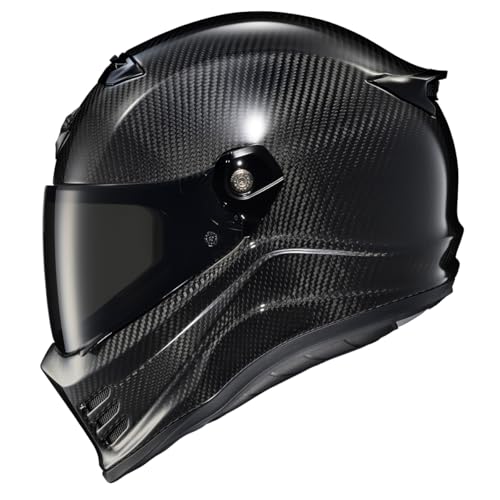
The full face street-fighter design makes this the closest fit for riders who want fighter pilot styling with coverage around the face. Its TCT-U 3K carbon fiber shell, multi-layer EPS, top intake vent and exhaust vents are specified, along with Bluetooth-ready speaker pockets. The maker says the helmet meets U.S. DOT and ECE 22.06 standards. It comes in the 2X-Large size, so riders needing another size should compare their head measurement with the maker’s sizing chart before choosing. The source text cuts off during the mouth-vent description, so avoid assuming additional functions.
Bottom line: Pick this if you want a full face street-fighter look and need a 2X-Large size.
Motorcycle Helmet, Aircraft Style, Black

The rounded aircraft-inspired shape and matte black finish give this helmet a more vintage aviation look than the modern full face option. It has a polycarbonate shell, faux-leather exterior, leather-padded interior and adjustable chin strap. The maker says it meets DOT and FMVSS 218 standards. The size is XL, and the fit description also says “three size fits most” while mentioning M, so confirm the size and fit before ordering if either point matters. Its coverage type is not clear from the text, so riders prioritizing full face protection should choose a model that explicitly identifies that coverage.
Bottom line: Choose this for the aircraft-inspired appearance if its XL fit works for you.
ILM Model 726X Open-Face Helmet
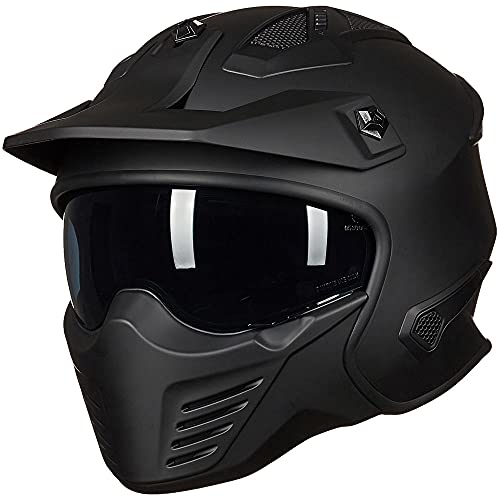
The 3/4 open-face format sets this apart from the full face and aircraft-styled choices; it is a related riding option, not a direct fighter-pilot-style match. This matte-black helmet has a detachable lens, sun shield and chin guard, plus multiple vents and a quick-release buckle. The maker says it meets or exceeds FMVSS 218 and DOT standards. The size is Large. An open-face design leaves more of the face exposed than a full face helmet, so riders seeking maximum facial coverage should look at a full face model instead.
Bottom line: Pick this if you want a 3/4 open-face helmet rather than a close fighter-pilot look.
How to Choose a Fighter Pilot Style Motorcycle Helmet
Choose coverage first, then compare the aviation-inspired styling. Full face helmets cover the chin and jaw; 3/4 helmets leave the face open, even when they include a removable chin guard. A snug fit matters: the cheek pads should press evenly, and the helmet should not rotate freely when you move it side to side. Measure around the widest part of your head, just above the eyebrows, and use the manufacturer’s size chart rather than relying on a hat size. If a helmet shifts or causes painful pressure points, try another size or shape. For road riding, do not mistake costume replicas for protective helmets; look for the required road-safety marking on the actual riding helmet.
Full Face Versus Open-Face Coverage
Full face coverage is the clearest choice for riders who want the chin area enclosed; an open-face helmet trades that coverage for an exposed face. DOT is the U.S. road-helmet standard associated with FMVSS 218, while ECE 22.06 is a separate European helmet standard. The products’ safety claims differ, so compare the markings and certification claims on the specific helmet you receive. A detachable chin guard is not automatically equivalent to a fixed full face structure; verify the helmet’s intended configuration and certification. Use this comparison to match the main tradeoff:
| Need | Suitable format | Tradeoff |
|---|---|---|
| Chin and jaw enclosed | Full face | More coverage around the face |
| Open-face preference | 3/4 open-face | More face remains exposed |
| Costume or display | Costume replica | Not a substitute for a certified riding helmet |
How to Check Helmet Fit and Size
A motorcycle helmet should fit snugly without creating sharp pressure points, and the cheek pads should contact the cheeks. Head shape matters as well as circumference: two helmets with the same size label can feel different because their interiors have different shapes. Measure your head where it is widest, then check that model’s size chart; do not assume an XL or 2X-Large label is consistent across brands. After fastening the chin strap, try to roll the helmet forward and backward: a loose shell that moves independently of your head is a poor fit. If the helmet’s size or coverage description conflicts, confirm those details before ordering rather than guessing from its appearance.
Motorcycle Helmet Safety and Replacement
A helmet involved in a crash should be replaced, even if the outer shell looks intact, because impact damage can be hidden. DOT-marked helmets are associated with FMVSS 218 requirements; buyers should distinguish a road helmet from a decorative costume prop. Secure the chin strap each ride, and do not ride with a loose or unfastened helmet. After a fall, inspect for visible cracks, crushed liner areas, damaged straps or a failed buckle, but a clean appearance does not prove the impact liner is unaffected. Store a helmet away from prolonged heat and solvents that may damage its materials. For a used helmet, unknown crash history is a reason to choose one with known history instead.
Frequently Asked Questions
How should a motorcycle helmet fit around the cheeks?
A properly fitted helmet presses its cheek pads evenly against both cheeks without sharp pain. If the shell shifts independently when you move your head, try a different size or interior shape.
Can an open-face helmet protect the chin?
An open-face helmet leaves the face exposed, and a removable chin guard does not by itself establish full face-equivalent protection. Check the model’s certified configuration if chin coverage is important.
What does a DOT mark mean on a motorcycle helmet?
DOT marking indicates the maker certifies the helmet to the U.S. FMVSS 218 standard. Compare the marking on the riding helmet itself, not just a costume or decorative replica.
Should I replace a helmet after a crash?
Yes, replace a helmet after a crash or significant impact because damage to its energy-absorbing liner may not be visible. Cracks, compressed liner areas, damaged straps or a failed buckle are additional reasons not to ride in it.
How do I measure my head for a motorcycle helmet?
Wrap a flexible tape around the widest part of your head, just above the eyebrows, and compare that circumference with the maker’s size chart. Try the helmet on as well, since head shape affects fit beyond the measurement.