
Shade Cloth for Trees: Covers Compared by Fit

For a fruit tree that needs a fitted cover, Fruit Tree Sunshade Cloth, 5.9 x 4.5 ft is the closest match because it is sized for fruit trees and has a zipper and bottom drawstring.
Shade cloth reduces direct sunlight; its percentage indicates how much sunlight the fabric blocks, while breathable construction lets air pass through.
We earn a commission if you buy through links on this page. As an Amazon Associate I earn from qualifying purchases. Products are compared on manufacturer specifications, not hands-on testing.
- Best overall: Fruit Tree Sunshade Cloth, 5.9 x 4.5 ft – Fruit tree fit, zipper access, and bottom drawstring make it purpose-built for covering a canopy.
- Best for compact plants: Garden Plant Shade Covers, 3.94 x 2.62 ft – Two small 3.94-by-2.62-foot covers offer 70% shade for limited coverage.
| Product | Best for | Size | Material | Shop |
|---|---|---|---|---|
| Fruit Tree Sunshade Cloth, 5.9 x 4.5 ft | Fruit tree cover | 5.9 x 4.5 ft | Nonwoven fabric | Check Price on Amazon |
| Garden Plant Shade Covers, 3.94 x 2.62 ft | Small plants | 3.94 x 2.62 ft | HDPE | Check Price on Amazon |
| White Nonwoven Plant Shade Covers, 6.5 x 5 ft | Light-diffusing cover | 6.5 x 5 ft | Nonwoven fabric | Check Price on Amazon |
Shade Cloth for Trees
Compare each cover’s shade level, dimensions, and access features with the shape and size of the canopy you need to protect.
Fruit Tree Sunshade Cloth, 5.9 x 4.5 ft

Unlike flat garden netting, this fruit tree cover has a zipper and a bottom drawstring for access around a single canopy. The 5.9-by-4.5-foot cover is made from lightweight, breathable nonwoven fabric, which the maker says blocks intense sunlight while maintaining air circulation. The opening can help when you need to water, prune, or harvest without removing the cover.
Bottom line: Pick this for a fruit tree whose canopy fits within the cover’s dimensions.
Garden Plant Shade Covers, 3.94 x 2.62 ft

These are the smallest covers in the group, making them more suitable for compact plants or limited canopy sections than for a mature tree. The pack contains two black high-density polyethylene covers, each 3.94 by 2.62 feet, with 70% shade. The maker says the fabric allows hot air to escape and water droplets to pass through. A 70% block is substantial; choose it only where strong sun reduction is wanted, and check the actual canopy dimensions because the covers may not span a tree’s crown.
Bottom line: Choose these for small plants or a narrowly targeted area needing strong shade.
White Nonwoven Plant Shade Covers, 6.5 x 5 ft
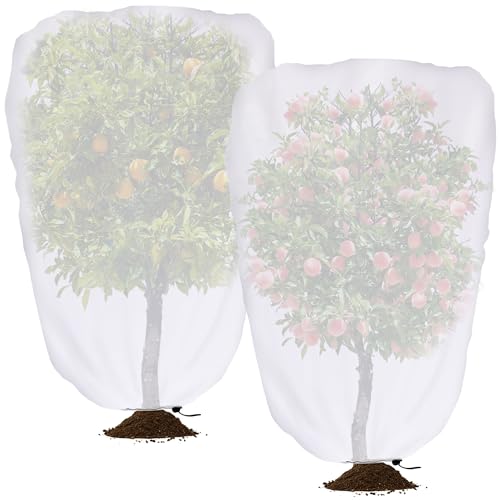
Unlike the black nets, these white nonwoven covers are promoted for light refraction rather than a shade percentage. The pack includes two covers measuring 6.5 by 5 feet, with an adjustable bottom drawstring. The maker says the material is breathable and lets plants receive refracted light while reducing direct sun exposure. That can suit a smaller tree or plant where retaining diffuse light matters, but the missing shade percentage makes exact light reduction hard to compare; use the cover dimensions and canopy shape to decide whether it will fit.
Bottom line: Choose these when diffuse light and a bottom drawstring matter more than a specified shade rate.
Choose shade percentage for the tree
Shade percentage is the share of sunlight a cloth blocks, so higher numbers mean deeper shade. For many established trees, begin with about 30% to 50% shade when temporary protection is needed; young transplants and sun-sensitive plants may call for stronger shade, while too much shade can limit light. These are general starting points, not a species-specific prescription. Among these options, one net is rated 55% and one small cover 70%; the other covers do not give a percentage. If you need predictable light reduction, favor a product with a numeric rate. A useful rule is to choose a lower shade rate for a sun-loving tree and reserve 70% for short-term, especially intense exposure.
Measure the canopy before choosing a cover
Tree covers must fit over the canopy, not just match the trunk height. Measure canopy width at its widest point and the vertical distance from the top to the bottom edge you want shaded; add room for branches and access. The fitted covers here range from 3.94 by 2.62 feet to 6.5 by 5 feet, while the 6.5-by-10-foot net can span a larger area but is not shaped to enclose a tree. Check the lift or mounting arrangement as well: a canopy taller than the cover will leave upper foliage exposed. For irregular branches, a flat net may be easier to position than a tight enclosure.
Compare fitted covers with flat shade nets
Fitted covers and flat nets solve different shading problems. A fitted cover surrounds a smaller canopy and may offer a zipper or drawstring for access; a flat net is better for creating overhead or area shade when you can provide supports. HDPE netting is woven with openings that permit airflow and water passage, while nonwoven fabric has a continuous textile-like structure. The choice can change how the cover sits and how much it diffuses light. Use this comparison when selecting a format:
| Need | Better format | Key trade-off |
|---|---|---|
| Enclose a compact canopy | Fitted cover | Must match canopy dimensions |
| Shade a broad area | Flat net | Requires separate anchoring |
| Access for pruning or harvest | Zippered cover | Still limited by cover size |
A measured fit and a practical support plan matter more than buying the largest piece of fabric.
Secure shade cloth without harming branches
Secure shade material to a frame, fence, or sturdy supports rather than pulling it tightly against delicate branches. Wind can turn a large panel into a sail, so use several secure attachment points and leave enough tension to prevent flapping without stretching the fabric. Do not let the cover press heavily on fruit or branches, especially as wet fabric becomes heavier. Recheck ties after windy weather and adjust the cover if it rubs bark or blocks access to the trunk.
Frequently Asked Questions
What shade percentage is suitable for a young tree?
A 30% to 50% shade cloth is a common starting range for temporary protection, while very intense exposure may call for more shade. Match the percentage to the tree species and avoid blocking more light than needed.
Can shade cloth stay over a tree in the rain?
Check that the cover is firmly secured, since pooled water or wind can strain fabric and fasteners.
How should shade cloth be attached to a tree?
Use an independent frame or well-placed supports rather than tying the fabric tightly around the trunk or thin branches. Multiple attachment points help limit flapping, and the cloth should not rub against bark.
Does black shade cloth make a tree hotter?
Color alone does not determine the shade rate; the percentage and airflow matter more when comparing cloth.
How much larger should a tree cover be than its canopy?
Measure the widest canopy span and its height, then choose fabric that exceeds both dimensions enough to fit without compressing branches. For a 5-foot-wide crown, a 4.5-foot cover is too small to enclose it comfortably.