
Best Well House Heater: 4 Thermostat Models Compared

For most buyers, Gptwht 600W Well House Heater is the best well house heater because its thermostat adjusts from 40°F to 105°F and its dual display shows both room and preset temperatures. A well house heater warms an enclosed utility space to help reduce freezing risk; choose another option if you specifically want a fan-free convection model or 1000W output.
We earn a commission if you buy through links on this page. As an Amazon Associate I earn from qualifying purchases. Products are compared on manufacturer specifications, not hands-on testing.
- Best overall: Gptwht 600W Well House Heater – Its adjustable 40°F–105°F thermostat and dual display make it straightforward to set and monitor a target temperature.
- Best for fan-free heat: GMKYH 600W Utility Heater – The maker describes its 600W heater as fan-free convection and gives an approximate 80–110 sq. ft. range.
- Best for higher output: 1000W Well House Heater – Its 1000W rating is higher than the 600W alternatives, and its name identifies two-stage overheat safety.
| Product | Best for | Wattage | Thermostat range | Heat / display feature | Shop |
|---|---|---|---|---|---|
| Gptwht 600W Well House Heater | Temperature monitoring | 600W | 40°F–105°F | Dual digital display | Check Price on Amazon |
| GMKYH 600W Utility Heater | Fan-free convection | 600W | 40°F–105°F | Fan-free convection; dual display | Check Price on Amazon |
| AEGONAN 600W Pump House Heater | Digital temperature setting | 600W | — | Digital display; thermostat | Check Price on Amazon |
| 1000W Well House Heater | Higher wattage | 1000W | — | Two-stage overheat safety | Check Price on Amazon |
Well House Heaters Compared
Compare wattage and control features against the size and conditions of the enclosed space you need to protect.
Gptwht 600W Well House Heater
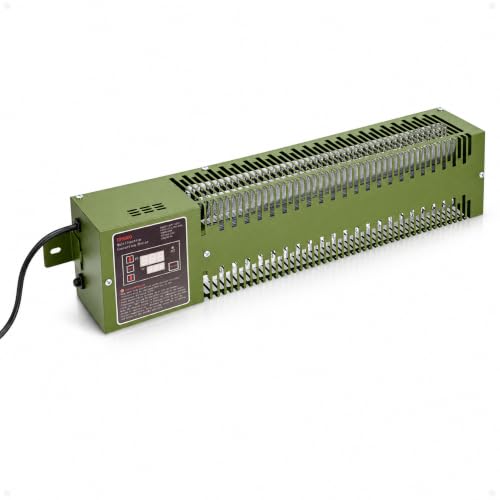
The dual digital display is the standout here: it shows room temperature and the preset temperature together, while the thermostat adjusts from 40°F to 105°F. The maker says the 600W heater is designed for freeze protection in well houses, pump houses, crawl spaces, utility rooms, relay stations and sheds. That range suits buyers who want to set a target rather than rely on a fixed thermostat. The broad list of intended spaces does not establish how large a particular room it can heat, so match the output to the enclosure and cold conditions.
Bottom line: Choose this if checking both current and target temperatures is a priority.
GMKYH 600W Utility Heater

Unlike a fan-forced heater, this 600W model uses natural convection, so there is no fan moving air. The maker gives an approximate coverage range of 80–110 square feet and says the thermostat spans 40°F to 105°F; the dual display shows current and target settings. That makes it a distinct fit for buyers who prefer fan-free heat and have a small enclosed space within the range. Coverage is approximate, and a poorly insulated enclosure or severe cold can change heating needs; do not treat the range as a guarantee for every well house.
Bottom line: Pick this for fan-free convection in a small enclosed utility space.
AEGONAN 600W Pump House Heater

The digital display and built-in thermostat distinguish this 600W option, with the screen showing room temperature by default or a preset value when the user selects one. The maker says it is intended for freeze protection in pump houses, well houses, utility rooms, relay stations and construction sheds, and says it has no moving parts to wear out or maintain. This suits buyers who want a digital setting interface. The maker does not establish a thermostat range, so compare the needed set point against the control range before choosing it.
Bottom line: Choose this when a digital temperature-setting interface matters most.
1000W Well House Heater

At 1000W, this heater has 400W more output than the three 600W options, making it the higher-wattage choice in this group. The maker says it is designed to help reduce freezing risk for pumps, pipes and pressure tanks, and that its built-in thermostat switches heating on and off to maintain a selected temperature. Its name identifies two-stage overheat safety. Choose it when you need more wattage than the 600W choices; the maker does not give a room-size range, so size the heater to the enclosure rather than assuming the higher output fits every setup.
Bottom line: Pick this when the higher 1000W output is the deciding factor.
Choosing a Well House Heater by Wattage
Start with the enclosure’s heat loss, not just its floor area: insulation, air leaks, outdoor lows and exposed pipe runs all affect how much heat is needed. A common rough sizing starting point for electric resistance heat is about 10 watts per square foot, but that is not a guarantee for a poorly insulated or very cold pump house. The 600W models here provide about 2,047 BTU per hour, while 1000W provides about 3,412 BTU per hour (using 1 watt = 3.412 BTU per hour). If the structure is drafty or has vulnerable pipes near an exterior wall, improve air sealing and insulation rather than relying on wattage alone.
Use a measurable rule: if the enclosure is within 80–110 square feet and conditions are reasonably insulated, the coverage range on GMKYH 600W Utility Heater can be a starting point; outside that range, size from heat loss and monitor the coldest area.
Thermostat Settings and Temperature Displays
A thermostat turns heat on as room temperature falls below its set point and off as the space warms, reducing the need for constant manual switching. A display that shows both room and target temperatures makes it easier to tell whether the space is approaching the setting; Gptwht 600W Well House Heater has that dual readout and a 40°F–105°F adjustment span. The minimum setting is not automatically the right setting for every well house: set it above the temperature at which the most vulnerable pipe or equipment could freeze, allowing a margin for colder corners. Place the temperature sensor away from the heater’s direct warmth and near the protected equipment, so the reading reflects the risk area rather than a warm pocket.
Do not treat the thermostat’s set point as a pipe temperature. Water freezes at 32°F, but pipes against cold exterior surfaces can be colder than the room’s displayed temperature.
Safe Placement in a Pump House
Keep a portable electric heater on a stable, dry surface and away from combustible materials; never cover it or put fabric, insulation or stored items against its air openings. Follow the heater’s own clearance requirements because safe spacing differs by design. Well houses can be damp, so use an appropriately protected electrical supply and keep plugs and connections dry; a ground-fault circuit interrupter (GFCI) helps reduce shock risk where moisture is present. Do not use an extension cord unless the heater maker permits it and the cord is rated for the heater’s electrical load. Check the equipment periodically during cold spells, especially after a power interruption.
For unattended freeze protection, an independent low-temperature alarm can alert you to a failed heater or outage; a thermostat is not a backup power source.
Comparing Heater Types and Outputs
Resistance heaters turn electrical energy into heat, but their output alone does not tell you how evenly warmth reaches pipes and equipment. Fan-free convection relies on warm air rising and circulating naturally; it avoids a fan but depends on unobstructed airflow. A thermostat-controlled heater cycles to maintain its target, while a simple fixed-output heater may require another control. The 600W options in this group are about 2,047 BTU per hour, and the 1000W option is about 3,412 BTU per hour. Use this table to match the design feature to the problem you are solving.
| Need | Relevant type or feature |
|---|---|
| Avoid moving air | Fan-free natural convection |
| See room and target temperatures | Dual digital display |
| More electrical heat output | 1000W rather than 600W |
| Manage a chosen temperature | Built-in thermostat |
No heater output guarantees protection through every outage or extreme cold event. Insulation, sealing air leaks and protecting exposed plumbing are part of a freeze-protection plan, not optional substitutes for suitable heater sizing.
Frequently Asked Questions
How many watts does a well house heater need?
A rough electric-heater starting point is about 10 watts per square foot, but insulation and outdoor temperature can change the requirement substantially. A 600W heater produces about 2,047 BTU per hour; a 1000W heater produces about 3,412 BTU per hour.
What temperature should a well house heater be set to?
Keep the space above the freezing point of water, 32°F, with a margin for colder corners and pipes against exterior surfaces. Choose a set point based on the coldest vulnerable equipment, not just the heater’s immediate surroundings.
Can a well house heater run unattended all winter?
A thermostat can cycle heat automatically, but no heater can protect equipment during a power outage or a failure. Keep combustible materials clear, maintain dry electrical connections, and consider a low-temperature alarm for remote enclosures.
Where should a well house heater thermostat be placed?
The sensor should measure the area that needs protection rather than the heater’s warm air plume. Keep it near vulnerable plumbing or equipment and away from direct heater warmth, drafts and exterior cold spots.
Is a 600W heater enough for a small well house?
It may be suitable for a compact, reasonably insulated enclosure, but square footage alone is not enough to decide. One 600W model here gives an approximate 80–110 square-foot range; drafts, insulation and local cold affect actual needs.