
Best Steamer for Tablecloths: 4 Models Compared

The best steamer for tablecloths for most people is SALAV Heavy-Duty Full-Size Steamer, because its 3-liter tank provides more than 90 minutes of continuous steam for large linens. Choose a handheld option instead for occasional touch-ups and easier storage; a standing steamer takes more floor space but avoids frequent refills during event preparation.
We earn a commission if you buy through links on this page. As an Amazon Associate I earn from qualifying purchases. Products are compared on manufacturer specifications, not hands-on testing.
- Best overall: SALAV Heavy-Duty Full-Size Steamer – Its 3-liter tank provides more than 90 minutes of continuous steam.
- Best for quick touch-ups: Conair Handheld Steamer, 1875W – The handheld format heats in 35 seconds and runs up to 20 minutes.
- Best for moving between rooms: True & Tidy Heavy-Duty Garment Steamer – Wheels and a 3-liter tank suit extended steaming sessions.
| Product | Best for | Format | Tank capacity | Steam runtime | Shop |
|---|---|---|---|---|---|
| SALAV Heavy-Duty Full-Size Steamer | Large linens | Standing | 3 L | 90+ min | Check Price on Amazon |
| True & Tidy Heavy-Duty Garment Steamer | Room-to-room use | Standing with wheels | 3 L | 90+ min | Check Price on Amazon |
| Conair Handheld Steamer, 1875W | Quick touch-ups | Handheld | 7.3 oz | Up to 20 min | Check Price on Amazon |
| Prvite Steamer with Rotating Board | Flat-surface pressing | Standing with rotating board | 2 L | — | Check Price on Amazon |
Steamers for Tablecloths
Match the steamer’s format and refill interval to the size of your linens and the amount of steaming you expect to do.
SALAV Heavy-Duty Full-Size Steamer
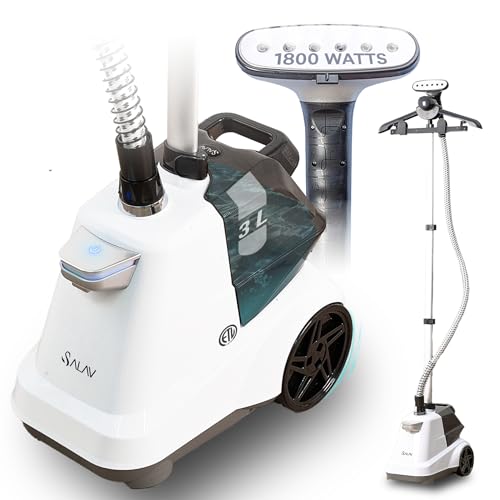
For long tablecloths and repeated event prep, this standing steamer pairs a 3-liter removable tank with more than 90 minutes of continuous steam. Its 1,800-watt output and built-in hanger are designed for garments and curtains as well as upholstery, making it a fit for a household that steams linens alongside clothing. A foot pedal activates steam, leaving hands free to guide fabric. The upright frame needs a dedicated floor area, so it is less convenient than a handheld model for a quick pass or compact storage.
Bottom line: Choose this for long steaming sessions with fewer refill stops.
True & Tidy Heavy-Duty Garment Steamer

For moving a full-size steamer between rooms, this model adds wheels to its standing design while keeping a 3-liter tank and more than 90 minutes of continuous steaming. The maker says its 1,800-watt steam is intended for clothing, curtains, upholstery, and bedding, which gives it a broader stated use than a garment-only setup. Three steam settings provide an adjustment option. Its 66-inch height and 16-by-12-inch footprint still require storage space, so it is not the compact choice for a small apartment.
Bottom line: Pick this if wheels matter when preparing linens in different rooms.
Conair Handheld Steamer, 1875W

The handheld format makes this Conair a different choice from the two floor-standing models: it is easier to bring out for a small tablecloth or spot touch-up. It has a 7.3-ounce removable tank, five steam settings, and heats in 35 seconds; the maker says it provides up to 20 minutes of steam. A heated soleplate and built-in creaser support pressed finishes, while three attachments are included. The smaller tank means more interruptions on large tablecloths, so it suits occasional use better than steaming multiple linens in one session.
Bottom line: Choose this for occasional tablecloth touch-ups and compact handling.
Prvite Steamer with Rotating Board

Unlike the other standing models, this Prvite includes a 360-degree rotating board for vertical, angled, or flat ironing, offering a surface for positioning fabric as well as steaming. It has a 2-liter tank, 1,800 watts, dual support rods, and ten fabric modes; the maker says it heats in 30 seconds. The board may appeal when you want to work across a section of linen in a set position. Its taller, heavier standing setup is less convenient to store or move than a handheld steamer.
Bottom line: Pick this for a rotating board and multiple fabric-mode options.
How to choose a steamer for tablecloths
For a large tablecloth or several linens, prioritize a standing steamer with a large tank; a handheld tank can require a refill during a long session. A 3-liter tank is about 101.5 fluid ounces, while 7.3 ounces is a much smaller capacity. Upright models also let you work with fabric hanging vertically, whereas a board-equipped steamer can position cloth flat. If you have less than about 2 feet of clear floor width, measure the unit’s footprint before choosing a standing model. A handheld format is easier to store but requires holding its weight throughout the task.
| Need | Format to consider | Trade-off |
|---|---|---|
| Many tablecloths | Standing, large tank | More floor and storage space |
| Occasional touch-up | Handheld | More refill stops |
| Flat positioning | Steamer with board | Bulkier setup |
Steam tablecloths safely and evenly
Steam can burn skin, so keep hands out of the steam path and direct the head away from your body. For a tablecloth, hang the fabric securely or use a stable board, then work in overlapping vertical passes from the top downward; gravity helps loosen wrinkles as the cloth hangs. Keep the steamer head moving rather than holding it in one spot, especially on delicate or synthetic fabric. Check the garment-care label before applying heat, and test an inconspicuous corner first if the fabric’s heat tolerance is uncertain. Never steam a tablecloth while it is on a table with food, candles, or electrical items.
Prepare tablecloths before steaming
Remove deep folds by shaking the tablecloth out and hanging it fully before steaming; compact creases may take repeated passes. A full-size unit can reduce interruption for multiple linens, while a handheld tank is better suited to a few small touch-ups. Leave space behind and below hanging fabric so the hot cloth does not brush people, furniture, or the steamer’s power cord. Use distilled water if your tap water is hard to limit mineral deposits; empty and dry the reservoir after use to reduce stagnant water buildup. Let the tablecloth dry completely before folding or placing it on a table, since damp fabric can crease again.
Frequently Asked Questions
Can a clothes steamer remove wrinkles from a tablecloth?
Yes, a garment steamer can relax wrinkles in many tablecloth fabrics while the cloth hangs. Check its care label first, since heat tolerance varies by fiber and finish.
How long does it take to steam a tablecloth?
A single time cannot be predicted without the cloth’s size, fabric, and crease depth. Work in overlapping passes from top to bottom, allowing extra passes for deep folds.
Should I steam a tablecloth while it is on the table?
No; hang it or use a stable ironing board so the hot steam and damp fabric stay away from the tabletop. Keep hands clear of the steam path, which can cause burns.
How often should I refill a steamer for linens?
A 3-liter reservoir holds about 101.5 fluid ounces, compared with 7.3 ounces in a small handheld tank. Larger tanks generally reduce refill interruptions, though actual runtime depends on steam output and settings.
Can I use tap water in a garment steamer?
Hard tap water can leave mineral deposits in a steamer over time, so distilled water is a common way to reduce buildup. Empty and dry the reservoir after each session to limit stagnant water.