
Best Baking Soda for Consumption: 5 Food-Grade Picks

ARM & HAMMER Baking Soda 2.7 lb is the best baking soda for consumption for most people because its maker explicitly identifies it as food-grade and USP-grade 1. Baking soda is sodium bicarbonate, a leavening ingredient that reacts with acids in recipes; choose another option if you prefer a multipack or a product framed for cooking rather than household versatility.
Food-grade baking soda is for culinary use, not a daily wellness supplement. A teaspoon contains about 1,259 mg of sodium, so people limiting sodium or considering it as an antacid should check with a clinician or pharmacist first.
We earn a commission if you buy through links on this page. As an Amazon Associate I earn from qualifying purchases. Products are compared on manufacturer specifications, not hands-on testing.
- Best overall: ARM & HAMMER Baking Soda 2.7 lb – Its maker explicitly identifies it as food-grade and USP-grade 1.
- Best for multipacks: Bob’s Red Mill Baking Soda 16 oz, 4 Pack – It comes as four 16-ounce packages, and the maker says it reacts with acidic recipe ingredients.
- Best for non-GMO preference: It’s Just Baking Soda 20 oz – The maker identifies it as non-GMO and food-grade.
| Product | Best for | Package amount | Food-use cue | Other stated attribute | Shop |
|---|---|---|---|---|---|
| ARM & HAMMER Baking Soda 2.7 lb | Food-grade versatility | 43.2 oz | Food-grade; USP-grade 1 | Resealable bag | Check Price on Amazon |
| Bob’s Red Mill Baking Soda 16 oz, 4 Pack | Multipack baking | 64 oz total | Baking; gluten-free tested | Four 16 oz packages | Check Price on Amazon |
| It’s Just Baking Soda 20 oz | Non-GMO preference | 20 oz | Food-grade; baking | Non-GMO | Check Price on Amazon |
| Organic-Use Sodium Bicarbonate Powder 1 lb | Cooking-focused powder | 16 oz | Cooking; organic use | Aluminum-free claim | Check Price on Amazon |
| BioWisdom Baking Soda Powder 1 lb | Cooking powder | 16 oz | Cooking; organic use | Aluminum-free claim | Check Price on Amazon |
Baking Soda for Consumption
Compare food-use cues and package formats, then choose a product suited to culinary use rather than routine supplementation.
ARM & HAMMER Baking Soda 2.7 lb

ARM & HAMMER Baking Soda 2.7 lb stands out for naming both food-grade use and USP-grade 1 crystals. The 43.2-ounce resealable bag is positioned for baking as well as household tasks, so it suits a buyer who wants one multipurpose staple. The maker says it contains no additives, cornstarch, or fragrance. Its household-use emphasis may be unnecessary if you want a product focused only on cooking, and food-grade wording does not make baking soda a suitable daily supplement.
Bottom line: Choose this if you want an explicitly food-grade product with a resealable, multipurpose package.
Bob’s Red Mill Baking Soda 16 oz, 4 Pack

Bob’s Red Mill Baking Soda 16 oz, 4 Pack is the multipack choice: four 16-ounce packages provide 64 ounces total. The maker says the baking soda is tested and confirmed gluten-free, with processing and packaging in a separate gluten-free facility, and says it reacts with acidic ingredients such as buttermilk, cocoa, molasses, or yogurt. That makes it a fit for recipe-focused kitchens that use baking soda regularly. The four-package format takes more storage space than a single 16-ounce container, and the gluten-free statement is the maker’s claim.
Bottom line: Pick this for recipe baking if you prefer four separate packages and value the maker’s gluten-free testing claim.
It’s Just Baking Soda 20 oz

It’s Just Baking Soda 20 oz is the option whose maker explicitly calls it both food-grade and non-GMO. The 20-ounce package is presented as a baking leavening agent, alongside cleaning and deodorizing uses, so it suits someone who wants a modest kitchen-and-household supply. The maker says it is packaged in California. The product’s broad household positioning may not appeal if you want a baking-only product; for consumption, keep its use to culinary purposes rather than assuming general-use language recommends supplementation.
Bottom line: Choose this if a non-GMO claim and a 20-ounce food-grade package match your preferences.
Organic-Use Sodium Bicarbonate Powder 1 lb
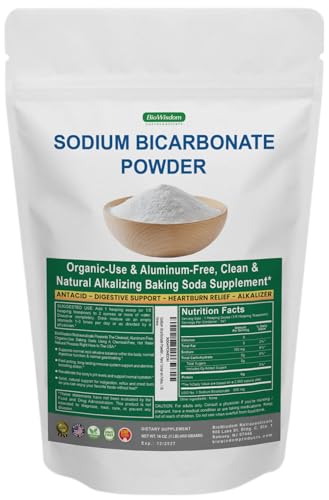
Organic-Use Sodium Bicarbonate Powder 1 lb is positioned for cooking and organic-use, with a 16-ounce package. The maker says the powder is OMRI listed for organic-use and contains no fillers or preservatives; those are product claims, not a reason to use sodium bicarbonate as a health supplement. This option may suit buyers specifically seeking a cooking powder marketed for organic-use. The “take” and body-pH language in its name and features should not be treated as medical guidance; baking soda adds substantial sodium and is not a substitute for care.
Bottom line: Consider it for cooking if organic-use positioning matters, but do not rely on its health-oriented claims.
BioWisdom Baking Soda Powder 1 lb
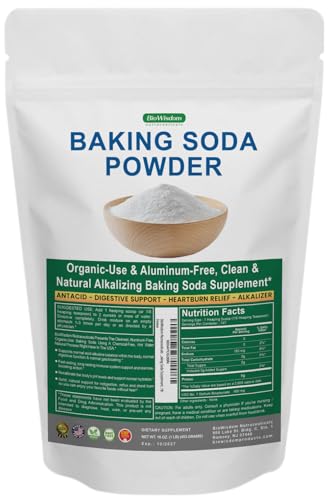
BioWisdom Baking Soda Powder 1 lb combines cooking language with a supplement-oriented presentation, in a 16-ounce package. It may fit someone seeking a powder for cooking, but buyers wanting a straightforward culinary product may prefer packaging with less wellness framing. Baking soda is high in sodium, so routine ingestion warrants professional advice.
Bottom line: Pick it only for culinary use if its powder format suits you; do not use the wellness claims as medical advice.
How to Choose Baking Soda for Consumption
For food use, choose a package explicitly identified as food-grade or clearly intended for baking or cooking. Baking soda is sodium bicarbonate; in recipes it reacts with acidic ingredients to release carbon dioxide, which helps baked goods rise. Baking powder is different: it includes an acidifying component and is not a one-for-one substitute in every recipe. A teaspoon of baking soda weighs about 4.6 grams and contains roughly 1,259 milligrams of sodium, so even small amounts matter for people with sodium limits. Use culinary baking soda in recipes, not as a routine wellness product. If considering it as an antacid, check with a clinician or pharmacist, especially if you take medicines or have a sodium restriction.
Food-Grade and Supplement Claims
Food-grade wording supports culinary use, but it does not establish that a product is appropriate for regular ingestion as a supplement. Organic-use claims and aluminum-free claims also do not prove a health benefit. Baking soda supplies sodium; one teaspoon has about 1,259 milligrams, more than half the 2,300-milligram daily sodium limit recommended for most adults. People with high blood pressure, kidney or heart conditions, or a prescribed sodium restriction should ask a clinician before using it outside recipes. Avoid treating product language about body pH, digestion, or cleansing as medical evidence. A measurable decision rule: if a clinician has advised you to limit sodium, do not begin ingesting baking soda without getting specific advice first.
When Baking Soda Works in a Recipe
Baking soda needs an acidic ingredient to react effectively; common recipe acids include buttermilk, yogurt, molasses, and natural cocoa. The reaction starts after wet and dry ingredients meet, so bake promptly rather than leaving the batter to stand. Baking powder is usually the better choice when a recipe has no meaningful acidic ingredient, because it contains an acid component of its own. Do not substitute equal amounts automatically: the leavening balance and flavor can change, and excess baking soda can leave a soapy or bitter taste. Follow the recipe’s specified leavener and amount. Product choice should not override recipe chemistry; use the package you choose for the job the recipe actually calls for.
Safe Storage and Handling
Keep baking soda dry and in a tightly closed package so moisture does not compromise its free-flowing powder. Store it away from strongly scented household products because powders can absorb odors, and keep food-use supplies separate from cleaning-use supplies to avoid mix-ups. Do not use a container without a readable label for food. Baking soda is not interchangeable with washing soda, which is a different, more caustic cleaning chemical. Keep any household chemical supplies away from children and pets, and do not leave an open bag where it can be mistaken for food. If the intended use is ingestion beyond normal recipe amounts, ask a healthcare professional rather than estimating a dose.
Frequently Asked Questions
How much sodium is in one teaspoon of baking soda?
One teaspoon contains about 1,259 milligrams of sodium. That is over half of the 2,300-milligram daily sodium limit recommended for most adults, so account for it if you monitor sodium.
Can I use baking soda instead of baking powder?
Not as a direct one-for-one substitute in every recipe. Baking soda needs an acidic ingredient to create leavening, while baking powder includes an acid component; use the leavener and amount the recipe specifies.
Is food-grade baking soda safe to take daily?
Food-grade labeling indicates culinary use, not daily supplement safety. A teaspoon contains about 1,259 milligrams of sodium, so ask a clinician or pharmacist before using it regularly outside recipes.
Does aluminum-free baking soda work differently?
The specifications do not establish a difference in baking performance based on an aluminum-free claim. Baking soda is sodium bicarbonate, and recipe results depend on the required amount and presence of acidic ingredients.
How should baking soda be stored for cooking?
Store culinary baking soda dry in a tightly closed, clearly labeled package. Keep it separate from cleaning supplies and strongly scented products to reduce mix-ups and odor absorption.