
Best Camera Sensor Cleaning Kit: 4 Kits Compared

UES Full-Frame Sensor Kit suits most full-frame camera owners because it pairs 14 individually sealed 24mm swabs with 15ml of alcohol-free cleaner. Choose a broader kit instead if you also want tools for lenses and camera crevices, or pick swabs sized for your sensor rather than assuming 24mm fits every camera.
We earn a commission if you buy through links on this page. As an Amazon Associate I earn from qualifying purchases. Products are compared on manufacturer specifications, not hands-on testing.
- Best overall: UES Full-Frame Sensor Kit – Fourteen individually vacuum-sealed 24mm swabs and 15ml of alcohol-free cleaner suit repeated full-frame sensor cleaning.
- Best for all-in-one tools: VSGO DKL-20F 24mm Kit – Combines sensor swabs and cleaner with an air blower and dual-tip lens pen.
| Product | Best for | Swab count | Cleaner volume | Shop |
|---|---|---|---|---|
| UES Full-Frame Sensor Kit | Full-frame sensors | 14 | 15 ml | Check Price on Amazon |
| VSGO DKL-20F 24mm Kit | Sensor and lens care | — | 15 ml | Check Price on Amazon |
| K&F CONCEPT 24mm Sensor Kit | Six-swab kit | 6 | 20 ml | Check Price on Amazon |
| VSGO VS-S03-12 24mm Kit | Twelve swabs | 12 | 10 ml | Check Price on Amazon |
Camera sensor cleaning kits
Match the swab width to your sensor, then choose the kit whose cleaner and extra tools fit your routine.
UES Full-Frame Sensor Kit

For a full-frame sensor, this kit stands out for its 14 individually vacuum-sealed 24mm swabs and 15ml alcohol-free solution. The maker says the cleaner is intended for CMOS and CCD sensors and IBIS systems, making it a focused option for sensor care rather than general lens maintenance. Each swab is sealed against dust and debris before use. The limitation is the narrow focus: the kit is centered on sensor cleaning, so choose a broader option if you also want an air blower, lens pen, or cloth assortment.
Bottom line: Pick this for a full-frame camera when you want the largest swab count among these sensor-focused kits.
VSGO DKL-20F 24mm Kit

Unlike the sensor-only options, this kit combines a sensor cleaner and swabs with tools for other camera surfaces, including a mini air blower and dual-tip lens pen. Its 15ml sensor cleaner is separate from the 30ml lens cleaner, and the pen has a carbon tip for fingerprints and grease plus a brush for crevices. The kit is described for full-frame cameras and also references 16mm and 24mm cleaning. Swab count is not clear from the product name, so this is less useful if you are comparing refill quantities.
Bottom line: Choose this when you want sensor supplies plus a blower and lens-cleaning tools in one kit.
K&F CONCEPT 24mm Sensor Kit
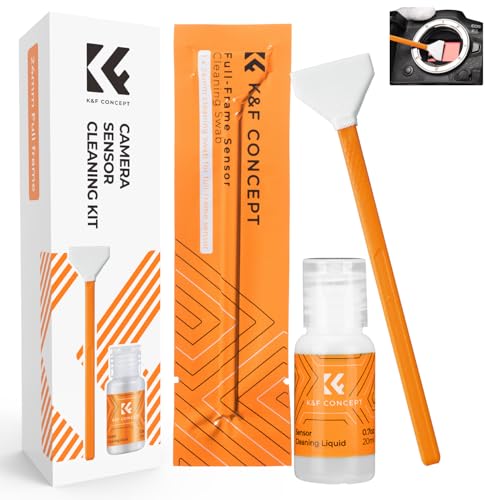
This kit has the largest cleaner volume here at 20ml, paired with six vacuum-sealed 24mm swabs. The maker describes the liquid as ammonia-free and low-VOC, and the flexible grip rods use microfiber-covered heads. That combination suits a full-frame owner who prefers a smaller swab supply with more cleaner. Its six-swab count is lower than the 14-piece UES set, so photographers expecting frequent sensor cleaning may prefer the larger pack. The instructions specify using one or two drops on a swab edge and making a careful pass.
Bottom line: Pick this if 20ml of cleaner matters more to you than having a large swab count.
VSGO VS-S03-12 24mm Kit

This VSGO kit provides 12 individually dust-free-produced, vacuum-sealed 24mm swabs and 10ml of cleaner, a middle ground in swab count between the six-swab K&F kit and the 14-swab UES kit. The maker says the liquid uses ultrapure water and is intended for sensors, lenses, filters, and displays. That wider stated application may suit someone maintaining multiple optical surfaces. Its cleaner bottle is smaller than the other quantified sensor kit volumes here, so consider another option if you prioritize having more solution on hand.
Bottom line: Choose this for a 12-swab supply and cleaner the maker also positions for other optical surfaces.
How to choose a camera sensor cleaning kit
Start with swab width: a full-frame sensor is typically cleaned with a 24mm swab, while smaller sensor formats need a narrower, correctly matched swab. A swab that is too wide can make edge-to-edge passes awkward. Next compare sealed swab count and cleaner volume; a larger pack is useful when cleaning several bodies, but a greater liquid volume does not replace a correctly sized swab. For dust that can be removed without contact, a blower is a useful first tool. Avoid canned compressed air, which can expel propellant or moisture onto delicate surfaces.
Sensor swabs versus general camera cleaning kits
Sensor kits include a swab sized to the sensor and a liquid intended for sensor surfaces; general camera kits focus on lenses, exterior crevices, and accessories. A lens pen, cloth, or brush is not automatically a sensor-cleaning tool. Use a blower first for loose dust, then use a sensor swab only when marks remain and the product is intended for the sensor. Keep lens-cleaning tools separate from sensor swabs so grit and oils from other surfaces are not transferred to the sensor.
The choice depends on whether the kit explicitly provides a sensor-sized swab:
| Need | Choose | Check |
|---|---|---|
| Full-frame sensor marks | 24mm sensor swabs | Width matches sensor format |
| Loose dust only | Air blower | Use without touching the sensor |
| Lens fingerprints | Lens pen or cloth | Keep off the sensor |
Safe sensor cleaning and common mistakes
Turn off the camera and follow its sensor-cleaning procedure before opening the mount; a powered sensor can attract dust, and mirrorless bodies expose the sensor directly when the lens comes off. Never reuse a swab after it has touched the sensor, because trapped particles can scratch the cover glass. Apply only the amount of fluid directed for the swab, typically one or two drops when the kit gives that instruction, and avoid flooding the sensor chamber. If you are unsure how to expose or lock the sensor safely, use a camera service professional rather than improvising.
Frequently Asked Questions
How often should I clean a camera sensor?
Clean a sensor when dust spots appear in images, rather than on a fixed schedule. Dust is easiest to see in an evenly lit image made at a small aperture such as f/16, where particles show as darker marks.
Can I use a 24mm swab on an APS-C camera?
No, a 24mm swab is intended for full-frame sensors and is too wide for most APS-C sensors. APS-C sensors are commonly about 22mm wide for Canon or 23.5mm for many other systems, so use a swab specifically sized for the camera.
Should I blow dust off before using a sensor swab?
Yes, remove loose dust with a hand blower before wet swabbing. A particle caught under a swab can drag across the sensor cover glass, so do not use a swab that has already touched another surface.
How many drops of cleaner should go on a sensor swab?
Use the amount specified for the swab; the K&F kit’s instructions call for one or two drops on the swab edge. Too much liquid can leave residue or run into the camera chamber.
Can lens cleaning fluid be used on a camera sensor?
Only use a fluid explicitly intended for sensor cleaning. Lens formulas and sensor cleaners may differ, and sensor cleaning requires a properly sized swab as well as compatible liquid.