
David Burke Cookware: 5 Pieces Compared by Use

For a versatile skillet, David Burke GeoClad 10-Inch Fry Pan stands out for its 10-inch size and hybrid ceramic-and-stainless cooking surface. Choose a different piece if you need a lidded pot for sauce, soup or serving; those jobs call for capacity and lid features rather than a frying surface.
We earn a commission if you buy through links on this page. As an Amazon Associate I earn from qualifying purchases. Products are compared on manufacturer specifications, not hands-on testing.
- Best overall: David Burke GeoClad 10-Inch Fry Pan – The 10-inch hybrid fry pan suits skillet cooking and has a 500°F oven rating.
- Best for sauces: David Burke GeoClad 1.5-Quart Sauce Pan – Its 1.5-quart capacity, lid and tri-ply clad body suit smaller stovetop tasks.
- Best for large batches: David Burke Prestige 16.5-Quart Stock Pot – The 16.5-quart capacity is the largest among these pieces.
| Product | Best for | Size or capacity | Oven limit | Construction | Shop |
|---|---|---|---|---|---|
| David Burke GeoClad 10-Inch Fry Pan | Skillet cooking | 10-inch pan | 500°F | Tri-ply clad; ceramic hybrid | Check Price on Amazon |
| David Burke GeoClad 1.5-Quart Sauce Pan | Small sauces | 1.5 qt | 500°F | Tri-ply clad; ceramic hybrid | Check Price on Amazon |
| David Burke Splendor 7-Quart Dutch Oven | Covered cooking | 7 qt | 500°F; glass lid 350°F | Stainless steel | Check Price on Amazon |
| David Burke Prestige 3.5-Quart Casserole | Serving dishes | 3.5 qt | 400°F; glass lid 350°F | Stainless steel | Check Price on Amazon |
| David Burke Prestige 16.5-Quart Stock Pot | Large batches | 16.5 qt | 400°F; glass lid 350°F | Stainless steel | Check Price on Amazon |
David Burke cookware by cooking task
Compare each piece by its size, oven limit and construction before choosing for a particular cooking job.
David Burke GeoClad 10-Inch Fry Pan

For skillet cooking, David Burke GeoClad 10-Inch Fry Pan is the only fry pan among these five pieces, with a 10-inch diameter and a geometric hybrid surface of stainless-steel peaks over ceramic valleys. Its tri-ply clad body has an aluminum core between stainless-steel layers, and the maker says it is oven safe to 500°F. The ceramic coating is identified as PFOA-free in the name.
This is the most direct fit for frying and searing rather than simmering or serving a large batch. The limitation is its shallow 10-inch pan format: choose a lidded pot when you need room for substantial liquid or a covered simmer.
Bottom line: Choose it for skillet meals and a hybrid cooking surface.
David Burke GeoClad 1.5-Quart Sauce Pan

For smaller stovetop jobs, David Burke GeoClad 1.5-Quart Sauce Pan pairs a 1.5-quart capacity with a lid, unlike the open fry pan in this group. Its tri-ply clad body places a thick aluminum core between stainless-steel layers; the maker says it works on all cooking surfaces and is oven safe to 500°F. The geometric surface combines stainless-steel peaks with ceramic valleys, and the maker identifies the coating as free of PFAS, PFOA and PTFE.
The capacity favors sauces and modest portions, not large batches. If you need a pot for several quarts of soup or stock, the 7-quart or 16.5-quart options provide substantially more room.
Bottom line: Pick it for small portions and sauce-making.
David Burke Splendor 7-Quart Dutch Oven

For covered cooking with more room than a small saucepan, David Burke Splendor 7-Quart Dutch Oven holds 7 quarts and includes a vented glass lid. Interior capacity marks help gauge liquid in the pot, and the maker says the pot is oven safe to 500°F while the glass lid is safe to 350°F. Side handles support lifting and repositioning.
This size bridges everyday multi-portion cooking and larger-batch cookware. The lid’s lower oven limit matters when moving a covered pot into the oven: keep the glass lid at or below 350°F, even though the pot itself has a higher stated oven limit.
Bottom line: Choose it for covered cooking in a mid-size pot.
David Burke Prestige 3.5-Quart Casserole

For a smaller covered dish that can also go from cooking to serving, David Burke Prestige 3.5-Quart Casserole is a 3.5-quart stainless-steel casserole with a glass lid. The maker says the casserole is oven safe to 400°F and the lid to 350°F, making the lid the limiting part when the piece is used covered in the oven.
Its capacity sits between the 1.5-quart saucepan and the 7-quart Dutch oven, so it suits a moderate dish rather than a large stock batch. The features do not identify a special nonstick surface, so buyers wanting that surface type should choose the hybrid GeoClad pieces instead.
Bottom line: Pick it for moderate-size covered dishes and serving.
David Burke Prestige 16.5-Quart Stock Pot
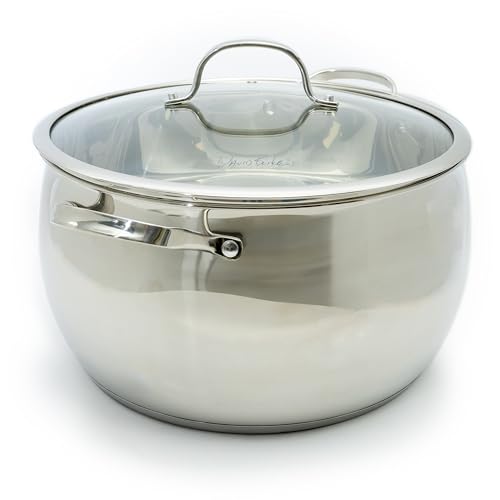
For the largest batch capacity in this group, David Burke Prestige 16.5-Quart Stock Pot is a 16.5-quart stainless-steel stock pot with a lid. The maker says it is oven safe to 400°F, while the glass lid is safe to 350°F. Its capacity is more than twice the 7-quart Dutch oven’s, making it the choice here when volume is the deciding factor.
A stock pot’s tall, spacious form is useful for cooking large quantities of liquid, but it takes more room to store and handle when full than a smaller saucepan or casserole. Consider your storage space and how much food you routinely prepare before opting for the largest vessel.
Bottom line: Choose it when large-batch capacity is the priority.
How to choose David Burke cookware
Start with the cooking task, then match the vessel’s capacity and surface to it. A fry pan handles shallow cooking, while a saucepan is sized for smaller liquid-based jobs; a Dutch oven or stock pot gives more room for covered cooking and larger batches. These five pieces range from 1.5 to 16.5 quarts, so the difference in volume is substantial.
Construction matters too: the GeoClad pieces have a tri-ply clad body with an aluminum core and a ceramic hybrid surface, while the other three pieces are stainless steel. Use the 10-inch fry pan for skillet tasks, choose the 1.5-quart saucepan for small quantities, and move up to 7 or 16.5 quarts when batch size calls for it. If you plan to use a lid in the oven, cap the temperature at the lid’s 350°F limit.
Cookware sizes and cooking jobs
Match capacity to the amount you typically cook: 1.5 quarts is the smallest covered vessel here, and 16.5 quarts is the largest. Pot capacities are useful for comparing volume, but a 10-inch fry pan is measured by diameter rather than quarts, so compare it by its shallow skillet form instead.
The chart maps each vessel type to its common role; choose based on whether you need surface area, a modest liquid capacity or room for a large batch.
| Vessel type | Typical role | Useful decision rule |
|---|---|---|
| Fry pan | Shallow skillet cooking | Choose when a wide open surface matters more than depth |
| Saucepan | Small amounts of liquid or sauce | Choose 1.5 qt for smaller quantities |
| Dutch oven or casserole | Covered cooking and serving | Choose 3.5 to 7 qt for moderate batches |
| Stock pot | Large liquid-based batches | Choose 16.5 qt when volume is the priority |
Oven limits for pots and glass lids
Use the lower oven limit when a pot and its lid have different ratings. In this selection, the glass lids are rated to 350°F, while the pots are rated to either 400°F or 500°F; the lid is therefore the constraint for covered oven cooking.
Remove the glass lid before using a higher oven temperature, and verify that the cookware itself has the required rating for that temperature. Oven-safe ratings do not mean every component has the same limit. Avoid sudden temperature changes with hot glass, which can cause thermal shock; let cookware and lids transition gradually rather than placing a hot lid on a cold or wet surface.
Hybrid ceramic and stainless cookware care
Ceramic-coated cookware generally lasts longer when used over low to medium heat and cleaned after cooling with a soft sponge; high heat and abrasive scrubbing can wear the coating. Use nonmetal utensils on coated surfaces to reduce scratching, even where stainless-steel ridges are part of the design.
Stainless cookware can be cleaned with warm water and dish soap, and dried promptly to reduce water spots. For stuck-on food, soak the pan before scrubbing rather than scraping aggressively. Avoid heating an empty coated pan, and do not subject hot cookware to cold water, since abrupt temperature changes can warp metal or stress glass lids.
Frequently Asked Questions
Can glass lids go in the oven with these pots?
The glass lids are rated to 350°F, so keep a covered pot at or below that temperature. The cookware bodies have higher ratings, but those do not raise the lid’s limit.
What is the difference between a stock pot and Dutch oven?
A stock pot prioritizes tall capacity for large quantities of liquid, while a Dutch oven is a more moderate-capacity covered vessel. Here, the stock pot is 16.5 quarts and the Dutch oven is 7 quarts.
How should ceramic hybrid cookware be cleaned?
Let the pan cool, then wash with warm soapy water and a soft sponge. Avoid abrasive pads and metal utensils, which can scratch or wear a coated surface.
What pan size works for small amounts of sauce?
A 1.5-quart saucepan is the smallest lidded vessel in this group and suits modest quantities. For larger batches, step up to a 3.5-quart casserole or 7-quart pot.
Can stainless steel cookware go from stovetop to oven?
The stainless-steel pieces here have stated oven limits of 400°F or 500°F, depending on the piece. For covered oven use, observe the glass lid’s separate 350°F ceiling.