
Best Dog Harness for Labrador: 4 Large-Dog Fits Compared

rabbitgoo Large No-Pull Harness is the best starting point for most Labradors because its four adjustable straps and front and back leash clips offer two attachment positions. Choose PHOEPET Large Reflective Harness instead if you want a harness that opens at the neck and chest rather than slipping over your dog’s head; for any option, confirm the fit using your dog’s chest measurement.
A dog harness distributes leash force across the body rather than concentrating it at the neck, but a secure fit and leash training still matter.
We earn a commission if you buy through links on this page. As an Amazon Associate I earn from qualifying purchases. Products are compared on manufacturer specifications, not hands-on testing.
- Best overall: rabbitgoo Large No-Pull Harness – Four adjustable straps and both front and back leash attachment points.
- Best for gear carrying: Beebiepet Tactical XL Harness – MOLLE strips on both sides accommodate compatible pouches.
- Best for easy entry: PHOEPET Large Reflective Harness – Three buckles let you put it on without passing it over the dog’s head.
- Best for wet walks: Carhartt Nylon Duck Large Harness – 500-denier polyester with a water-repellent finish for light rain.
| Product | Best for | Leash attachment | Adjustment or entry | Construction | Shop |
|---|---|---|---|---|---|
| rabbitgoo Large No-Pull Harness | Flexible leash setup | Front and back clips | Over-head; 4 straps | Breathable mesh; padding | Check Price on Amazon |
| Beebiepet Tactical XL Harness | Carrying compatible gear | Two leash clips | Chest buckles; 4 adjusters | Reinforced nylon; MOLLE | Check Price on Amazon |
| PHOEPET Large Reflective Harness | Avoiding head entry | Front and back clips | 3 buckles; 2 chest | Reflective material | Check Price on Amazon |
| Carhartt Nylon Duck Large Harness | Light-rain walks | No-pull martingale strap | Over-head; adjustable | 500-denier polyester | Check Price on Amazon |
Dog harnesses for Labrador walks
Compare the attachment setup, putting-on style and construction before choosing by your dog’s measurements.
rabbitgoo Large No-Pull Harness

rabbitgoo Large No-Pull Harness stands out for offering both front and back leash attachment points alongside four adjustable straps. Its breathable mesh, soft padding and quick-release buckles are intended to make routine walks and adjustments straightforward. The front attachment may help redirect a dog that pulls, while the back clip suits casual walking. The harness is Large, but that label alone cannot establish a Labrador’s fit: measure the chest and neck and compare them with the manufacturer’s sizing guidance before choosing. The over-head entry may be less convenient for dogs that resist having a harness slipped over their head.
Bottom line: Choose it if you want front and back leash attachment options and can verify the fit by measurement.
Beebiepet Tactical XL Harness
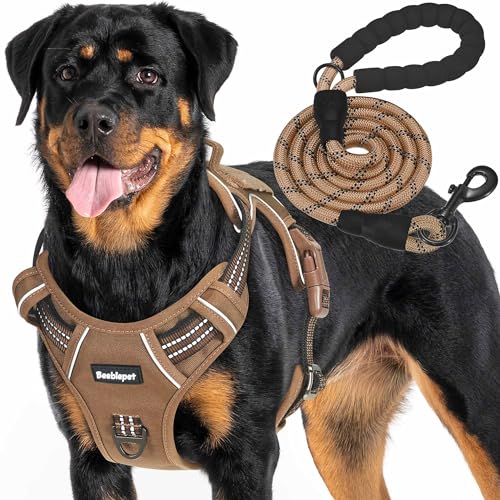
Beebiepet Tactical XL Harness is the option here with MOLLE strips on both sides for compatible pouches, making it suited to owners who want a gear-carrying harness for outdoor activities. It uses durable nylon, reinforced stitching, two triangular rings and four adjustment points, with chest buckles that open for putting it on. Its X-Large size differs from the Large sizes among the other options, but size labels are not interchangeable across brands. The harness adds more structure and carrying capability than a basic walking vest; if you only need a simple leash connection, that extra setup may not be useful.
Bottom line: Choose it if compatible pouch attachment matters and its sizing suits your dog.
PHOEPET Large Reflective Harness
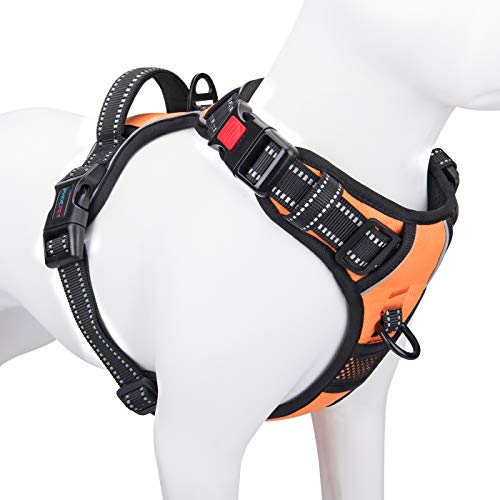
PHOEPET Large Reflective Harness differs in how it goes on: its three-buckle setup, including a neck buckle and two chest buckles, avoids pulling the harness over the dog’s head. It has front and back metal leash rings, a handle and reflective material. The front ring is intended to reduce pulling, while the back ring is the conventional walking point. That entry style may suit a Labrador uncomfortable with head-first gear, though the multiple buckles still need to be fastened and adjusted correctly each time. Check the chest measurement against the maker’s fit guidance rather than relying on the Large label.
Bottom line: Choose it if avoiding over-head entry is a priority and the measured fit is right.
Carhartt Nylon Duck Large Harness

Carhartt Nylon Duck Large Harness is distinguished by its yoke-style construction, martingale chest strap and 500-denier polyester with Rain Defender water-repellent treatment. It also has adjustable chest and belly straps, spacer-mesh backing, reflective accents and a quick-control handle. The maker says the finish repels light rain and helps maintain the harness’s form with daily use; it is not presented as waterproof gear. This is a Large over-head style, so it may not suit a dog that dislikes head entry. Measure the dog and check the fit guidance before selecting a size.
Bottom line: Choose it for a water-repellent finish and adjustable yoke-style fit.
How to choose a Labrador dog harness
Start with chest fit, then choose the entry style and leash attachment that suit your walks. Measure the widest part of the rib cage just behind the front legs; Labrador breed descriptions commonly put adults around 55 to 80 pounds, but weight does not determine chest circumference. A fit should be snug without restricting movement: aim to slide two fingers between the harness and your dog, and check that straps do not rub behind the front legs. A front clip can help redirect a dog that pulls; it does not replace leash training. For walks near traffic or at night, reflective material can improve visibility, but it is not a substitute for a leash or safe handling.
Harness fit and putting it on
Measure the chest and neck with a soft tape, then use the maker’s sizing range rather than choosing by breed name or weight alone. Labradors vary in build, and a loose harness can shift or allow a dog to back out, while a tight one can rub or restrict shoulder movement. After adjustment, check that the harness stays centered as the dog walks and that the front legs move freely. For an over-head design, introduce it calmly and secure the buckles before attaching a leash. A buckle-entry design can be easier for dogs that resist head entry, but every fastener still needs checking before the walk.
Front-clip and back-clip harnesses compared
Choose the leash point based on walking behavior and handling needs. A front attachment may turn a pulling dog toward the handler, while a back attachment allows a straighter leash path for a dog already walking calmly. Neither clip makes a dog pull-free on its own; reward-based leash practice remains important. Use the table to match the attachment style to the intended walk.
| Walking need | Attachment to consider | Why |
|---|---|---|
| Redirect pulling | Front clip | Can guide the dog back toward the handler |
| Calm everyday walk | Back clip | Keeps leash connection behind the dog |
| Different walk situations | Front and back clips | Offers a choice of leash position |
Avoid jerking the leash or relying on a harness as a restraint system; keep a secure hold and check all buckles before heading out.
Harness care and common fit mistakes
Inspect straps, stitching, buckles and metal rings regularly, especially after a dog pulls hard or the harness gets wet. Frayed webbing, a cracked buckle or a loose ring is a reason to stop using the harness until it is repaired or replaced. Dirt and grit can irritate skin under a strap, so clean the harness according to its care label and let it dry before use. A common mistake is trusting a “Large” or “XL” label across brands; those labels do not create a shared sizing standard. Recheck fit after adjustment and whenever your dog’s body condition changes.
Frequently Asked Questions
How do I measure a Labrador for a harness?
Measure around the widest part of the chest, just behind the front legs, and measure the neck if the maker’s size chart requests it. Use those measurements with the specific harness chart; breed and weight alone do not confirm fit.
How tight should a dog harness fit?
A harness should be snug enough not to shift, with room for about two fingers between the straps and your dog. Check that it does not rub behind the front legs or restrict shoulder movement.
Does a front-clip harness stop a Labrador from pulling?
A front clip can redirect a pulling dog toward the handler, but it does not train the dog to walk calmly by itself. Pair the harness with consistent leash practice and avoid sharp leash jerks.
Can a dog wear a harness all day?
A harness is generally best worn for supervised walks rather than continuously, since straps can rub or catch during unsupervised activity. Remove it at home and check your dog’s skin after walks, especially under the chest and behind the front legs.
Are reflective harnesses enough for night walks?
Reflective material can help make a dog more visible when light reaches it, but it does not glow on its own. Use a leash and choose well-lit routes; reflective gear does not replace careful handling near traffic.