
Hemani Black Seed Oil: Sizes and Uses Compared

For a regular household supply of Hemani black seed oil, Hemani Black Seed Oil 500 mL is the named product and its 500 mL bottle is the deciding feature. Choose one of the alternatives only if you want a topical rub or a smaller oil bottle.
Black seed oil is extracted from Nigella sativa seeds; oils meant for skin or hair use differ from products sold as rubs.
We earn a commission if you buy through links on this page. As an Amazon Associate I earn from qualifying purchases. Products are compared on manufacturer specifications, not hands-on testing.
- Best overall: Hemani Black Seed Oil 500 mL – The only Hemani black seed oil in the group, in a 500 mL household-size bottle.
- Best for topical rub: Hemani Black Seed Vapor Rub 50 mL – A 50 mL ointment format with black seed and eucalyptus oils.
- Best for certified organic: Prime Natural Organic Black Seed Oil 4 oz – A 4 oz oil identified as USDA organic and cold-pressed.
| Product | Best for | Format | Size | Processing or certification | Shop |
|---|---|---|---|---|---|
| Hemani Black Seed Oil 500 mL | Household supply | Liquid oil | 16.9 fl oz | Cold-pressed; halal certified | Check Price on Amazon |
| Hemani Black Seed Vapor Rub 50 mL | Topical rub | Ointment | 50 mL | Black seed and eucalyptus oils | Check Price on Amazon |
| Prime Natural Organic Black Seed Oil 4 oz | TQ specification | Liquid oil | 4 fl oz | Cold-pressed; USDA organic | Check Price on Amazon |
| HBNO Organic Black Seed Oil 4 oz | Topical oil | Liquid oil | 4 fl oz | Cold-pressed; USDA organic | Check Price on Amazon |
Hemani black seed oil and alternatives
Compare the intended use and package format first, then choose the oil or rub that suits your routine.
Hemani Black Seed Oil 500 mL

The 500 mL bottle distinguishes this Hemani oil from the smaller oils and topical rub in this group. The product is cold-pressed Nigella sativa oil and is identified as halal certified. Its household-size format suits buyers who want one larger bottle for a regular routine rather than a compact container. Decanting into a smaller daily-use container may make dispensing easier, as the product suggests, but that adds a container to clean and maintain. The product’s intended use is oral; buyers wanting a skin or hair product should compare a topical-use oil instead.
Bottom line: Choose this if you specifically want Hemani black seed oil in a larger bottle.
Hemani Black Seed Vapor Rub 50 mL

Unlike the liquid oils, this Hemani product is an ointment intended for application to the chest or throat. It comes in a 50 mL jar, and its formula includes black seed oil and eucalyptus oil; the product also says massage oil is included. That format is the relevant difference for someone seeking a topical product rather than a bottle of black seed oil. The manufacturer promotes it for congestion and muscle discomfort, but those are health claims and should not be treated as established outcomes. Do not use a topical rub as a substitute for oral oil.
Bottom line: Pick this only if a topical ointment, not liquid oil, is your goal.
Prime Natural Organic Black Seed Oil 4 oz

Prime Natural makes the clearest quantified thymoquinone claim among these liquid oils: its product says the oil is third-party tested at 1.7% TQ and offers 50+ mg naturally occurring thymoquinone per serving. The 4 fl oz glass bottle is also identified as Turkish, USDA organic, cold-pressed and unrefined. This suits a buyer comparing a specific TQ claim, rather than someone set on Hemani or a larger household bottle. The amount per serving and test claim come from the manufacturer; they do not establish a health benefit.
Bottom line: Choose it if the TQ measurement matters more than the Hemani brand.
HBNO Organic Black Seed Oil 4 oz
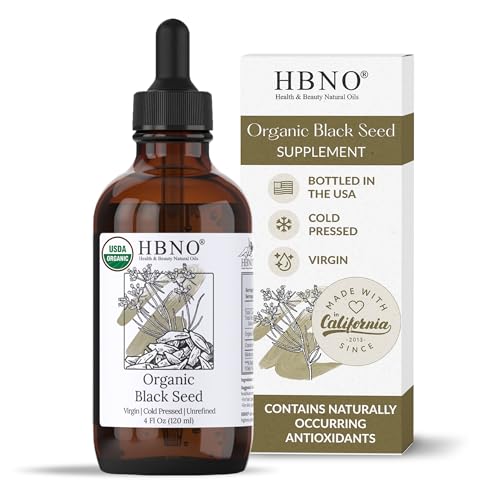
HBNO distinguishes this 4 oz oil by explicitly describing hair, face, body and lip care uses. The glass bottle contains cold-pressed Nigella sativa oil and is identified as USDA certified organic, hexane-free and routinely tested for purity. That makes it the most directly positioned option here for topical routines, whereas the Hemani product is a larger household oil. The product also mentions mixing oil into shampoo or conditioner. Buyers seeking an oil intended for oral use should confirm that purpose before choosing, since HBNO’s uses focus on external care.
Bottom line: Choose this for a small oil bottle aimed at hair and skin routines.
How to choose Hemani black seed oil
Choose by intended use first: a liquid oil and a vapor rub are different product formats, not interchangeable versions of the same item. Nigella sativa oil is commonly called black seed, black cumin or kalonji oil. Cold pressing means oil is extracted mechanically rather than using a solvent; it does not by itself establish a specific thymoquinone concentration. For a named Hemani oil and a larger container, the 500 mL format is the direct match here. A practical rule: if your routine is topical hair or skin care, select an oil whose maker names those uses; if you want an ointment, select a rub instead. Organic certification and quantified TQ claims are separate attributes, so compare the exact claim you care about rather than treating one as proof of the other.
Oil, ointment and bottle size differences
The format determines how the product fits a routine: liquid oils come in 4 fl oz or 16.9 fl oz packages here, while the vapor rub is a 50 mL ointment. One US fluid ounce is about 29.6 mL, so 4 fl oz is about 118 mL and 16.9 fl oz is about 500 mL. Larger packages reduce how often a buyer replaces a bottle, but they can be less convenient to handle. Use this comparison to narrow the purpose before considering bottle size.
| Format or claim | Best match | Decision cue |
|---|---|---|
| Household liquid oil | Hemani 500 mL | Choose for the named brand and larger bottle |
| Topical ointment | Hemani vapor rub | Choose when a rub format is wanted |
| Measured TQ claim | Prime Natural 4 oz | Choose when the maker’s 1.7% TQ claim matters |
| Hair and skin use | HBNO 4 oz | Choose for explicitly named external-care uses |
How to compare black seed oil claims
Thymoquinone, often abbreviated TQ, is a naturally occurring compound in Nigella sativa oil, but a percentage claim and a per-serving amount are not the same measure. Prime Natural gives both a 1.7% claim and a 50+ mg per-serving claim, while the Hemani oil is identified as cold-pressed without a concentration figure. Do not infer a product’s TQ amount from its bottle size or extraction method. USDA organic certification addresses production standards, while cold-pressed and hexane-free refer to other aspects of processing. For an oral product, check the intended route and serving directions on the package; for topical use, patch test a small area first and discontinue if irritation occurs.
Safe use and storage for black seed products
Keep oils and ointments out of children’s reach, and do not apply a rub inside the nose or near eyes. Topical products can irritate sensitive skin; testing a small patch first is a cautious way to spot a reaction. Store oils tightly closed, away from direct light and heat, because exposure to oxygen, warmth and light can speed rancidity in edible oils. Refrigeration may slow oxidation but can make oil cloudy or thicker; return it to room temperature before judging its texture. For any oral oil, use the serving instructions on the package rather than assuming that a teaspoon is appropriate for every person. People taking medication or with a medical condition should ask a clinician before adding a supplement.
Frequently Asked Questions
What is black seed oil made from?
Black seed oil comes from Nigella sativa seeds, also called black cumin or kalonji. The plant name helps distinguish it from unrelated oils with similar common names.
How should black seed oil be stored after opening?
Keep the bottle tightly closed and away from heat and direct light to limit oxidation. Refrigeration can slow oxidation, though it may make the oil cloudy or thicker until it warms.
Does cold-pressed black seed oil guarantee a high TQ level?
No; cold-pressing describes an extraction method, not a measured thymoquinone concentration. Look for a specific percentage or amount per serving if TQ content is a deciding factor.
Can black seed vapor rub go inside the nose?
No, keep ointment out of the nostrils and away from eyes. Apply topical products only to the external area directed on the package, and stop if irritation occurs.
How do I choose oral versus topical black seed oil?
Choose according to the product’s route: an oral oil is not automatically intended for skin, and a vapor rub is not an oral oil. For topical use, test a small skin patch first.