
Lava Rocks for Gas Fireplace: 4 Sizes Compared

For most gas log sets, Midwest Hearth Black Lava Granules is the best fit because its 1/4- to 1/2-inch granules are sized for gas log sets. Choose a larger rock if your fire feature calls for a coarse base or decorative stones rather than small granules.
Lava rock is porous volcanic stone used as decorative media around gas burners; confirm your appliance permits loose lava rock and keep burner ports and pilot openings clear.
We earn a commission if you buy through links on this page. As an Amazon Associate I earn from qualifying purchases. Products are compared on manufacturer specifications, not hands-on testing.
- Best overall: Midwest Hearth Black Lava Granules – Its 1/4- to 1/2-inch granules are sized for gas log sets.
- Best for coarse granules: Stanbroil Black Lava Granules, 0.8–1.2 in. – Its 0.8- to 1.2-inch pieces suit buyers seeking a larger base layer.
- Best for larger stones: Stanbroil Black Lava Rock, 1.2–2 in. – Its 1.2- to 2-inch pieces are suited to a coarser decorative layer.
- Best for multi-use decor: IwoodUS Black Lava Rocks, 1.2–2 in. – Its 1.2- to 2-inch rocks are intended for fireplaces, fire tables, and landscaping.
| Product | Best for | Granule size | Stated use | Shop |
|---|---|---|---|---|
| Midwest Hearth Black Lava Granules | Gas log sets | 1/4–1/2 in. | Gas log sets; indoor/outdoor | Check Price on Amazon |
| Stanbroil Black Lava Granules, 0.8–1.2 in. | Coarse base layer | 0.8–1.2 in. | Fireplaces, pits, bowls | Check Price on Amazon |
| Stanbroil Black Lava Rock, 1.2–2 in. | Large decorative rock | 1.2–2 in. | Fireplaces, pits, bowls | Check Price on Amazon |
| IwoodUS Black Lava Rocks, 1.2–2 in. | Fire table decor | 1.2–2 in. | Fireplaces, fire tables, landscaping | Check Price on Amazon |
Lava rocks for gas fireplaces
Compare granule size and intended use to choose media that matches your appliance and burner layout.
Midwest Hearth Black Lava Granules

Midwest Hearth Black Lava Granules has the smallest granules in this group, sized 1/4 to 1/2 inch for gas log sets. The 10-pound bag contains natural black volcanic rock with brown and gray hints and no added dyes. The maker says the rock withstands high heat without crumbling. That fine size suits buyers filling around a log set where smaller pieces are specified. Its main limitation is scale: these granules are less suited to someone seeking a visibly coarse layer of larger decorative stones.
Bottom line: Choose this when your gas log set calls for small granules.
Stanbroil Black Lava Granules, 0.8–1.2 in.

Stanbroil Black Lava Granules, 0.8–1.2 in. uses 0.8- to 1.2-inch granules, noticeably larger than the gas-log-set-sized pieces in Midwest Hearth Black Lava Granules. The 10-pound bag is described for fire bowls, fire pits, and indoor or outdoor fireplaces, including liquid propane or natural gas. The maker says the rock tolerates extreme temperatures and can serve as a neutral base beneath logs or fire glass. Its coarser pieces may not suit a burner or log arrangement that calls for small granules, so match the media size to the appliance requirements.
Bottom line: Pick this for a coarser base layer where the appliance allows it.
Stanbroil Black Lava Rock, 1.2–2 in.

Stanbroil Black Lava Rock, 1.2–2 in. has 1.2- to 2-inch stones, making it the largest-size choice here. The 10-pound bag is intended for fire bowls, fire pits, gas log sets, landscaping, and indoor or outdoor fireplaces. The maker says the rock withstands extreme temperatures and can add depth around gas logs. Large pieces create a different look from fine granules, but they may not fit a burner bed or log set designed for smaller media. Check the appliance’s permitted rock size before using this coarse option.
Bottom line: Choose this for a fireplace setup that permits larger decorative stones.
IwoodUS Black Lava Rocks, 1.2–2 in.
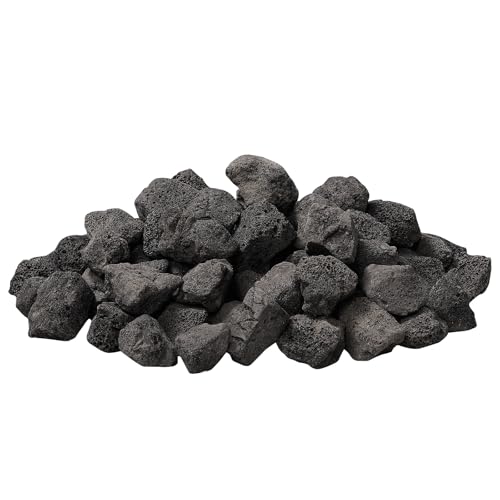
IwoodUS Black Lava Rocks, 1.2–2 in. combines 1.2- to 2-inch black and gray rocks with uses that include indoor fireplaces, outdoor gas fire tables, and landscaping. The 10-pound bag matches the weight of the other options, while its multi-use framing makes it relevant for buyers coordinating fireplace media with outdoor decor. The maker says the natural rock is heat-resistant and retains heat. These large pieces are not a substitute for fine granules where the burner or log-set instructions require smaller media.
Bottom line: Pick this for larger rock decor across a fireplace and fire table.
Choosing lava rock size for a gas fireplace
Start with the appliance’s permitted media size, then choose the look: small granules blend around logs, while larger pieces read as a coarse decorative layer. The products here span 1/4 inch through 2 inches, so a difference in size can matter more than color. Loose media belongs only in locations approved by the fireplace manufacturer; never cover burner ports, air openings, or the pilot assembly. Gas appliances are designed around a particular burner and fuel, and changing the media or its depth can alter flame behavior. If your manual specifies a size or placement pattern, use that as the deciding rule rather than choosing by appearance alone.
| Need | Size to compare | Choice |
|---|---|---|
| Fine coverage around a log set | 1/4–1/2 in. | Midwest Hearth Black Lava Granules |
| Coarse decorative layer | 0.8–1.2 in. | Stanbroil Black Lava Granules, 0.8–1.2 in. |
| Large decorative pieces | 1.2–2 in. | Stanbroil Black Lava Rock, 1.2–2 in. or IwoodUS Black Lava Rocks, 1.2–2 in. |
Gas fireplace media and burner safety
Use only media approved for the specific gas fireplace, because burner ports and pilot openings need clear paths for gas flow and ignition. Lava rock is decorative volcanic stone, not a replacement burner component, and extra depth can change how flames emerge. Avoid placing stones directly over ports unless the appliance instructions explicitly call for that arrangement. For a vent-free gas appliance, correct burner operation and ventilation are especially important; stop using the fireplace and consult a qualified technician if flames are abnormal, soot appears, or gas odor is present. The safe decision rule is simple: if the manual does not permit loose lava rock, do not add it.
Granules versus larger lava rocks
Granules under 1/2 inch are suited to finer coverage, while pieces from roughly 1 inch to 2 inches create a more open, coarse appearance. Larger stones can leave more visible gaps, and they may not sit appropriately around compact gas log arrangements. Smaller pieces can also shift or settle, so maintain the layout and depth specified for the appliance rather than filling every visible space. The four options range from gas-log-set granules to large stones marketed for fire tables and landscaping. A fireplace’s approval and burner geometry outrank whether a product is also marketed for outdoor pits or decorative use.
Maintaining lava rock in a gas fireplace
Inspect the fire media when the appliance is cool and shut off, looking for displaced pieces, debris, or blocked openings. Lava rock itself is stone, but dust and small fragments can accumulate around burner components and interfere with airflow or ignition. Keep the burner and pilot area clear according to the fireplace instructions; do not vacuum or reposition media while hot. A technician should investigate recurring soot, delayed ignition, or an uneven flame rather than treating the symptoms by moving stones. Store any unused rock dry and keep it separate from the burner until the appliance instructions call for installation.
Frequently Asked Questions
Can any lava rock go in a gas fireplace?
No; use loose media only if the fireplace manufacturer permits it. Burner openings, pilot assemblies, and approved media sizes differ by appliance, so the manual’s placement rules decide whether lava rock is suitable.
How much lava rock should I put around gas logs?
Use only the depth and coverage specified for the fireplace, rather than filling the firebox to a visual level. Added rock can cover burner ports or change flame behavior, so keep every required opening clear.
Can lava rock cover gas fireplace burner ports?
Do not cover burner ports unless the appliance instructions specifically require that placement. Gas needs an unobstructed designed path, and blocked ports can contribute to poor ignition or abnormal flames.
Should I use small or large lava rocks?
Choose the size the burner or log-set instructions allow; the options here span 1/4 inch to 2 inches. Small granules are intended for fine coverage, while larger pieces create a coarse decorative layer.
When should I inspect gas fireplace lava rock?
Inspect the rock when the fireplace is cool and shut off, particularly if pieces have shifted or debris has accumulated near openings. Abnormal flame appearance, soot, or delayed ignition warrants professional service, not merely rearranging the rock.