
DeWalt Cordless Coffee Maker Options Compared by Fit

Taingwei DeWalt 20V Portable Coffee Maker is the direct fit for a DeWalt cordless coffee maker because it accepts compatible DeWalt 20V batteries and brews about 6.4 ounces per cycle. Choose a different model only if you use another battery platform or need a different brewing format or cup size.
We earn a commission if you buy through links on this page. As an Amazon Associate I earn from qualifying purchases. Products are compared on manufacturer specifications, not hands-on testing.
- Best overall: Taingwei DeWalt 20V Portable Coffee Maker – Uses compatible DeWalt 20V batteries and makes a 190 mL cup.
- Best for Makita batteries: Makita DCM501Z Cordless Coffee Maker – Works with Makita 18V LXT or 12V max CXT batteries and accepts grounds or single-serve packs.
- Best for K-Cups: BougeRV 144Wh Portable Coffee Maker – Supports K-Cup pods and ground coffee, with an included 144Wh battery.
| Product | Best for | Battery platform | Cup capacity | Coffee format | Shop |
|---|---|---|---|---|---|
| Taingwei DeWalt 20V Portable Coffee Maker | DeWalt 20V users | DeWalt 20V | 6.4 oz | Ground coffee | Check Price on Amazon |
| Byutrcfuy Milwaukee 18V Coffee Maker | Milwaukee M18 users | Milwaukee M18 18V | 8 oz | Ground coffee | Check Price on Amazon |
| Makita DCM501Z Cordless Coffee Maker | Makita battery users | Makita 18V LXT / 12V max CXT | 5 oz | Ground coffee or single-serve packs | Check Price on Amazon |
| Taingwei Milwaukee M18 Portable Coffee Maker | M18 battery owners | Milwaukee M18 18V | 6.4 oz | Ground coffee | Check Price on Amazon |
| BougeRV 144Wh Portable Coffee Maker | K-Cup flexibility | Included 18V 8Ah battery; AC/DC | 8 oz | K-Cup pods or grounds | Check Price on Amazon |
DeWalt Cordless Coffee Makers and Alternatives
Start with the battery platform you own, then compare cup size and the coffee formats each brewer accepts.
Taingwei DeWalt 20V Portable Coffee Maker
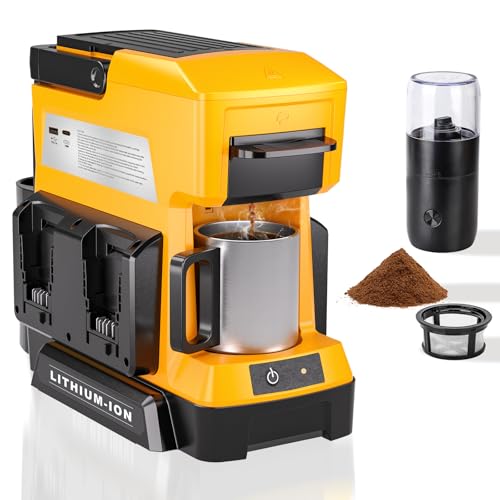
For DeWalt 20V battery owners, this is the only model here built around that battery platform. It brews a 190 mL cup, has a permanent drip filter, and includes a grinder for whole beans. Taingwei says it can brew that cup in 200 seconds and supports one to four battery channels; batteries are not included. The grinder and battery compatibility make it suited to people who want a self-contained setup, but the small cup size is limiting if you want a larger serving from one brew.
Bottom line: Choose this if you want a cordless brewer that uses compatible DeWalt 20V batteries.
Byutrcfuy Milwaukee 18V Coffee Maker

The Byutrcfuy is the larger-cup alternative for Milwaukee M18 users rather than a DeWalt-battery model. It makes an 8-ounce serving, uses a reusable metal filter, and comes with a separate rechargeable grinder. The maker says its 400W heater brings water to 195–205°F and that a 4Ah battery provides about two to three cups; the tool is sold without a battery. Its Milwaukee-only platform is the key limitation for DeWalt owners, while the separate grinder means it is not an all-in-one grinder-and-brewer unit.
Bottom line: Choose it if you use Milwaukee M18 batteries and want an 8-ounce brew.
Makita DCM501Z Cordless Coffee Maker

The Makita DCM501Z stands apart by supporting two Makita battery families and two coffee formats: grounds or single-serve packs. It brews a 5-ounce cup in about five minutes on an 18V LXT battery, and Makita says a 5.0Ah LXT charge can make up to three cups; the battery is not included. Its compact body is 8 9/16 inches tall, with 3 1/2 inches of cup clearance. That short clearance favors small cups, so check your mug height before choosing it.
Bottom line: Pick it if your battery is Makita LXT or CXT and a 5-ounce cup suits you.
Taingwei Milwaukee M18 Portable Coffee Maker

This Taingwei shares the grinder-and-brewer approach of its DeWalt-compatible counterpart but fits Milwaukee M18 batteries instead. The 190 mL brew is about 6.4 ounces, and a permanent filter lets you add ground coffee without paper filters. Taingwei says the brewer accepts one to four battery channels and brews in 200 seconds; batteries are not included. The smaller serving may suit an individual cup, but buyers seeking an 8-ounce brew should compare it with the larger Milwaukee option.
Bottom line: Choose it for an M18 battery setup with an integrated grinder and a smaller cup.
BougeRV 144Wh Portable Coffee Maker

The BougeRV differs from the tool-battery models by including a removable 8Ah/144Wh battery and accepting both K-Cup pods and ground coffee. It brews an 8-ounce cup, and the maker says the battery can brew five to six cups per charge; the maker also gives a six-to-eight-minute brew time. AC power is another option, so it does not depend on a DeWalt battery platform. Its broader power and coffee-format flexibility comes with a larger footprint than a simple small-cup brewer.
Bottom line: Pick it if you want K-Cup compatibility and an included battery rather than DeWalt compatibility.
How to Choose a Cordless Coffee Maker
Choose a cordless coffee maker by matching its battery platform first, then its serving size and coffee format. DeWalt 20V, Milwaukee M18, and Makita LXT/CXT batteries are distinct systems; a matching voltage alone does not make packs interchangeable. Battery capacity is measured in amp-hours, but runtime also depends on voltage and the appliance’s power draw, so do not compare Ah figures across platforms as if they were equal. For coffee strength, a common starting point is roughly 1 to 2 tablespoons of ground coffee per 6 ounces of water; adjust the amount to taste. A permanent filter avoids paper filters but may let more fine sediment through than paper. If you need more than one cup per brewing cycle, compare the serving size rather than the machine’s portability.
| Need | Choose by |
|---|---|
| Keep using a DeWalt battery | DeWalt 20V compatibility |
| Use single-serve packs | Explicit pack compatibility |
| Make a larger single serving | Capacity of at least 8 oz |
Battery Compatibility and Safe Use
Use only a battery platform named for the coffee maker, because tool batteries with similar voltage can have different connectors and electronics. Battery packs also vary in capacity: higher Ah can store more energy within a compatible system, but it does not guarantee a fixed number of cups because heating water consumes substantial power. Keep the battery and its contacts dry, and do not set a hot brewer where spilled water can reach the pack. Pouring water and coffee grounds introduces burn and spill risks, so place the brewer on a stable, heat-resistant surface and keep hands clear of the hot brew outlet. When a model supports several battery channels, use the compatible pack configuration described for that unit rather than improvising combinations.
Cup Size, Mug Clearance, and Coffee Format
Match the serving volume to the cup you actually use: 5 ounces is a small serving, while 8 ounces gives more room for a standard mug. Cup capacity and mug clearance are different measurements; a brewer can make a 5-ounce serving yet still have limited space beneath the outlet. Measure the mug height and compare it with the brewer’s clearance before choosing a model. Grounds, single-serve packs, and K-Cup pods are not interchangeable inputs, so confirm the format you use is explicitly supported. For ground coffee, start with about 1 to 2 tablespoons per 6 ounces, then adjust grind and dose gradually; too-fine grounds can pass through some reusable filters or slow drainage.
Brewing Temperature and Cleanup
Water around 195–205°F is a common coffee-brewing range, and a maker that reaches that range can brew hotter than one with no stated heating temperature. Allow hot water and the brewer to cool before cleaning, and keep battery contacts away from rinse water. Reusable metal or permanent filters should be emptied and rinsed after each brew; trapped oils and fine grounds can affect later cups if buildup remains. If you use whole beans, grind only what you need and keep the grinder area dry. Follow the coffee maker’s compatible cleaning method for its electrical parts, since immersing a powered appliance can create an electric-shock hazard.
Frequently Asked Questions
Can I use a DeWalt battery on any cordless coffee maker?
No, the battery connector and platform must be compatible, not merely the voltage. These options include DeWalt 20V, Milwaukee M18, and Makita LXT/CXT systems, which are not interchangeable.
How much coffee should I use for one cup?
Start with about 1 to 2 tablespoons of ground coffee per 6 ounces of water. Use the lower end for a milder cup and increase the dose gradually for a stronger one.
What does an 8-ounce coffee maker cup mean?
An 8-ounce capacity means the machine brews about 8 fluid ounces in a cycle, not that it fits every mug. Check the space under the outlet if your mug is tall.
Are reusable coffee filters easy to clean?
Empty and rinse reusable filters after each brew so grounds and coffee oils do not build up. Let hot parts cool before handling, and keep water away from batteries and electrical contacts.
Can I brew K-Cup pods in a ground-coffee brewer?
Only if the brewer explicitly supports K-Cup pods; a ground-coffee basket is not the same pod holder. Check the supported format before brewing to avoid a poor fit or spill.