
Salt-Water Pool Test Kits: 3 Options Compared

For salt-water pool testing, Taylor K-2006-SALT FAS-DPD Kit is the most complete match because it tests sodium chloride plus eight other water parameters with FAS-DPD reagents. Choose Hofun 5-in-1 Digital Salinity and pH Meter for digital salinity, pH, temperature, EC and TDS readings, or 8-in-1 Salt-Water Pool Test Strips, 125 Count for dip-strip checks.
We earn a commission if you buy through links on this page. As an Amazon Associate I earn from qualifying purchases. Products are compared on manufacturer specifications, not hands-on testing.
- Best overall: Taylor K-2006-SALT FAS-DPD Kit – Combines sodium chloride testing with eight other pool-water parameters using FAS-DPD reagents.
- Best for digital readings: Hofun 5-in-1 Digital Salinity and pH Meter – Measures salinity, pH, temperature, EC and TDS, with salinity shown in ppm, ppt or percent.
- Best for quick checks: 8-in-1 Salt-Water Pool Test Strips, 125 Count – Tests salt and seven other parameters with a dip strip, with 125 strips included.
| Product | Best for | Method | Salt coverage | Other parameters | Shop |
|---|---|---|---|---|---|
| Taylor K-2006-SALT FAS-DPD Kit | Broad water checks | Reagent comparator | Sodium chloride | 8 parameters | Check Price on Amazon |
| Hofun 5-in-1 Digital Salinity and pH Meter | Digital measurements | Digital meter | 0–9,999 ppm pool salt | pH, temperature, EC, TDS | Check Price on Amazon |
| 8-in-1 Salt-Water Pool Test Strips, 125 Count | Dip-strip testing | Dip strips | Salt level | 8 parameters | Check Price on Amazon |
Salt-Water Pool Test Kits Compared
Match the testing method and parameter coverage to the checks you want to make routinely.
Taylor K-2006-SALT FAS-DPD Kit

Taylor K-2006-SALT FAS-DPD Kit stands apart by pairing FAS-DPD chlorine testing with sodium chloride and seven additional water checks. Its 15 reagents cover free and combined chlorine, pH, acid and base demand, total alkalinity, calcium hardness, cyanuric acid and chloride; the comparator supports sample mixing. The kit suits owners who want a single manual routine covering salt and core chemistry. It requires collecting a sample and adding the appropriate reagents, so it is less suited to someone who wants a meter-style readout or a simple dip-and-discard check.
Bottom line: Choose this if you want salt and a broad set of pool chemistry checks in one reagent kit.
Hofun 5-in-1 Digital Salinity and pH Meter
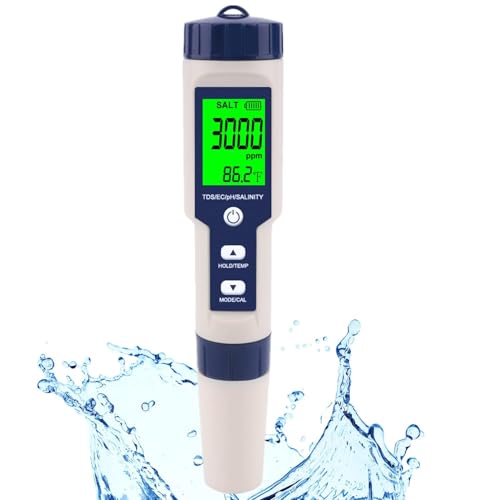
Hofun 5-in-1 Digital Salinity and pH Meter is the digital option, combining salinity readings with pH, temperature, electrical conductivity and total dissolved solids. Its salinity display can use ppm, ppt or percent; for swimming pools the range is 0–9,999 ppm, and the meter switches to ppt above that range. That format suits owners who want several numerical readings from one instrument rather than reagent color comparisons. Unlike the reagent kits and strips here, it does not list chlorine, alkalinity, calcium hardness or cyanuric acid among its measurements, so it is not a complete substitute for routine pool chemistry checks.
Bottom line: Choose this for digital salinity and pH readings plus temperature, EC and TDS.
8-in-1 Salt-Water Pool Test Strips, 125 Count

8-in-1 Salt-Water Pool Test Strips, 125 Count makes salt testing a dip-strip task and includes 125 strips. Each strip covers salt plus total hardness, free chlorine, bromine, total chlorine, cyanuric acid, total alkalinity and pH, making it useful for routine screening across several common measures. The product gives 2,700–3,400 ppm as a common ideal salt concentration range for saltwater pools and hot tubs, but a pool’s required target should be checked against its salt system guidance. A strip provides a different workflow from a reagent titration kit, so buyers seeking the latter’s FAS-DPD method should choose another option.
Bottom line: Choose these strips for convenient salt and multi-parameter screening.
How to choose a salt-water pool test kit
Choose a saltwater kit by the measurements you need, not by the number of tests alone. Salt systems commonly operate around 2,700–3,400 ppm sodium chloride, but the salt-cell manufacturer’s target takes priority because systems vary. A useful routine checks salinity alongside free chlorine, pH and stabilizer; salt readings alone cannot show whether sanitizer and balance are in range. For broad reagent coverage, select a kit that explicitly tests sodium chloride and chlorine. If you choose a meter or strips, check which additional chemistry measures it covers before relying on it for a full maintenance routine.
| Need | Method to choose | Trade-off |
|---|---|---|
| Salt plus broad chemistry | Reagent kit with salt testing | Sample and reagent steps |
| Several digital readings | Salinity and pH meter | Check coverage for chlorine and balance |
| Fast routine screening | Multi-parameter strips | Color matching instead of numerical readout |
Salt readings and pool targets
Salt concentration is commonly reported in parts per million, and many residential salt pools run near 2,700–3,400 ppm. Treat that as a typical operating band, not a universal setting: the cell’s operating range and target can differ by system. A decision rule is straightforward: if a reading falls outside the manufacturer’s target, retest before changing salt, then adjust only after confirming the pool volume and current concentration. Salt cells generate chlorine, but a salinity check does not measure free chlorine. Keep a chlorine test in the routine, and avoid adding salt solely because a single questionable reading looks low.
Strips, meters and reagent kits compared
Strips favor speed, meters provide digital numerical readings for their supported measures, and reagent kits use measured reagents to assess pool chemistry. Pool test strips use color pads that are compared with a chart after the specified contact time; wet fingers, expired strips or reading outside the instructed time can distort results. Digital meters require a clean probe and correct calibration for dependable pH readings; rinse the probe between samples and store it as its instructions require. Reagent tests depend on clean sample vessels, correct drop counts and careful endpoint observation. Choose the method you can repeat consistently, then use a second method to verify an unexpected result before treatment.
Testing and handling pool chemicals safely
Collect pool samples away from return jets and skimmers so the water represents the pool rather than a concentrated flow. Test before adding chemicals, and keep testing reagents tightly closed and separate from pool-treatment products; never mix reagents together or pour them into a treatment container. Store strips and reagents dry, shaded and within their labeled storage conditions because heat, moisture and sunlight can degrade test materials. Keep all testing supplies out of reach of children and pets, and wear eye protection when handling concentrated pool chemicals. A test result guides a measured adjustment; adding chemicals before testing can mask the original imbalance and lead to repeated corrections.
Frequently Asked Questions
How often should I test salt in a saltwater pool?
Check salinity at least monthly during regular operation and after substantial water replacement, heavy rain or a suspected salt-system warning. Test more often when readings are unstable or the pool is being opened for the season.
What salt level should a saltwater pool have?
Many salt pools operate around 2,700–3,400 ppm, but the cell maker’s target range is the deciding reference. Confirm the system target before adding salt, since excess salt may require dilution rather than another adjustment.
Can salt strips measure chlorine too?
Some multi-parameter salt strips include chlorine pads, while salt-only strips do not. Check that the strip set measures free chlorine if you need to confirm active sanitizer.
Why do salt test results differ between methods?
Color interpretation, sample contamination and measurement technique can shift results. If two methods differ by several hundred ppm, rinse the sample vessel, retest a fresh sample, and verify an unusual reading with a second method before adjusting.
Should I test pool water before adding chemicals?
Yes, test first so the result reflects the pool before treatment. After an adjustment, allow the pool water to circulate before retesting; many pools need several hours of circulation for a representative reading.