
Purewell Water Filter: 3 Replacement Types Compared

The Purewell PF-3 is the closest match for a replacement with a three-stage composite design and compatibility with several gravity-fed systems. Choose the ceramic PF-4 if you want a washable element, or the PF-4 and FL-2 set if you need the included fluoride element.
These are replacement elements, not complete water-filter systems, so confirm the replacement type and fit for your specific system before ordering.
We earn a commission if you buy through links on this page. As an Amazon Associate I earn from qualifying purchases. Products are compared on manufacturer specifications, not hands-on testing.
- Best overall: Purewell PF-3 Black Composite, 2-Pack – Three-stage composite element with a 0.01 μm hollow-fiber membrane and compatibility with Purewell systems.
- Best for reusable ceramic: Purewell PF-4 White Ceramic, Single – The ceramic element is washable and reusable and has a three-layer design.
- Best for fluoride element: Purewell PF-4 and FL-2 Set, 4-Pack – The four-pack set combines ceramic and FL-2 elements and is described as reducing fluoride.
| Product | Best for | Filter type | Size | Pack count | Shop |
|---|---|---|---|---|---|
| Purewell PF-3 Black Composite, 2-Pack | Composite replacement | 3-stage composite | 9.0 in high | 2 | Check Price on Amazon |
| Purewell PF-4 White Ceramic, Single | Washable ceramic | 3-stage ceramic | 8.5 in high | 1 | Check Price on Amazon |
| Purewell PF-4 and FL-2 Set, 4-Pack | Fluoride element set | 8-stage ceramic set | 10.8 in high | 4 | Check Price on Amazon |
Purewell Water Filter Replacement Elements
Compare the filter construction, dimensions and pack format to match a replacement to your gravity-fed system.
Purewell PF-3 Black Composite, 2-Pack

The PF-3 is the composite option here, combining a 0.01 μm hollow-fiber UF membrane, a silver-ion barrier and a high-density layer. The maker says it is certified to NSF/ANSI 42 and compatible with Purewell gravity systems as well as specified ProOne and Berkey-style systems. Each element measures 9.0 inches high and 3.0 inches wide. It suits buyers replacing a composite element rather than a ceramic one. Its limitation is the replacement-only format: it does not include a complete gravity filter system, and fit should be confirmed against the system model.
Bottom line: Choose this if your system takes the PF-3 composite element and you want a two-pack.
Purewell PF-4 White Ceramic, Single
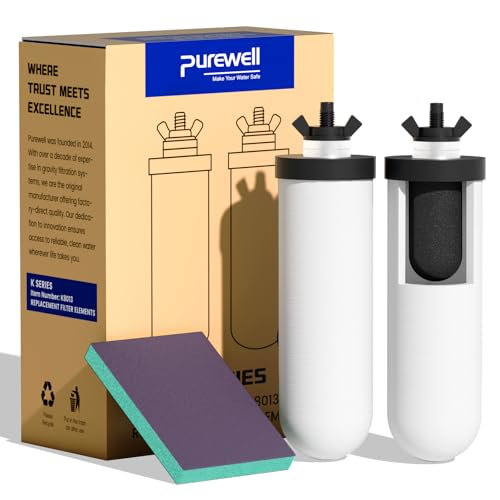
The PF-4 stands apart with a washable, reusable ceramic element rather than a composite cartridge. Its three-layer construction uses ceramic, activated carbon and an inner layer; the maker says the carbon removes 99% of chlorine and harmful chemicals. The maker also says it is certified to NSF/ANSI 42 and 372. At 8.5 inches high and 2.5 inches wide, it is a medium-size replacement for compatible Purewell, ProOne and Berkey-style systems. Buyers wanting multiple replacement elements should note this option is a single element.
Bottom line: Pick this if your compatible system uses the washable PF-4 ceramic element.
Purewell PF-4 and FL-2 Set, 4-Pack

The PF-4 and FL-2 set is the only option here that pairs ceramic elements with separate fluoride elements. Its name identifies an eight-stage set, and the maker says it is certified to NSF/ANSI 42 and designed to connect with a white fluoride or alkaline filter. The four-pack measures 10.8 inches high and 7.3 inches wide as packaged dimensions. It suits buyers seeking this combined element arrangement. Because it is a set rather than a standalone ceramic element, confirm your system accepts the included element types and connection arrangement.
Bottom line: Choose this set if you need the ceramic-and-fluoride element combination for a compatible system.
How to choose a Purewell replacement filter
Start with the replacement element type your system accepts: the PF-3 is composite, the PF-4 is ceramic, and the PF-4/FL-2 set combines ceramic and fluoride elements. Gravity filters use the height of water above the element to push water through it, so flow rate can change as the upper chamber empties and as an element accumulates particles. A tighter-fitting replacement matters because water that bypasses the element is not being filtered through it. Match the model and connection arrangement before comparing stage counts. NSF/ANSI 42 addresses aesthetic effects such as chlorine taste and odor; that certification alone does not establish reduction of every contaminant. For health-related contaminant concerns, check the exact contaminant claim and certification for the specific element.
Filter size and system fit
Compare the element’s dimensions and attachment style with the element already installed; a difference of even a fraction of an inch can affect clearance or seating. The PF-3 is 9 inches high, while the PF-4 is 8.5 inches high; the set’s 10.8-inch figure is the package height, not a single element measurement. The products identify compatibility with particular Purewell, ProOne and Berkey-style gravity systems, but names alone do not ensure every model or generation fits. Measure the chamber height and opening, then verify the replacement model against your system. A sound seal is important: water should pass through the filter element rather than around its mounting point.
Composite and ceramic filters compared
Composite and ceramic elements differ in construction and upkeep, so choose based on the replacement your system takes and the maintenance you want. Ceramic surfaces can generally be cleaned when flow slows, while composite media may require replacement rather than surface cleaning; use the specific element maker’s care directions. This comparison table summarizes the purchase-relevant distinction without treating stage count as proof of contaminant reduction. NSF/ANSI 372 concerns lead content in materials, not broad filtration performance. A claim about one contaminant should not be read as a claim about all contaminants, and filtration does not make unsafe water safe during a boil-water advisory.
| Need | Element choice | Key distinction |
|---|---|---|
| Composite element | PF-3 | Hollow-fiber membrane and silver-ion barrier |
| Washable ceramic element | PF-4 | Ceramic and activated-carbon layers |
| Ceramic plus fluoride element | PF-4/FL-2 set | Combined element arrangement |
Care and common replacement mistakes
Replace or maintain an element according to the model’s instructions and actual flow, rather than assuming all gravity filters share one service interval. Sediment-heavy water can clog elements sooner, and scrubbing a ceramic element too aggressively can damage its surface. The PF-4 is identified as washable and reusable, but that feature should not be applied to the composite PF-3 or the set’s separate element types without specific directions. Before use, check for a secure seal and discard any initial water if the system’s directions call for it. Do not rely on a gravity filter to replace boiling, disinfection or an approved treatment step when an official water advisory requires one.
Frequently Asked Questions
What does NSF/ANSI 42 cover on a water filter?
NSF/ANSI 42 covers aesthetic effects such as chlorine taste and odor, rather than every health-related contaminant. A filter’s certification should not be treated as proof of reduction for substances beyond its specific claims.
Can ceramic gravity filter elements be washed?
Some ceramic elements are designed to be cleaned when flow slows, and the Purewell PF-4 is identified as washable and reusable. Clean only the ceramic surface as directed; composite media and attached elements can have different care requirements.
Does an NSF/ANSI 372 mark mean a filter removes lead?
No; NSF/ANSI 372 addresses lead content in materials, not a filter’s lead-reduction performance. Check for a specific lead-reduction claim and applicable certification if lead is the concern.
Should a gravity filter be used during a boil-water advisory?
No; use the treatment method required by the local advisory, commonly bringing water to a rolling boil for at least 1 minute. At elevations above 6,500 feet, boil for 3 minutes.
How can I tell whether a replacement filter will fit?
Match the exact system model and element type, then compare the element height, width and attachment arrangement. Gravity filter models can have different chamber clearances even when they share a brand name.