
No-Drill Cellular Shades: Fit and Light Control

LazBlinds Cellular Shade, 34 × 48 in. is the leading choice for a 34-by-48-inch inside-mount window when light filtering matters more than blackout fabric. Choose LazBlinds Cellular Shade, 22 × 36 in. for a smaller window needing blackout coverage or SUNOFF Cellular Shade, 34 × 64 in. for a taller opening; confirm the frame’s depth and width fit each shade.
We earn a commission if you buy through links on this page. As an Amazon Associate I earn from qualifying purchases. Products are compared on manufacturer specifications, not hands-on testing.
- Best overall: LazBlinds Cellular Shade, 34 × 48 in. – Light-filtering fabric and a spring rod fit windows 33 5/8 to 34 3/5 inches wide.
- Best for smaller windows: LazBlinds Cellular Shade, 22 × 36 in. – The 22-by-36-inch blackout shade has a spring-rod width range of 21.7 to 22.6 inches.
- Best for taller windows: SUNOFF Cellular Shade, 34 × 64 in. – The 34-by-64-inch blackout shade uses a dual-spring tension mount.
| Product | Best for | Shade size | Light control | Mount | Shop |
|---|---|---|---|---|---|
| LazBlinds Cellular Shade, 34 × 48 in. | Light filtering | 34 × 48 in. | Light filtering | Inside mount | Check Price on Amazon |
| LazBlinds Cellular Shade, 22 × 36 in. | Small blackout windows | 22 × 36 in. | Blackout | Inside mount | Check Price on Amazon |
| SUNOFF Cellular Shade, 34 × 64 in. | Tall blackout windows | 34 × 64 in. | Blackout | Tension mount | Check Price on Amazon |
No-Drill Cellular Shades Compared
Match each shade’s inside-mount dimensions and fabric type to your window and light-control needs.
LazBlinds Cellular Shade, 34 × 48 in.
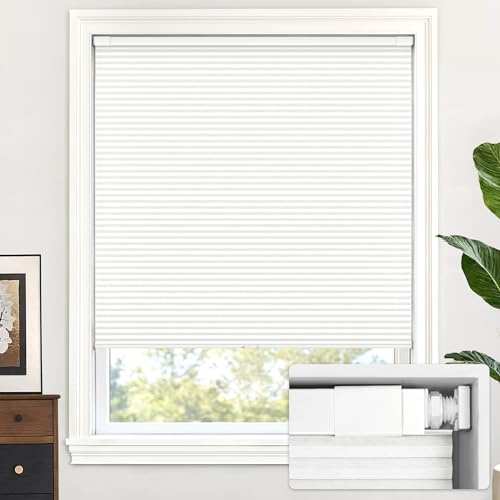
For a light-filtering option rather than blackout coverage, this LazBlinds shade is sized for a 34-by-48-inch inside-mount window. The actual shade measures 33 3/5 inches wide by 48 inches high, and its spring rod extends across a window-width range of 33 5/8 to 34 3/5 inches. The shade height adjusts from 0 to 48 inches. LazBlinds says its no-drill system installs without tools. The key limitation is fit: the window frame needs at least 1 1/5 inches of depth, so measure before choosing this model.
Bottom line: Pick this if your frame meets the depth requirement and you want filtered rather than blackout light.
LazBlinds Cellular Shade, 22 × 36 in.

The 22-by-36-inch size sets this LazBlinds blackout shade apart from the larger options. Its actual width is 21 5/8 inches, with a spring rod range of 21.7 to 22.6 inches; the shade is 36 inches high. LazBlinds says the tool-free mount can support up to 30 kg. Its cordless design avoids a dangling lift cord, which can matter in homes with children or pets. The limitation is its specific fit: this model is intended for an inside mount and a window around 22 inches wide by 36 inches high, not a taller opening.
Bottom line: Choose this for a roughly 22-by-36-inch inside mount that needs blackout fabric.
SUNOFF Cellular Shade, 34 × 64 in.

The 64-inch height makes this SUNOFF shade the option for taller windows among these three. It uses a dual-spring tension mount and a free-stop mechanism, which lets the user position the shade at different heights without a pull cord. SUNOFF says the mount supports up to 30 kg and that the shade provides blackout coverage. The limitation is that the size is 34 by 64 inches, so it is not the right pick for shorter windows; measure the opening and confirm its tension-mount fit before ordering.
Bottom line: Pick this for a taller opening needing blackout fabric and a cordless free-stop lift.
How to Measure for No-Drill Cellular Shades
For an inside mount, measure the window opening rather than the existing shade. Measure width at the top, middle and bottom, and use the narrowest reading; measure height at the left, center and right, and use the longest reading. Check the maker’s fit range and any width deduction before selecting a size, because spring rods and fabric widths can differ from nominal dimensions. A useful decision rule is to choose a shade only when your narrowest width falls within its range and the frame meets its depth requirement. For these options, LazBlinds Cellular Shade, 34 × 48 in. specifies at least 1 1/5 inches of depth. Keep the tape level and record measurements in inches.
Blackout and Light-Filtering Cellular Fabric
Choose light filtering when the goal is to soften incoming daylight, and blackout when reducing light through the shade is the priority. These terms describe different fabric outcomes, not a guarantee that a room will be completely dark: light can still enter around the edges of an inside-mounted shade. The comparison here includes one light-filtering shade and two blackout shades. Cellular shades use folded, honeycomb-shaped fabric; the air pockets add an insulating layer between the window and room. Fabric color, cell construction and edge gaps can affect the room’s result, so decide whether daylight control or privacy is the main need before settling on size.
How Tension Mounts Stay in Place
No-drill cellular shades use a tension-based mount to hold the shade inside the window frame, rather than screws through the frame. A close fit and firm, sound mounting surfaces matter because the shade relies on pressure at its contact points. Check that the frame is square and that the opening width is within the product’s fit range; a mismatch can make the shade sit unevenly or fail to stay positioned. Product-specific support claims are not interchangeable: the two blackout options here each carry a maker claim of support up to 30 kg. Do not treat that figure as a universal capacity for no-drill shades or use it to hang additional objects.
Cordless Shade Safety and Everyday Use
Cordless shades remove the dangling lift cord found on traditional corded window coverings, a useful distinction in homes with children and pets. Keep furniture and climbable objects away from windows, since cordless operation does not remove fall hazards near an open window. Cellular shades are raised and lowered by handling the bottom rail or its integrated grip; move the shade evenly rather than pulling one corner, which can strain the mechanism. The options here use cordless operation, while SUNOFF Cellular Shade, 34 × 64 in. also specifies a free-stop system for positioning the shade. Avoid forcing a shade past its height or width range, because mount pressure and moving parts depend on correct fit.
Frequently Asked Questions
How much depth does an inside-mount cellular shade need?
The required depth depends on the shade’s mount design, so use its minimum rather than a general estimate. LazBlinds Cellular Shade, 34 × 48 in. requires at least 1 1/5 inches of frame depth.
How do I measure a window for an inside mount?
Measure width at the top, middle and bottom, then use the narrowest measurement; measure height at three points and use the longest. Compare those figures with the shade’s fit range and any maker-specified width deduction.
Do no-drill shades damage window frames?
A tension mount avoids drilling holes, but it still presses against the frame to stay in place. Check that the frame surface is firm and that the opening width falls within the shade’s range.
Do blackout cellular shades block all outside light?
Blackout fabric blocks light through the shade material, but an inside mount can leave gaps around its edges. For less edge light, prioritize a close fit and check whether an outside mount is suitable for your window.
Are cordless cellular shades safer around children?
Cordless shades eliminate a dangling lift cord, reducing exposure to a common strangulation hazard. They do not prevent falls, so keep furniture away from windows and supervise children around open windows.