
WOSPORTS G600 Trail Camera: Models Compared by Fit

The WOSPORTS G600-style non-Wi-Fi trail camera suits most buyers who want local wildlife recording, with 4K video, 64MP photos and a 120-degree detection angle. Choose a different model if you want app transfers, a rechargeable two-camera setup or a six-camera pack; the G600-style unit has no cellular or Wi-Fi access.
We earn a commission if you buy through links on this page. As an Amazon Associate I earn from qualifying purchases. Products are compared on manufacturer specifications, not hands-on testing.
- Best overall: WOSPORTS 64MP 4K Trail Camera – Records 4K video and 64MP photos, with a 0.2-second trigger and 120-degree detection.
- Best for rechargeable two-camera setups: WOSPORTS Rechargeable 2-Pack Trail Camera – Includes two rechargeable cameras, local SD storage and 56MP/4K capture.
- Best for phone transfers: WOSPORTS Solar Wi-Fi Trail Camera – Pairs with an app over Wi-Fi and Bluetooth, with a 30-foot connection range.
| Product | Best for | Capture resolution | Trigger speed | Connectivity | Shop |
|---|---|---|---|---|---|
| WOSPORTS 64MP 4K Trail Camera | Local 4K recording | 64MP photos; 4K video | 0.2 seconds | Non-cellular, non-Wi-Fi | Check Price on Amazon |
| WOSPORTS Rechargeable 2-Pack Trail Camera | Rechargeable two-pack | 56MP photos; 4K video | 0.2 seconds | Non-cellular, non-Wi-Fi | Check Price on Amazon |
| WOSPORTS Solar Wi-Fi Trail Camera | App-based transfers | 48MP photos; 1296P video | 0.1 seconds | Wi-Fi, Bluetooth | Check Price on Amazon |
| WOSPORTS Mini Trail Camera 6-Pack | Multi-site monitoring | 32MP photos; 1080P video | — | — | Check Price on Amazon |
| GardePro E5S Trail Camera | Faster trigger and range | 64MP photos; 1296P video | 0.1 seconds | Non-cellular, non-Wi-Fi | Check Price on Amazon |
WOSPORTS G600 Trail Camera Options
Compare these WOSPORTS cameras by how they capture, store and let you retrieve wildlife footage.
WOSPORTS 64MP 4K Trail Camera

The 64MP 4K camera is the closest match for a G600-style non-cellular, non-Wi-Fi trail camera. It captures 4K video and photos up to 64MP, with a 0.2-second trigger, a 120-degree detection angle and 32 no-glow 940nm IR LEDs. Its 2-inch LCD supports on-camera viewing, and burst shooting can be set to one to three images. The camera records motion without remote app access, so it suits a site where you can retrieve the SD card. The trade-off is that footage cannot be transferred over Wi-Fi or cellular service.
Bottom line: Pick this for local 4K capture and a wide detection angle without wireless access.
WOSPORTS Rechargeable 2-Pack Trail Camera

The rechargeable two-pack differs from the single-camera G600-style option by providing two units and a removable lithium battery. Each camera records locally to an SD card and captures 56MP photos and 4K video, with a 0.2-second trigger and 120-degree lens. Its settings include shot delay from 5 seconds to 2 minutes and time-lapse, useful when two sites need different schedules. The key limitation is the charging routine: remove the battery to charge it separately, and do not use the camera’s USB-C port for charging; that port is for data transfer.
Bottom line: Choose this when you need two local-recording cameras and a removable rechargeable battery.
WOSPORTS Solar Wi-Fi Trail Camera

The Solar Wi-Fi model is the wireless alternative for buyers who want to transfer footage to a phone instead of relying only on card retrieval. It captures 48MP photos and 1296P video, and its maker says the app connects over Wi-Fi and Bluetooth without monthly fees. The connection range is 30 feet, and it does not connect to a home Wi-Fi network, so it is best for nearby retrieval at the camera rather than remote monitoring. The camera includes a 7,800mAh built-in battery and eight AA batteries; its video resolution is below the 4K options.
Bottom line: Pick this if app transfers within 30 feet matter more than 4K video.
WOSPORTS Mini Trail Camera 6-Pack

The Mini six-pack prioritizes camera quantity over the higher resolution of the single G600-style unit. Each mini camera captures 32MP photos and 1080P video, and a 32GB microSD card is included in each camera; the pack also includes a card reader for viewing cards on a computer. That setup can cover several monitoring locations at once without moving one camera between sites. The trade-off is lower video resolution than the 4K models, and the product facts do not establish a trigger speed or connectivity mode, so it is not the choice for buyers requiring those specifications.
Bottom line: Choose this to cover multiple sites with compact cameras and included cards.
GardePro E5S Trail Camera
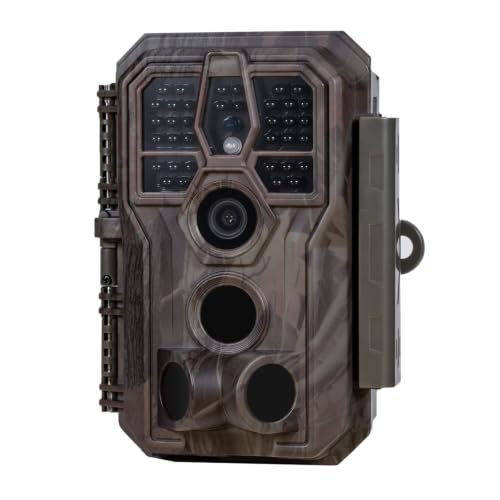
The GardePro E5S is a non-Wi-Fi alternative with a faster 0.1-second trigger and maker-claimed no-glow night vision up to 100 feet. It captures 64MP photos and 1296P video, and its IP66 waterproof rating and 1/4-20 mounting thread distinguish it for fixed outdoor mounting. Like the G600-style camera, it requires card retrieval rather than remote access. Its main compromise is video resolution: 1296P is below 4K, so buyers focused on higher-definition motion clips should favor the WOSPORTS 4K options.
Bottom line: Choose this for a faster trigger and a 100-foot night-vision range.
How to Choose a WOSPORTS Trail Camera
Start with the retrieval method: non-Wi-Fi cameras store footage on an SD card, while the Solar Wi-Fi model offers phone transfer within 30 feet. A trail camera uses a passive infrared sensor to detect changes in heat and movement, then triggers a photo or clip; trigger time and detection angle influence whether a fast animal is captured. For remote monitoring beyond the camera’s local connection range, do not assume a Wi-Fi model works like a cellular camera. For tight trails under 10 feet wide, a wide-angle sensor can cover more ground but may include more background; aim the camera along the path rather than directly across it.
Trail Camera Resolution and Detection Range
Video resolution, photo megapixels and detection angle measure different things: 4K describes video detail, megapixels describe still-image dimensions, and degrees describe horizontal coverage. A camera with a 120-degree sensor sees a broader scene than a narrower sensor, but positioning still affects how much of the animal fills the frame. Trigger speed matters when wildlife crosses quickly; a 0.1-second trigger is quicker on paper than 0.2 seconds, though detection zone, distance and subject movement also affect capture. For a narrow game trail, point the camera at an approach zone rather than a broad clearing so the animal stays in the useful part of the image.
Trail Camera Power and Mounting
Power strategy affects how often a camera needs attention: removable batteries can be exchanged at the site, while a rechargeable unit’s battery may need to be carried out for charging. The rechargeable two-pack requires removal of its battery for charging and reserves its USB-C port for data transfer. Solar assistance can reduce battery maintenance, but confirm the power setup and mounting position before placing a camera where sunlight is limited. Mount cameras roughly 3 to 4 feet above ground and angle them slightly downward on level terrain; higher placement may suit steep slopes. Use a secure strap or mount and avoid aiming into direct sunrise or sunset glare.
Trail Camera Weather and Retrieval
Outdoor placement exposes cameras to rain, dust and temperature swings, so an IP rating is useful when comparing models; IP66 means dust-tight protection and resistance to powerful water jets, not submersion. Memory capacity affects how often you retrieve footage: video consumes more card space than still photos, and short clips or lower resolutions can extend card life. Format cards in the camera before deployment and use a card capacity supported by the camera manual. To reduce disturbance at a wildlife site, retrieve cards on a consistent schedule and approach from downwind when practical; repeated visits can change animal movement.
Frequently Asked Questions
How far from a trail should a camera be mounted?
A practical starting distance is 10 to 20 feet from the target zone, adjusted for the camera’s detection angle and lens framing. A 120-degree detection field covers more width, so aim across a narrow route only if the subject stays within the center zone.
What height should a trail camera be mounted?
Mount a camera about 3 to 4 feet above level ground for deer-sized wildlife, then angle it toward the expected path. Raise or lower it for smaller animals or steep terrain, and keep the lens clear of vegetation that can trigger motion.
How often should I check a trail camera SD card?
A common interval is every 1 to 2 weeks, with more frequent checks if the camera records long video clips or the site has heavy activity. Larger cards and shorter clips reduce the chance of storage filling before retrieval.
Can a Wi-Fi trail camera send footage from far away?
A local Wi-Fi camera generally requires a nearby phone, and the WOSPORTS Solar Wi-Fi model lists a 30-foot connection range. Cellular cameras use a mobile network instead, so confirm cellular capability and coverage when remote access is essential.
What does IP66 mean on a trail camera?
IP66 indicates dust-tight construction and protection against powerful water jets; it does not mean a camera can be submerged. Mount the camera with its ports and seals closed, and use a different specification if placement risks standing water.