
Best Eye Mask After Blepharoplasty: 5 Options Compared

For most people, NEWGO Reversible Cooling Eye Mask is the most versatile choice because its reversible design offers a plush side and a smoother cooling side. After blepharoplasty, use any cold compress only if your surgeon approves it, and avoid pressure on healing eyelids.
Choose a different option if you want two masks for rotation, a contoured shape, or broader coverage; comfort and fit matter, but your surgeon’s postoperative instructions take priority.
We earn a commission if you buy through links on this page. As an Amazon Associate I earn from qualifying purchases. Products are compared on manufacturer specifications, not hands-on testing.
- Best overall: NEWGO Reversible Cooling Eye Mask – The reversible design offers both a plush backing and a smooth cooling surface.
- Best for rotation: BeeVines Gel Eye Mask 2-Pack – The two-pack provides a second mask to alternate while one is being chilled.
- Best for contoured coverage: Full-Eye Contour Cooling Gel Mask – The 3D shape is designed to cover the eye area and surrounding face.
| Product | Best for | Pack count | Shape or coverage | Cooling surfaces | Shop |
|---|---|---|---|---|---|
| NEWGO Reversible Cooling Eye Mask | Flexible cooling | 1 mask | Eye mask | Plush and smooth | Check Price on Amazon |
| BeeVines Gel Eye Mask 2-Pack | Alternating masks | 2 masks | Eye mask | Fabric and plastic | Check Price on Amazon |
| Full-Eye Contour Cooling Gel Mask | Wider coverage | 1 mask | Full-eye contour | — | Check Price on Amazon |
| BeeVines 3D Contoured Gel Mask | Contoured fit | 1 mask | 3D contoured | — | Check Price on Amazon |
| Full Eye-Area Cooling Gel Mask | Temple coverage | — | Eyes and temples | — | Check Price on Amazon |
Eye Masks After Blepharoplasty
Compare each mask’s shape and cooling design, then confirm with your surgeon how and when to use a compress.
NEWGO Reversible Cooling Eye Mask

For a choice between a soft-touch side and a smoother cooling surface, this NEWGO mask has a reversible design. The manufacturer says it supports hot and cold use and is intended for post-surgery recovery as well as general eye-area comfort. Its 9.84-inch length and 3.93-inch width give a compact format for storage. Use it after blepharoplasty only as your surgeon directs, and do not press it against healing eyelids. The main limitation is that the single-mask pack offers no spare to rotate while it chills.
Bottom line: Choose this if you want a reversible surface in a single mask.
BeeVines Gel Eye Mask 2-Pack

The two-mask pack is the clearest distinction here: one mask can chill while the other is ready, subject to your surgeon’s schedule for compresses. Each mask has a fabric side and a plastic side, and the manufacturer says the set stays cool for up to 30 minutes. Its compact stated dimensions are 5.9 inches long by 3.1 inches wide. For postoperative use, follow your surgeon’s instructions about temperature and placement rather than relying on the product’s general-use claims. The limitation is that the narrow listed width may provide less face-area coverage than a full-contour design.
Bottom line: Pick this if having two masks to alternate is useful.
Full-Eye Contour Cooling Gel Mask

This mask’s wider, contoured form is designed to cover more than the immediate under-eye area, extending toward the forehead, temples, and upper cheeks. The manufacturer recommends chilling it in a refrigerator and describes it as a reusable cold compress. That broader contact may appeal to someone seeking surrounding-face coverage, but after eyelid surgery, more coverage is not automatically better: confirm that its shape can rest without pressure on incisions or healing skin. The maker does not give dimensions or a pack count beyond one, so check fit before choosing it for a particular face.
Bottom line: Choose this if broad, contoured coverage suits your surgeon-approved routine.
BeeVines 3D Contoured Gel Mask
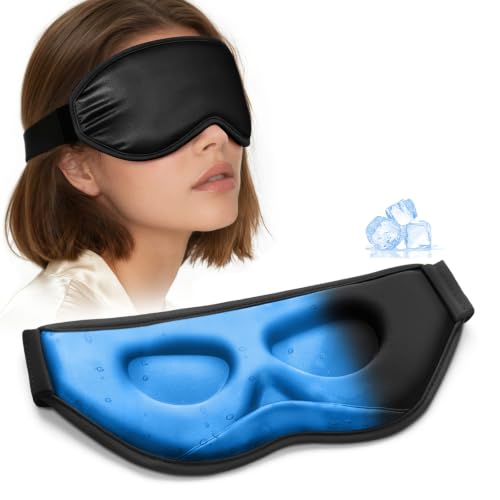
The BeeVines 3D mask combines a contoured shape with an adjustable band and a 6-ounce weighted construction, unlike the simpler reversible designs. The manufacturer says its targeted cooling lasts 15–20 minutes and describes the mask as providing blackout coverage. Those features may suit someone who also wants a sleep-mask style, but weight and a securing band can create unwanted pressure after blepharoplasty. Ask your surgeon whether this style is appropriate before using it, particularly near incisions. Its main tradeoff is that the weighted, strapped design may be less suitable than a light compress for sensitive healing eyelids.
Bottom line: Consider this only if your surgeon approves its weight and band.
Full Eye-Area Cooling Gel Mask

This option is described as covering the eyes, temples, and part of the forehead, making its emphasis broader than a mask limited to the eye contour. The product name gives a 22-by-4-inch size, and the manufacturer says it can be chilled for use when cold therapy is recommended. Before postoperative use, check that the long shape can be positioned without pressure or rubbing on healing areas; full-area contact is not a substitute for your surgeon’s specific instructions. The pack count and cooling-surface materials are unclear, so confirm those points if they affect your preference.
Bottom line: Pick this if temple and forehead coverage is important and approved.
How to Choose an Eye Mask After Blepharoplasty
Choose by pressure, temperature, and surgeon approval before choosing by shape. Eyelid surgery instructions can differ by procedure and surgeon, so confirm whether cold compresses are recommended and how they should be positioned. A cold pack should not be placed directly against bare skin; use a clean, soft barrier if your care team permits one. Common general cold-pack guidance uses short applications of about 10–20 minutes, followed by a break, but postoperative directions override that range. Avoid sleeping with a cold pack in place, since prolonged contact can irritate or injure skin. If a mask feels heavy, tight, or pushes on the eyelids, stop and ask your surgical team about a lighter option.
Use this decision guide to narrow the shape before discussing it with your surgeon:
| Need | Consider | Check before use |
|---|---|---|
| Two masks for rotation | Two-pack style | Approved use interval |
| Wider face-area contact | Contoured or full-area shape | No pressure on healing areas |
| Light contact near eyelids | Simple mask without added weight | Comfort and secure placement |
Cold Compress Timing and Safe Placement
Short, intermittent cooling is safer than leaving a cold compress in place continuously. General cold-pack guidance commonly uses 10–20-minute sessions with breaks, but follow the exact schedule from your surgical team after blepharoplasty. Keep the compress clean, and avoid direct contact with ice or a frozen surface; extreme cold can damage skin. Do not press down to improve contact, because pressure itself may be inappropriate for healing eyelids. A mask that slides, feels painfully cold, or leaves the skin numb should be removed. Contact your surgeon promptly about worsening pain, vision changes, or unexpected bleeding rather than trying to manage those symptoms with a mask.
Mask Shape, Coverage, and Fit
A close fit is useful only when it does not press on tender areas or drag across incisions. Eye masks range from compact eye-only formats to shapes that extend over the temples and forehead; broader coverage can be harder to position gently after surgery. Adjustable straps may help a mask stay in place, but tightening a band can add pressure. Check whether the mask can be rested in position without pulling the eyelids, and avoid wearing it while asleep unless the surgeon explicitly approves that use. If you cannot place it without contact or rubbing on a healing incision, do not force the fit.
Cleaning and Storage Between Uses
Clean the mask between sessions according to its care instructions, since reusable cold packs can pick up skin oils and residue. Keep the mask in a clean sealed bag in the refrigerator if your surgeon approves refrigerated cooling; do not assume freezer storage is suitable. A refrigerator is generally around 37–40°F, while freezers are typically near 0°F, a substantial difference for an item used near delicate skin. Inspect seams and surfaces before use, and discard a leaking gel pack rather than applying it near an incision. Do not share a mask during recovery, and avoid using a surface that cannot be cleaned safely.
Frequently Asked Questions
Can I use a cold eye mask right after blepharoplasty?
Use a cold eye mask only if your surgeon recommends it for your specific procedure. Postoperative timing and placement vary, and pressure on eyelids may be inappropriate even when cooling is allowed.
How long should a cold compress stay on eyelids?
General cold-pack guidance often uses 10–20 minutes at a time with a break afterward. Your surgeon’s schedule takes priority, and remove the compress sooner if skin becomes numb or painful.
Should an eye mask go in the freezer or refrigerator?
A refrigerator is typically about 37–40°F, while a freezer is near 0°F and can make a pack too cold for delicate eyelid skin. Use only the storage temperature your surgeon and the mask’s care directions permit.
Can I sleep wearing a cooling eye mask?
Do not sleep with a cold compress in place unless your surgeon explicitly approves it. Continuous contact can expose skin to prolonged cold, and straps or weight may press on healing eyelids.
When should I call my surgeon after eyelid surgery?
Call your surgical team for vision changes, worsening pain, unexpected bleeding, or symptoms that concern you. A cold mask is not a substitute for assessment of a postoperative problem.