
Best Sewer Jet Attachment for Pressure Washer: 3 Kits

For most homeowners, ZOFINE 100-Foot Sewer Jetter Kit is the best sewer jet attachment for a pressure washer because its 100-foot hose comes with four nozzle types and a washer pressure rating up to 5,800 PSI. Choose 100-Foot Sewer Jetter Kit, 4 Nozzles instead if your setup needs its included M22-14 adapter, but its 2,000-PSI maximum working pressure is a much lower limit.
A sewer jetter uses water jets to move a hose into a drain and flush debris; match the hose fittings and pressure rating to your washer before connecting it.
We earn a commission if you buy through links on this page. As an Amazon Associate I earn from qualifying purchases. Products are compared on manufacturer specifications, not hands-on testing.
- Best overall: ZOFINE 100-Foot Sewer Jetter Kit – The 100-foot hose and four nozzle styles provide several head options, with a rating up to 5,800 PSI.
- Best for broad cleaning use: NIFUAL 100-Foot Sewer Jetter Kit – The kit lists sinks, gutters, roofs, floor drains and other cleaning applications.
- Best for M22-14 setups: 100-Foot Sewer Jetter Kit, 4 Nozzles – An M22-14 female adapter is included, and the kit identifies a 2,000-PSI maximum working pressure.
| Product | Best for | Maximum working pressure | Nozzle options | Shop |
|---|---|---|---|---|
| ZOFINE 100-Foot Sewer Jetter Kit | Nozzle variety | Up to 5,800 PSI | 4 types | Check Price on Amazon |
| NIFUAL 100-Foot Sewer Jetter Kit | Multi-use cleaning | Up to 5,800 PSI | Multiple types | Check Price on Amazon |
| 100-Foot Sewer Jetter Kit, 4 Nozzles | M22-14 connections | 2,000 PSI | 4 designs | Check Price on Amazon |
Best Sewer Jet Attachments for Pressure Washers
Compare hose reach, nozzle selection and pressure limits before choosing a kit for your washer and drain access.
ZOFINE 100-Foot Sewer Jetter Kit
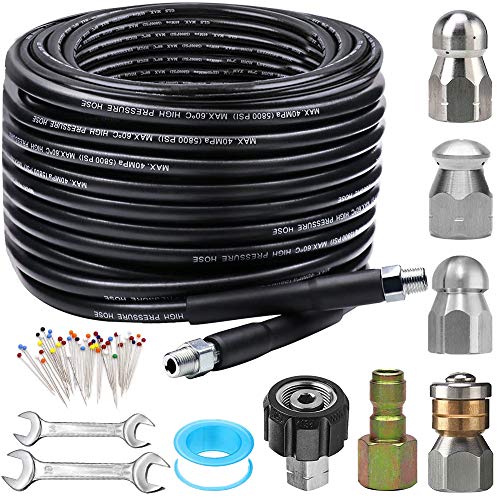
The four included nozzle types distinguish this kit: button, rotating, side-hole and corner heads accompany a 100-foot sewer jet hose. ZOFINE says the hose works with many gas and electric pressure washers up to 5,800 PSI. The package also includes an M22 female-to-1/4-inch female NPT coupler, a 1/4-inch quick-connect plug, tape and two spanners. This setup suits buyers who want several head shapes and connection pieces together. Its pressure ceiling is not a universal fit guarantee, so verify that your washer connection and operating pressure are compatible before use.
Bottom line: Pick this if you want a long hose and several nozzle shapes in one kit.
NIFUAL 100-Foot Sewer Jetter Kit

The range of cleaning uses sets this kit apart: NIFUAL names siding, sinks, gutters, roofs, wash basins, floor drains and toilets. The 100-foot hose has a maximum working pressure of 5,800 PSI, and the maker gives a temperature range of 40°F to 140°F. Two wrenches, waterproof tape and a box of pins are included. This option suits homeowners who expect to use a jetter for more than drain lines. Its broad application claims do not establish compatibility with every washer or drain, so confirm the fitting and use only where the hose and nozzle can safely enter.
Bottom line: Choose this for a kit marketed for several household cleaning tasks.
100-Foot Sewer Jetter Kit, 4 Nozzles
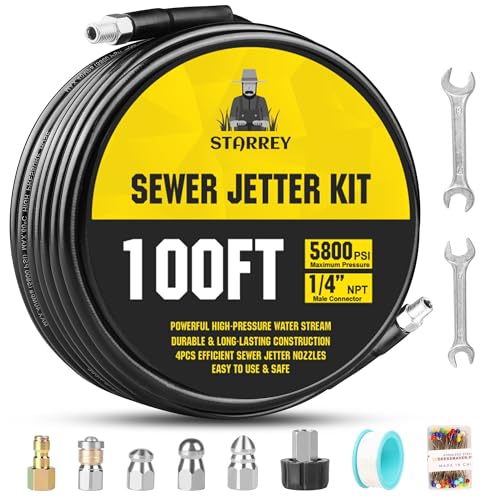
The clearly stated 2,000-PSI maximum working pressure is the key distinction for this 100-foot kit; 5,800 PSI is its burst pressure, not its working limit. Four nozzle designs are included: round-head, mushroom-head, rotating and pointed-tip. The kit also has male 1/4-inch NPT ends, an M22-14 female-to-1/4-inch female adapter, a male connector, tape, pins and two wrenches. That adapter makes it a candidate when an M22-14 washer connection is needed. The lower operating limit matters: do not use it with a washer whose intended pressure exceeds 2,000 PSI.
Bottom line: Pick this when the adapter suits your washer and its working pressure stays within 2,000 PSI.
How to choose a sewer jetter
Choose by working-pressure compatibility, connection fit and the distance from the washer to the drain entry. A sewer jetter sends water through a hose; rear-facing jets help pull the hose forward while flushing debris back toward the access point, and a forward-facing jet can direct water into an obstruction. Match the washer’s pressure to the kit’s maximum working pressure, not a burst-pressure figure. Also check whether the washer outlet and hose ends need an adapter: 1/4-inch NPT threads and M22 connections are different formats. For reach, measure the route from the washer to the drain opening and choose a hose longer than that route, leaving enough slack to handle the hose without tension.
How hose length and nozzle shape affect fit
A 100-foot hose provides more reach than a short nozzle alone, but bends and the path to the drain consume usable length. Measure from the washer to the cleanout or other access point rather than estimating only the underground pipe distance. Nozzle shapes change how water exits: rear or side jets provide forward thrust, while a forward jet aims water ahead. Choose a head that can pass through the drain opening and move through the line; do not force a nozzle that catches at a bend. A small opening, tight turn or fragile pipe can make a long hose and larger head difficult to manage, regardless of the hose’s reach.
Pressure ratings and sewer jetter safety
Use the maximum working-pressure rating as the operating ceiling; burst pressure describes failure strength and is not a usable setting. A kit rated for 2,000 PSI must not be treated as a 5,800-PSI kit just because its burst figure is higher. High-pressure water can puncture skin and cause serious injury, so wear eye protection and gloves, keep hands away from the jet, and never point a pressurized nozzle at a person. Shut off the washer and release pressure before disconnecting fittings or changing heads. Do not run a jetter through an uncertain or damaged line; stop if a hose, fitting or pipe leaks or behaves unexpectedly.
Common sewer jetter setup mistakes
The most common setup mistake is confusing thread compatibility with pressure compatibility: an adapter may make fittings connect, but it does not raise a hose’s pressure limit. Check the washer outlet, adapter type and kit working-pressure rating as separate requirements. Another mistake is choosing hose length by the advertised maximum without accounting for the walk from washer to drain entry and the bends on the route. Keep the hose un-kinked and feed it without forcing it around tight turns. Avoid using a sewer jetter in a fixture or pipe unless the access and hose fit allow controlled insertion; a nozzle that cannot pass freely can become lodged or damage the line.
Frequently Asked Questions
How does a pressure washer sewer jetter work?
A sewer jetter directs water through a hose, with rear-facing jets helping pull it into a drain while flushing material back toward the access point. A forward-facing jet may direct water at an obstruction, but flow and results depend on the washer, nozzle and line.
How much hose length do I need for a drain?
Choose a hose longer than the measured route from the pressure washer to the drain opening, with slack for handling. A 100-foot hose is useful only if the route and bends allow it to reach without tension or kinking.
Can I use any sewer jetter with my pressure washer?
No; the washer’s connection and operating pressure must both match the kit. An adapter can change the fitting format, but it does not change the hose’s maximum working-pressure limit.
Is burst pressure the same as working pressure?
No; burst pressure is not the intended operating limit. Use the maximum working-pressure figure, such as 2,000 PSI for 100-Foot Sewer Jetter Kit, 4 Nozzles, and do not operate above it.
What safety gear should I use with a sewer jetter?
Wear eye protection and gloves, and keep the pressurized nozzle away from skin because high-pressure water can cause severe injection injuries. Turn off the washer and release pressure before disconnecting the hose or changing a nozzle.