
Park Bench Replacement Slats: 3 Wood Options Compared

Barrington Hardwoods Cherry Lumber 48 in is the strongest starting point for most park bench repairs because its 48-inch length gives more room to trim to fit than the 36-inch boards in Barrington Hardwoods Sapele Lumber 36 in. Replacement slats are the individual boards fastened across a bench frame.
Choose Premium Wooden Garden Bench Slats, 2-Piece if you prefer a product marketed as ready-made garden bench slats, but verify its length and hole spacing against your frame before ordering.
We earn a commission if you buy through links on this page. As an Amazon Associate I earn from qualifying purchases. Products are compared on manufacturer specifications, not hands-on testing.
- Best overall: Barrington Hardwoods Cherry Lumber 48 in – Its 48-inch length can be trimmed to match many bench spans.
- Best for shorter frames: Barrington Hardwoods Sapele Lumber 36 in – The 36-inch boards suit repairs needing less length.
- Best for ready-made slats: Premium Wooden Garden Bench Slats, 2-Piece – It is marketed specifically as garden bench replacement slats.
| Product | Best for | Board length | Cross section | Pack count | Shop |
|---|---|---|---|---|---|
| Barrington Hardwoods Cherry Lumber 48 in | Longer custom spans | 48 in | 3/4 x 2 in | 4 pieces | Check Price on Amazon |
| Barrington Hardwoods Sapele Lumber 36 in | Shorter custom spans | 36 in | 3/4 x 2 in | 4 pieces | Check Price on Amazon |
| Premium Wooden Garden Bench Slats, 2-Piece | Ready-made slat option | — | — | 2 pieces | Check Price on Amazon |
Park Bench Replacement Slats Compared
Compare board dimensions and product type, then match them to your bench before cutting or fastening.
Barrington Hardwoods Cherry Lumber 48 in

Barrington Hardwoods Cherry Lumber 48 in provides the longest boards in this group at 48 inches, making it the most flexible starting point when a bench needs longer slats that can be cut down. Each of the four cherry lumber pieces measures 3/4 inch thick by 2 inches wide, and two sides are sanded to 3/4-inch thickness. The maker says the lumber is kiln dried. This option suits a repair where you can cut and drill boards to match the existing frame. Its limitation is that it is lumber, not a pre-drilled bench-specific kit, so measure and prepare each piece yourself.
Bottom line: Choose this for a longer board blank you can cut and drill to fit.
Barrington Hardwoods Sapele Lumber 36 in
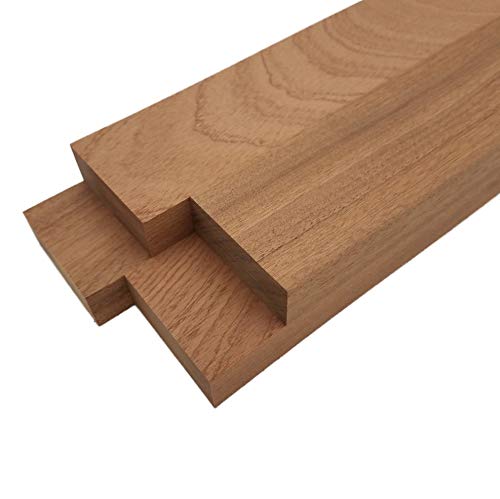
Barrington Hardwoods Sapele Lumber 36 in offers 36-inch sapele boards for repairs that do not need the extra length of Barrington Hardwoods Cherry Lumber 48 in. The four pieces have a 3/4-by-2-inch cross section, and the maker says they are kiln dried and have two sides sanded to 3/4-inch thickness. The product is identified as reddish-brown, which gives a different stated color from the cherry lumber option. It suits a shorter bench span or a project where limiting the amount of trimming matters. Because these are lumber blanks rather than fitted slats, the buyer still needs to check the frame length and make the fastening holes.
Bottom line: Pick this when 36 inches is enough and you want sapele lumber.
Premium Wooden Garden Bench Slats, 2-Piece

Premium Wooden Garden Bench Slats, 2-Piece is the product in this set explicitly promoted as replacement slats for wooden garden, patio and park benches, rather than as general lumber. Its features emphasize installation with basic tools and use for refreshing outdoor seating. The size wording includes “L 1.5,” but it does not provide a complete unit-bearing board length or a clear cross section here, so it cannot be directly compared dimension-for-dimension with Barrington Hardwoods Cherry Lumber 48 in or Barrington Hardwoods Sapele Lumber 36 in. The maker specifically advises checking the bench dimensions and hole spacing before purchase. Choose it only after confirming that its actual dimensions align with your existing frame.
Bottom line: Choose this if its confirmed dimensions and hole spacing match your bench.
How to Measure Park Bench Replacement Slats
Measure one existing slat from end to end, then measure its width and thickness before selecting replacement stock. Record the number of boards and the center-to-center distance between fastening holes; matching those measurements prevents a new board from colliding with the frame or sitting unevenly. For a damaged slat that has lost its original length, measure between the outer frame edges and check the other intact slats as a cross-reference. Allow for the actual frame geometry rather than assuming that the bench is symmetrical. If the replacement board is longer than the span, trim it to length only after confirming the fit; a board that is too short cannot be extended safely by shifting the holes inward.
Choosing Lumber or Ready-Made Bench Slats
Lumber blanks give you control over finished length and hole placement, while a product sold as bench slats may be intended to reduce fabrication. The two Barrington options here share a 3/4-by-2-inch cross section but differ in length and wood species; Premium Wooden Garden Bench Slats, 2-Piece is marketed as replacement slats, but its complete dimensions need confirmation. Use a simple rule: if you can measure, cut and drill accurately, select lumber whose cross section matches the old board and whose length is at least the finished span. If you need a more direct replacement, confirm the new slat’s full length, width, thickness and hole spacing before buying. Do not assume that similar-looking slats share the same mounting pattern.
| Repair need | Starting option | What to verify |
|---|---|---|
| Longer blank for trimming | Barrington Hardwoods Cherry Lumber 48 in | Finished length and hole positions |
| 36-inch blank | Barrington Hardwoods Sapele Lumber 36 in | Frame span and fastening layout |
| Slats marketed for bench replacement | Premium Wooden Garden Bench Slats, 2-Piece | Complete dimensions and hole spacing |
Planning the Slat Layout and Fasteners
Lay new boards in the existing sequence and preserve the current gaps unless the frame design calls for a change. Equal spacing is easier to maintain by measuring from the same edge of each slat rather than estimating each gap by eye. Mark hole centers against the metal or wood support, then check that each fastener will land within the frame and not too close to a board end. Pre-drilling a pilot hole in hardwood helps reduce splitting, but choose the pilot size to suit the screw or bolt core rather than its outside thread diameter. Keep the finished surface smooth and remove splinters before returning the bench to use.
Protecting Replacement Wood Slats Outdoors
Outdoor wood moves as moisture changes, so leave room for drainage and avoid trapping water between adjoining boards. Seal or finish replacement wood on all faces, including cut ends, with a coating intended for exterior wood; inspect the finish at least once each year and refresh it when it begins to peel or expose bare wood. Sand sharp corners and splintered edges before finishing, then allow the coating to cure as its manufacturer directs before seating use. Avoid sealing wet boards, since trapped moisture can undermine the finish. Periodically check fasteners for looseness and corrosion, especially at joints exposed to rain and standing water.
Frequently Asked Questions
How do I know what length bench slats to cut?
Measure an intact slat from end to end and use that as the target finished length. If none remain intact, measure the frame span at both ends because a bent or uneven frame can change the required length.
Should replacement bench slats have predrilled holes?
Predrilled holes are useful only when their spacing matches the bench frame. Measure hole centers from one end of an existing slat; if drilling new lumber, mark the frame locations and pilot-drill before fastening.
What thickness should a replacement park bench slat be?
Match the thickness of the original slat so its top surface aligns with neighboring boards and the fastener can engage securely. For a bench with missing or inconsistent boards, check the frame clearance and fastener length before cutting replacements.
How often should outdoor bench wood be refinished?
Inspect the finish at least once a year and renew it when peeling or bare patches appear. Apply exterior-rated finish to dry wood, including cut ends, and let it cure before use.
Can I use any wood board for a bench slat?
No; the board needs to match the bench’s span, cross section and mounting layout, and it should be suitable for outdoor exposure. A slat that is too thin, too short or drilled too close to an end may not fasten reliably.