
LabCharge Air Purifiers: 3 Packs Compared

LabCharge Ionic Purifier, 5-Pack is the closest fit for most buyers who want LabCharge’s plug-in ionizer in a five-unit pack, with each unit stated to cover 250 square feet. Choose a different pack if you need four or eight units; choose a fan-and-filter purifier instead if capturing airborne particles is your priority.
We earn a commission if you buy through links on this page. As an Amazon Associate I earn from qualifying purchases. Products are compared on manufacturer specifications, not hands-on testing.
- Best overall: LabCharge Ionic Purifier, 5-Pack – Five units, each to cover 250 square feet, make this the middle pack size.
- Best for four rooms: LabCharge Ionic Purifier, 4-Pack – The four-unit pack suits buyers who need fewer units than the other LabCharge options.
- Best for more rooms: LabCharge Ionic Purifier, 8-Pack – The eight-unit pack offers the largest unit count among these LabCharge options.
| Product | Best for | Pack count | Shop |
|---|---|---|---|
| LabCharge Ionic Purifier, 5-Pack | Mid-size pack | 5 units | Check Price on Amazon |
| LabCharge Ionic Purifier, 4-Pack | Smaller pack | 4 units | Check Price on Amazon |
| LabCharge Ionic Purifier, 8-Pack | More rooms | 8 units | Check Price on Amazon |
LabCharge Air Purifiers
Compare the three LabCharge filterless ionizer packs by unit count and stated coverage per unit.
LabCharge Ionic Purifier, 5-Pack

The five-unit package sits between the four- and eight-unit choices, while each compact black purifier is stated to cover 250 square feet. LabCharge describes these as plug-in ionic units that run without a fan or replaceable filter, so they suit buyers prioritizing a small footprint and no filter changes. The dimensions are 3.5 inches high, 1.5 inches long, and 2 inches wide. The maker’s “HEPA” wording does not make this a conventional HEPA-filter model; choose a fan-driven purifier with a particle filter if physical capture is what you need.
Bottom line: Pick this pack if five plug-in units match the rooms you want to address.
LabCharge Ionic Purifier, 4-Pack

The four-unit version is the smallest LabCharge pack here, with the same 250-square-foot coverage per unit and the same compact black dimensions as the five-pack. Its filterless, plug-in ionizing design is intended for buyers who want to avoid replacing purifier filters. Pack count, rather than a different coverage figure or body size, is the meaningful distinction from the other LabCharge options. Ionizers do not work like mechanical filters that trap particles in a cartridge, so this pack is a poor match if you specifically want particle capture by a replaceable filter.
Bottom line: Choose this version when four units are enough for your intended rooms.
LabCharge Ionic Purifier, 8-Pack
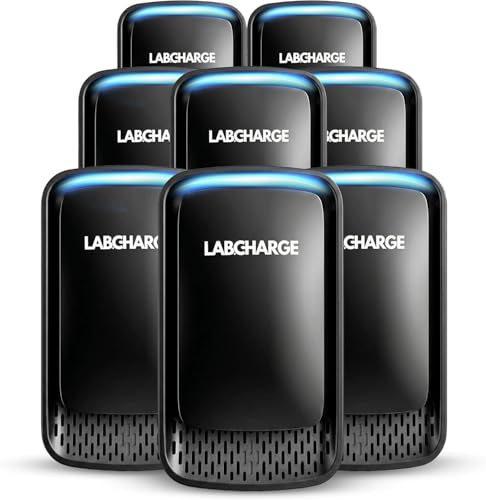
The eight-unit package provides the most individual LabCharge purifiers of these three options; each unit is stated to cover 250 square feet and measures 3.5 by 1.5 by 2 inches. The maker describes negative ions as attaching to airborne particles so they settle out of the air, and says the unit has no motor, fan, or replaceable filter. That approach differs from a purifier that draws room air through a filter. Settled particles can remain on floors and furnishings, so regular surface cleaning still matters; buyers seeking a filter-based device should choose another type.
Bottom line: Pick this pack if you need the highest unit count and prefer a filterless design.
How ionic air purifiers differ from HEPA filters
An ionizer charges particles so they can settle onto surfaces; a mechanical purifier pulls air through a filter that traps particles. A true HEPA filter is defined by capturing at least 99.97% of 0.3-micron particles under specified test conditions. The LabCharge options are described as filterless ionic devices, so the “HEPA” wording in some names should not be treated as proof of a HEPA filter. If particle removal is the main goal, compare a purifier’s clean air delivery rate (CADR) and room-size guidance, not just its coverage claim. Ionized particles that settle out of the air can still remain on nearby surfaces, making routine dusting and vacuuming relevant.
Matching stated coverage to room size
Room coverage only helps when the area and operating conditions line up: a 250-square-foot claim is for one room of that approximate floor area, not a guarantee for an entire home. Measure length times width in feet; a 12-by-15-foot room is 180 square feet. For filter-based purifiers, a common sizing target is about 4.8 air changes per hour, and CADR ratings help compare airflow for smoke, dust, and pollen. For any device, check that its placement leaves the outlet unobstructed and that its electrical plug can reach a suitable wall outlet. Do not assume several small units add up to the same performance as one independently rated larger purifier.
What to consider before choosing an ionizer
Choose a filterless ionizer only when you understand that it does not trap particles in a replaceable filter. Some ionizing air cleaners can generate ozone, a lung irritant; check the device’s ozone-emissions certification, such as UL 2998 validation, before using an ionizer in an occupied room. Keep any plug-in unit away from water, heat, and furniture that could block its vents, and avoid using damaged electrical equipment. Dust that settles after ionization still needs to be cleaned from surfaces. If your priority is measurable airborne-particle reduction, a fan-driven purifier with a suitable CADR and a replacement-filter schedule is easier to compare against room size.
Frequently Asked Questions
Does an ionizer remove dust from a room?
An ionizer can charge particles so some settle onto surfaces, but it does not collect them in a filter. Dust those surfaces regularly, and choose a filter-based purifier if capturing particles in a cartridge is your priority.
Is a filterless ionizer the same as HEPA?
No. HEPA refers to a mechanical filter standard requiring at least 99.97% capture of 0.3-micron particles under specified test conditions. A filterless ionizer uses charged particles rather than that filter mechanism.
Can ionizing air purifiers produce ozone?
Some ionizing air cleaners can produce ozone, which can irritate the lungs. Before using one in an occupied room, check for an ozone-emissions certification such as UL 2998 validation.
How do I calculate a room’s square footage?
Multiply the room’s length by its width in feet; a 12-by-15-foot room is 180 square feet. Compare that area with the unit’s coverage guidance, while remembering that coverage alone does not establish particle-cleaning performance.
Should an air purifier run near an open window?
A purifier generally works more efficiently in a room with doors and windows closed because outdoor air continually brings in new particles. If ventilation is needed, air the room out and then run the purifier with its intake and outlet clear.