
Hooga Red Light Therapy: 5 Models Compared

Hooga HG300 Panel suits most people seeking a compact red and near-infrared panel, with 660nm and 850nm light and an irradiance above 73 mW/cm² at 6 inches. Choose Hooga PRO300 Panel for dual-chip LEDs and independent wavelength controls, Hooga HG200 Panel for a smaller 40-LED tabletop panel, Hooga HG24 Bulb for a bulb format, or Hooga ULTRA360 Panel for four wavelengths and adjustable modes.
Red light therapy devices use LEDs to deliver red and near-infrared light; these models differ in form, wavelength options and controls, so choose by the area and setup you want rather than by wellness claims.
We earn a commission if you buy through links on this page. As an Amazon Associate I earn from qualifying purchases. Products are compared on manufacturer specifications, not hands-on testing.
- Best overall: Hooga HG300 Panel – A compact 60-LED panel combines 660nm and 850nm light and has an irradiance above 73 mW/cm² at 6 inches.
- Best for separate controls: Hooga PRO300 Panel – Its 60 dual-chip LEDs pair with independent red and near-infrared controls and a built-in timer.
- Best for four wavelengths: Hooga HG200 Panel – The 72 quad-chip LEDs deliver 630nm, 660nm, 810nm and 850nm light, with dimming and pulse modes.
- Best for bulb format: Hooga HG24 Bulb – A 12 dual-chip LED bulb offers a different setup from the panel-style choices.
| Product | Best for | Format | LEDs and wavelengths | Controls | Shop |
|---|---|---|---|---|---|
| Hooga HG300 Panel | Targeted panel use | Panel | 60; 660nm, 850nm | Adjustable stand, timer | Check Price on Amazon |
| Hooga PRO300 Panel | Separate light controls | Panel | 60 dual-chip; 660nm, 850nm | Independent wavelengths, timer | Check Price on Amazon |
| Hooga HG200 Panel | Smaller tabletop panel | Panel | 40; 660nm, 850nm | Timer, red/NIR/both selection | Check Price on Amazon |
| Hooga HG24 Bulb | Bulb-style setup | Bulb | 12 dual-chip; 660nm, 850nm | — | Check Price on Amazon |
| Hooga ULTRA360 Panel | Four-wavelength options | Panel | 72 quad-chip; 630/660nm, 810/850nm | Dimmable, pulse mode, touchscreen | Check Price on Amazon |
Hooga red light therapy devices
Compare the form factor, wavelengths and controls to find a device that fits your intended setup.
Hooga HG300 Panel

For a compact panel with an output figure, Hooga HG300 Panel combines 660nm red and 850nm near-infrared light across 60 LEDs and reports irradiance above 73 mW/cm² at 6 inches. Its adjustable stand and timer suit targeted sessions at home, especially when a tabletop bulb is not the format you want. The maker positions the panel for smaller body areas. The tradeoff is its targeted footprint: it is less suited to covering a broad area at once than a larger panel. Treat the output figure as a maker claim, not a measure of personal results.
Bottom line: Choose this if a compact, targeted panel and a 6-inch output figure are priorities.
Hooga PRO300 Panel

Independent red and near-infrared controls distinguish Hooga PRO300 Panel from panels that offer the wavelengths without separately selectable controls. Its 60 dual-chip LEDs each deliver 660nm and 850nm light; the unit also has a built-in digital timer, tabletop stand and cooling fans. This combination may suit someone who wants to choose the light settings rather than simply run both together. The limitation is that the maker does not give an irradiance figure or an output comparison with the other panels, so the LED count alone cannot establish relative intensity.
Bottom line: Pick this when separate wavelength controls matter more than a published output figure.
Hooga HG200 Panel

At 9.5 × 6 × 1 inches, Hooga HG200 Panel is the clearly dimensioned smaller tabletop panel in this group. It has 40 individual 5W LEDs in a 1:1 red-to-near-infrared ratio, plus a timer, cooling fan and a choice of red, near-infrared or both. That makes it a fit for a desk or tabletop setup where a compact footprint and selectable light modes are useful. It has fewer LEDs than the 60-LED panels and the 72-LED panel, so buyers prioritizing a larger LED array should compare those options instead.
Bottom line: Choose this for a compact tabletop panel with selectable red and near-infrared modes.
Hooga HG24 Bulb

The bulb format sets Hooga HG24 Bulb apart from every panel here: its 12 dual-chip LEDs combine 660nm red and 850nm near-infrared light. It suits a buyer who prefers a bulb-based arrangement over a stand-mounted panel and wants both wavelength types in one device. If those controls are important to your routine, a panel with a timer or selectable settings is a more suitable match.
Bottom line: Pick this if a bulb and base fit your setup better than a panel.
Hooga ULTRA360 Panel
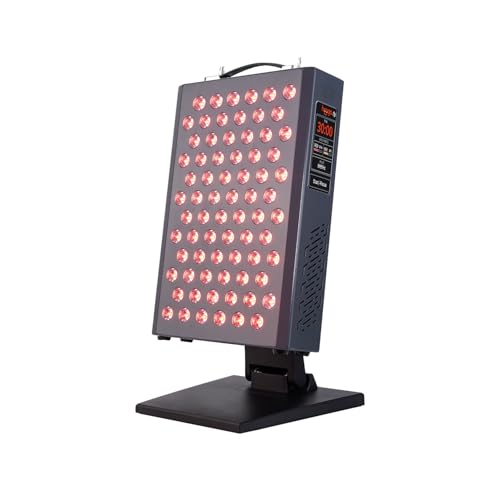
With 72 quad-chip LEDs and four wavelengths—630nm, 660nm, 810nm and 850nm—Hooga ULTRA360 Panel has the broadest wavelength range among these choices. A touchscreen controls brightness, session timing, wavelength settings and light modes; a remote is also included. This panel suits someone who wants multiple wavelength options and more control over a session. Those added choices can be unnecessary if a simple 660nm-and-850nm setup is enough.
Bottom line: Choose this when four wavelengths and adjustable modes are the deciding features.
How to choose a red light therapy device
Choose first by form factor and control needs, not by LED count alone. A bulb, compact tabletop panel and larger panel require different placement and cover different areas at a time. Wavelength numbers identify emitted light bands; these five choices use red light around 630–660nm and near-infrared light around 810–850nm. More wavelengths add options, but do not by themselves prove stronger output or a particular outcome. Compare irradiance only when a figure includes a distance, since intensity changes as the device moves farther away. If you need separate red and near-infrared operation, select a model that explicitly provides those controls rather than assuming dual-chip LEDs can be switched independently.
Panel, bulb and wavelength differences
A panel is generally the more direct format for aiming light at an area, while a bulb requires a compatible base and a setup that positions it appropriately. Red light is visible; near-infrared light is not readily visible, so brightness to the eye is not a reliable guide to its presence. Use this feature map to narrow the format and controls before deciding:
| Need | Feature to prioritize | Options here |
|---|---|---|
| Compact targeted setup | Small panel format | Hooga HG300 Panel or Hooga HG200 Panel |
| Separate wavelength selection | Independent red/NIR controls | Hooga PRO300 Panel |
| Bulb arrangement | Bulb with base and cord | Hooga HG24 Bulb |
| More wavelength choices | Four wavelength bands | Hooga ULTRA360 Panel |
Distance, session setup and eye safety
Distance is a key setup variable: irradiance falls as a light source moves farther away, so compare output claims only at the distance specified. The HG300 figure is tied to 6 inches; it should not be treated as an output value at another distance. A timer can help keep sessions consistent, but a timer does not establish an appropriate duration for every person or purpose. Avoid staring directly into bright LEDs, and take particular care around near-infrared sources because that light can be difficult to see. Check the device’s safety guidance for eye protection, placement and session limits before use, especially if you have an eye condition or take medication that increases light sensitivity.
What LED count and output can tell you
LED count is a component count, not a stand-alone measure of the light reaching skin. Chip design, drive power, optics, distance and the area being illuminated all affect practical output and coverage. A dual-chip LED here emits two wavelengths, while a quad-chip LED emits four; that describes wavelength capability, not proof of better results. For a fair comparison, look for irradiance in mW/cm² at a distance and compare like distances and measurement conditions. When a maker gives no comparable output figure, use format, controls and wavelengths as the decision criteria instead of ranking the device by LED count.
Frequently Asked Questions
What do 660nm and 850nm mean on a panel?
The numbers identify the light wavelengths in nanometers: 660nm is red light and 850nm is near-infrared light. Near-infrared is not readily visible, so visible brightness alone cannot show whether it is being emitted.
Does a higher LED count mean stronger light?
No; LED count alone does not determine irradiance at the target. Compare mW/cm² figures only when they are given at the same distance, since moving a light farther away reduces the intensity reaching the area.
How far away should a red light panel be used?
Use the distance specified for the device’s output claim; the HG300’s irradiance figure is measured at 6 inches. Output at a different distance cannot be assumed to match that figure, so verify the intended placement and session guidance for the chosen device.
Can near-infrared light be seen during use?
Near-infrared light is not readily visible to the eye, unlike red light. Do not use apparent brightness as a safety check or stare into LEDs; consult the device’s eye-protection guidance before a session.
Can red and near-infrared settings be used separately?
Only when the device has controls that allow separate selection. Among these models, Hooga PRO300 Panel has independent red and near-infrared controls, while Hooga HG200 Panel offers red, near-infrared or both.