
Light With Timer for Chicken Coop: 4 Options Compared

For a light with a timer for a chicken coop, Programmable Coop LED Light suits most owners who want programmable timing, dimming, and gradual sunrise or sunset transitions in one system. Choose a solar option if you need off-grid power, or an app-controlled wired fixture if phone scheduling matters more.
Coop lights add artificial light to the natural day; for laying hens, a consistent schedule matters more than maximum brightness.
We earn a commission if you buy through links on this page. As an Amazon Associate I earn from qualifying purchases. Products are compared on manufacturer specifications, not hands-on testing.
- Best overall: Programmable Coop LED Light – LCD scheduling, 10 brightness levels, and selectable gradual transitions cover several lighting needs.
- Best for remote solar control: Ajerg Solar Coop Light – Solar charging, a remote, timer settings, and a dusk-to-dawn sensor are combined.
- Best for off-grid flexibility: Solar Three-Color Coop Pendant – Solar charging is paired with USB charging and three light-color modes.
- Best for app scheduling: App-Controlled Wired Pendant – The wired pendant uses app controls for brightness, modes, and schedules.
| Product | Best for | Power | Timer controls | Dimming | Shop |
|---|---|---|---|---|---|
| Programmable Coop LED Light | Custom daily schedules | — | LCD custom times; 2, 4, or 8 hours | 10 levels, 10%–100% | Check Price on Amazon |
| Ajerg Solar Coop Light | Remote solar operation | Solar | Remote: 3, 5, or 8 hours; dusk-to-dawn sensor | Adjustable brightness | Check Price on Amazon |
| Solar Three-Color Coop Pendant | Solar with USB backup | Solar and USB | Timer function | 4 brightness levels | Check Price on Amazon |
| App-Controlled Wired Pendant | Phone-based scheduling | Wired | App schedules; sunrise/sunset mode | Dimmable | Check Price on Amazon |
Chicken Coop Lights With Timers
Compare power and scheduling controls first, then choose the lighting setup that fits your coop and daily routine.
Programmable Coop LED Light
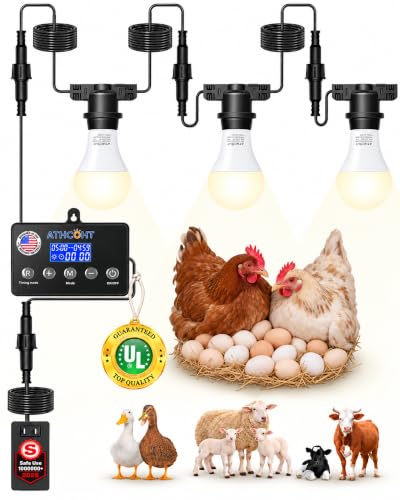
Programmable timing and gradual transitions distinguish this coop LED from the solar and app-controlled choices. The LCD controller offers custom start and stop times or 2-, 4-, and 8-hour timers, while brightness adjusts across 10 levels from 10% to 100%. Four sunrise and sunset modes include instant changes and 15-, 30-, or 60-minute fades. The maker says the light is intended to extend perceived daylight and support winter laying. Choose it for a recurring schedule with adjustable brightness; the controller weather rating does not establish that every part of the fixture is suitable for wet exposure, so check the light’s placement requirements.
Bottom line: Pick this when recurring LCD schedules and gradual light transitions matter most.
Ajerg Solar Coop Light

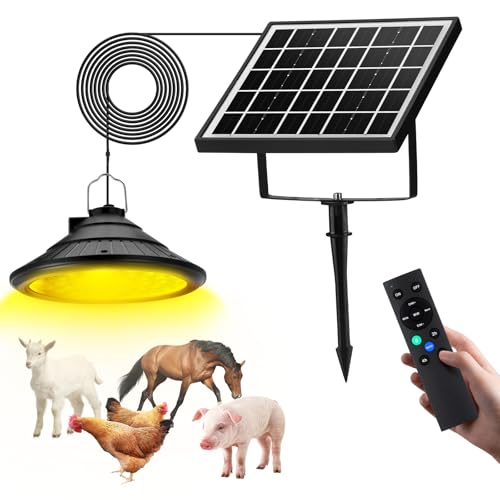
Remote operation and an automatic dusk-to-dawn sensor set this solar light apart from timer systems centered on a local controller or phone app. It has 200 LED beads and a 5V, 6W solar panel; the maker says its light can cover up to 650 square feet. The remote adjusts brightness, sets 3-, 5-, or 8-hour timers, and checks battery level. This option suits owners who want to adjust settings without entering the coop. Solar charging depends on panel exposure and available sun, so a shaded or cloudy location may make it a poor fit if dependable light at a fixed time is essential.
Bottom line: Choose this for remote adjustments and sensor-based solar operation.
Solar Three-Color Coop Pendant
USB charging is the distinguishing fallback on this solar pendant, alongside a three-color light and four brightness levels. Its hardware includes a 5W solar panel and a 4,500mAh battery. The maker says it can provide 48 hours of illumination after six hours of sunlight at 10% brightness; actual solar availability will affect charging. The three modes combine white and warm white, use white, or use warm white. Choose it if color options and charging flexibility are more important than app-based control. Its 10% runtime claim is tied to low brightness, so do not assume the same duration at brighter settings.
Bottom line: Pick this for a solar pendant with USB charging and multiple light colors.
App-Controlled Wired Pendant

Phone-based scheduling separates this wired pendant from the solar options and the LCD-controlled light. Its app adjusts brightness, changes lighting modes, and sets schedules; the maker says its sunrise and sunset mode can automate on and off times. The pendant has two light branches and warm-white 3000K lighting, with a memory function for preferred settings. It suits owners who want to manage a wired fixture from an app. Unlike the solar lights, it needs a suitable electrical connection, so confirm the mounting location and power arrangement before choosing it for a coop.
Bottom line: Choose this when app scheduling and a wired two-branch fixture suit your setup.
How to Choose a Chicken Coop Light With a Timer
Choose the power source and schedule before comparing brightness controls. Laying hens are commonly managed with a total photoperiod of about 14 to 16 hours daily; extending beyond 16 hours is generally avoided, and birds still need a dark rest period. A timer helps keep the schedule consistent instead of relying on someone to switch the light manually.
Solar systems avoid a direct electrical connection at the fixture, but panel shade, cloudy weather, and short winter days can limit charging. Wired fixtures can support fixed schedules but need a suitable power connection. If you want phone control, favor an app-based setup; if you want a local control, an LCD timer or remote may be simpler. Keep brightness moderate and observe whether light reaches feeder and water areas evenly.
Set a Daily Light Schedule for Laying Hens
Keep the total day length steady and include a dark period every day. A common target for laying flocks is 14 to 16 hours of total light, counting natural daylight; adding artificial light before dawn or after dusk can help reach that window. Increase the photoperiod gradually rather than making a sudden large change, and use the timer to preserve the same start and stop times.
Use this decision rule: if natural daylight already provides 14 hours, add no more than the hours needed to reach your chosen schedule, and do not extend the total past 16 hours. Gradual transitions can reduce abrupt changes at lights-on and lights-off, while an instant setting may work for a simple fixed schedule. Avoid leaving a coop light on overnight; a daily dark interval supports normal rest.
Compare Timer and Power Types
Timer style determines how much control you have over repeated schedules. Short duration timers are straightforward, while custom clocks or app schedules can align a light with a regular daily routine. Solar lights also depend on charging conditions, unlike wired options.
Use this table to match the setup to your priority.
| Need | Useful setup | Trade-off |
|---|---|---|
| Regular custom times | LCD or app schedule | Requires setting and maintaining a schedule |
| Off-grid placement | Solar light | Sun exposure affects charging |
| Remote adjustment | Remote or app control | Requires keeping the control method usable |
| Low-light transitions | Gradual fade mode | Not every timer offers fades |
For solar placement, position the panel where it receives as much unobstructed daylight as the site allows. If the coop is shaded or winter cloud cover is common, choose a setup with another charging method or a wired power source.
Install Coop Lighting With Moisture and Fire Safety in Mind
Keep electrical fixtures, connectors, and cords away from water, bedding, and birds that may peck or scratch. Poultry-house dust and damp air can collect around equipment, so use fixtures and connections rated for their actual exposure rather than assuming a timer’s weather rating applies to the entire light. Secure cords out of reach and prevent them from crossing walkways or being buried in litter.
Mount lights so they illuminate the coop without creating hot spots close to combustible bedding. Turn the power off before adjusting or cleaning wired equipment, and inspect cords and connections for damage or corrosion. Solar fixtures still need secure mounting and protection from pecking. Keep a consistent dark period: constant overnight illumination is not a substitute for a timed laying schedule.
Frequently Asked Questions
How many hours should a chicken coop light run?
A laying flock is commonly managed for about 14 to 16 total hours of light per day, including daylight. Use the timer only to fill the gap between natural daylight and that target, and preserve a dark interval.
Should coop lights turn on before sunrise?
Turning lights on before sunrise is one way to extend the day, provided the total reaches no more than about 14 to 16 hours. A consistent start time matters more than whether the added light is in the morning or evening.
Do solar coop lights work in winter?
Solar lights can work in winter when the panel receives enough sunlight to recharge. Short days, shade, and cloudy weather reduce available charging, so choose another charging option if the light must run on a fixed schedule.
Is a gradual sunrise setting useful for chickens?
A gradual fade can avoid a sudden switch from darkness to full brightness. If the light does not offer a fade, keep its schedule consistent and provide a daily dark period rather than leaving it on overnight.
Where should a chicken coop light be mounted?
Mount the fixture securely above birds and away from bedding, water, and reachable cords. In a dusty or damp coop, verify that the fixture and its electrical connections are rated for the exposure at the mounting location.