
Door Vents for Interior Doors: 4 Models Compared

INTERNAL VENTS 17.7 x 3.6-Inch Door Vent is the closest match for most interior doors because it specifies the cutout, accepts doors from 1 to 1.75 inches thick, and includes a cutting template. Choose another model if you need an oversized grille or have an existing opening that does not match.
A door vent is a grille that lets air pass between rooms while the door is closed; confirm the opening and door thickness before cutting.
We earn a commission if you buy through links on this page. As an Amazon Associate I earn from qualifying purchases. Products are compared on manufacturer specifications, not hands-on testing.
- Best overall: INTERNAL VENTS 17.7 x 3.6-Inch Door Vent – Defines a 17-by-3.125-inch cutout, door thickness range, template, and three screw lengths.
- Best for humid rooms: Steinberg14 17.7 x 3.6-Inch Door Vent – Plastic grille is specified for humid rooms and suits doors at least 1.06 inches thick.
| Product | Best for | Outer size | Cutout or insert size | Material | Shop |
|---|---|---|---|---|---|
| INTERNAL VENTS 17.7 x 3.6-Inch Door Vent | Precise cutout fit | 17.7 x 3.6 in | 17 x 3.125 in | — | Check Price on Amazon |
| Steinberg14 17.7 x 3.6-Inch Door Vent | Humid room use | 17.7 x 3.6 in | 17 x 3.1 in | Plastic | Check Price on Amazon |
| ABOUT VENT 18 x 4-Inch Plastic Door Vent | Furniture openings | 17.7 x 3.6 in | — | Plastic | Check Price on Amazon |
| Repa Market 17.7 x 3.6-Inch Plastic Door Grille | Screw-in replacement | 17.72 x 3.62 in | 16.93 x 2.99 in | Plastic | Check Price on Amazon |
Door vents for interior doors
Match the grille’s opening dimensions and door thickness before choosing the material or louver style.
INTERNAL VENTS 17.7 x 3.6-Inch Door Vent

INTERNAL VENTS 17.7 x 3.6-Inch Door Vent makes the opening size and door thickness explicit, which is useful when replacing a grille or planning a new cut. The frame measures 17.7 by 3.6 inches and covers a 17-by-3.125-inch cutout; it fits doors from 1 to 1.75 inches thick. The package includes a full-size template and screws in 25, 35, and 45 mm lengths.
The manufacturer says the two-sided louvers allow air movement between rooms with the door closed. This is the most suitable choice when the measured opening matches; it is not intended for floor, wall, or HVAC register use.
Bottom line: Choose this when its cutout dimensions and door-thickness range match your door.
Steinberg14 17.7 x 3.6-Inch Door Vent

Steinberg14 17.7 x 3.6-Inch Door Vent distinguishes itself with a 0.161-square-foot air passage and a plastic grille intended for humid rooms such as bathrooms, kitchens, and toilets. The outer grille is 17.7 by 3.6 inches, with a 17-by-3.1-inch required cutout, and it is intended for doors at least 1.06 inches thick.
The maker says the grille permits airflow between rooms and is suitable for wooden, plastic, and metal doors.
Bottom line: Pick this for a matching narrow cutout and a plastic grille in a humid room.
ABOUT VENT 18 x 4-Inch Plastic Door Vent
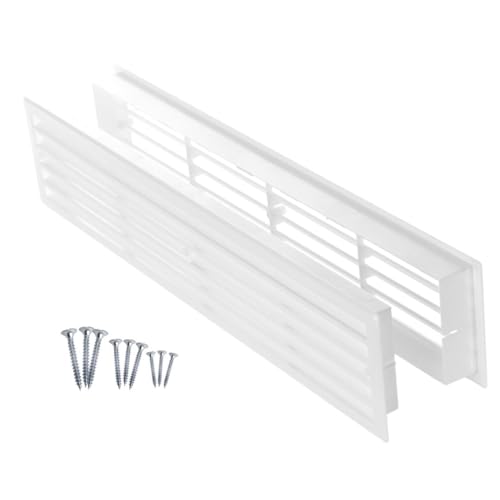
ABOUT VENT 18 x 4-Inch Plastic Door Vent is aimed at both doors and furniture, including cabinets and wardrobes, and the maker gives a minimum material thickness of 1.06 inches. Its white, two-sided plastic grille measures about 17.7 by 3.6 inches; the manufacturer also gives an air passage of 0.161 square feet.
The broad application range may suit someone fitting a grille into a furniture panel as well as an interior door. Measure the panel and verify fit before making a new cut.
Bottom line: Choose this for a door or furniture panel at least 1.06 inches thick when its cutout fit is confirmed.
Repa Market 17.7 x 3.6-Inch Plastic Door Grille

Repa Market 17.7 x 3.6-Inch Plastic Door Grille gives an insert size as well as its outer dimensions, helping distinguish the portion that enters the opening from the frame that remains visible. The white plastic grille measures 17.72 by 3.62 inches externally; the insert is 16.93 by 2.99 inches and 1.06 inches deep. It includes screws for installation in pre-drilled holes.
The maker says the grille has two-sided protection while allowing airflow, and gives a temperature range of 0 to 90°C. This is useful when those insert dimensions suit the existing opening, but the maker does not give a door-thickness range; verify the panel and fastening arrangement before purchase.
Bottom line: Pick this when the insert dimensions and screw mounting suit the existing opening.
How to measure an interior door vent
Measure the cutout, not just the grille frame, before selecting a replacement. Remove the old vent if possible and record the opening’s width and height; a frame can overlap the opening, so its outside dimensions do not tell you what size hole it needs. For a new opening, check the door’s thickness and the available clearance on both faces before cutting.
Use a tape measure and compare each measurement to the vent’s required cutout or insert size. A difference of even a fraction of an inch can leave the grille unsupported or prevent it from fitting. For example, the narrow models here have frames around 17.7 by 3.6 inches, while the large aluminum option has an inner opening near 19.7 by 11.8 inches. Do not treat those formats as interchangeable.
Door thickness and cutout fit
Door thickness determines whether a two-piece grille can join properly through the panel. Measure the door at the opening rather than relying on a standard-size assumption: interior slabs commonly run about 1⅜ inches thick, while some doors are 1¾ inches. A vent designed for a specific range may not clamp or align on a thinner or thicker slab.
Use the cutout or insert measurement for the hole and the outside frame measurement for coverage. For a new opening, the INTERNAL VENTS model supplies a full-size template and recommends drilling corner holes with a ⅜-inch bit before using a jigsaw. Cut cautiously and keep the kerf within the template line; a too-large opening cannot be corrected by a trim frame that does not cover it.
Plastic and aluminum door grilles compared
Plastic grilles are common for narrow interior-door openings because they are light and often supplied as two halves that meet through the door. Aluminum grilles can cover much larger openings and offer a rigid metal frame, but their dimensions and depth may call for a different installation. Material alone does not establish airflow capacity; compare the opening area and louver design when air movement is the priority.
Use this guide to narrow the format by panel and opening size.
| Vent format | Typical use | Measure first |
|---|---|---|
| Narrow plastic grille | Interior door or furniture panel | Cutout width, height, and thickness |
| Large aluminum grille | Large door or cabinet panel | Inner opening and frame clearance |
Do not substitute a wall or floor register simply because its outer size looks similar. Grilles made for different mounting surfaces may not provide the correct two-sided connection or edge coverage for a door slab.
Safe cutting and installation
Check for glass inserts, wiring, reinforcement, and hardware before cutting a door. Keep hands clear of the jigsaw path, support the panel, and wear eye protection; a door removed from its hinges is easier to support securely. A template helps place the cut, but it does not confirm the door is free of obstructions.
Air-transfer grilles can change pressure balance and reduce drafts that make a door move, but they are not automatically suitable where fire or smoke separation is required. Do not cut a rated fire door or alter a required fire barrier unless the door and applicable building rules permit it. For a standard interior slab, align both grille halves, use appropriate fasteners, and check that no screw point protrudes into the room or catches nearby items.
Frequently Asked Questions
What size hole does an interior door vent need?
The required hole depends on the vent, so match the cutout measurement rather than the frame. A common narrow format uses an opening around 17 by 3⅛ inches, while large grilles may need openings near 20 by 12 inches.
How thick should a door be for a vent grille?
Many interior doors are about 1⅜ inches thick, but vent designs have their own limits. Measure the slab at the opening; a grille specified for 1 to 1¾ inches is not a safe assumption for a thinner panel.
Can I install a door vent without removing the door?
A replacement grille may be fitted with the door in place if its cutout already exists and both faces are accessible. For a new cut, removing and supporting the door makes it easier to control a jigsaw and keep the panel stable.
Do louvered door vents block sound?
Open louvers allow sound to pass along with air, so they are not soundproof. If privacy is important, avoid placing a direct air-transfer grille between rooms where speech confidentiality matters.
Can a door vent go in a fire-rated door?
Do not cut or modify a fire-rated door unless the door’s approved configuration and local requirements allow it. A grille opening can compromise the intended fire and smoke barrier, so verify requirements before altering a rated assembly.