
Allen and Roth Blinds: Fit and Style Compared

The allen + roth Trim at Home blind is the direct match, with an 8.5-inch actual width and a 72-inch height for a very narrow opening. If you need a wider blind or a different style, consider the faux wood, roller, mini, or cellular alternatives instead.
We earn a commission if you buy through links on this page. As an Amazon Associate I earn from qualifying purchases. Products are compared on manufacturer specifications, not hands-on testing.
- Best overall: allen + roth Trim at Home 2-in Blind – It is the only allen + roth option and measures 8.5 inches wide by 72 inches high.
- Best for faux wood: Lotus & Windoware 2-in Embossed Faux Wood – Its embossed faux-wood slats are 33.5 inches wide for a 34-inch inside-mount opening.
- Best for blackout: SUNOFF Cordless Blackout Roller Shade – The roller shade uses blackout fabric and measures 24 by 72 inches.
| Product | Best for | Style and material | Light control | Actual width × height | Shop |
|---|---|---|---|---|---|
| allen + roth Trim at Home 2-in Blind | Narrow openings | 2-inch slats; engineered wood | Room darkening | 8.5 × 72 in | Check Price on Amazon |
| Lotus & Windoware 2-in Embossed Faux Wood | Faux-wood slats | 2-inch embossed faux wood | Cordless light control | 33.5 × 60 in | Check Price on Amazon |
| SUNOFF Cordless Blackout Roller Shade | Blackout fabric | Roller shade; fabric | Blackout | 24 × 72 in | Check Price on Amazon |
| Achim Cordless Light-Filtering Mini Blind | Light-filtering | 1-inch vinyl slats | Light filtering | 28.5 × 64 in | Check Price on Amazon |
| BlindsAvenue Cordless Cellular Shade | Cellular construction | Cellular shade | Light filtering | 27 × 72 in | Check Price on Amazon |
Allen and Roth Blinds and Alternatives
Compare the direct brand match with related blind styles by construction, light control, and actual dimensions.
allen + roth Trim at Home 2-in Blind

The allen + roth Trim at Home blind is the only option here from the searched brand, and its 8.5-inch actual width makes it suited to an unusually narrow window. It has 2-inch slats, a cordless design, and an outside-mount configuration; the product name identifies it as room darkening. Engineered wood is the material. The width is the deciding limitation: measure the coverage area before choosing it, because this is not a typical wide-window blind.
Bottom line: Choose this if you need an allen + roth blind and its 8.5-inch width fits your opening.
Lotus & Windoware 2-in Embossed Faux Wood

The Lotus & Windoware blind offers a wider faux-wood alternative, with a 33.5-inch actual width intended for a 34-inch inside-mount opening. Its 60-inch height suits a different window proportion than the 72-inch allen + roth option. Buyers seeking the named brand should note that this is a different brand; buyers focused on a 34-inch opening should verify the opening width at the top, middle, and bottom and use the narrowest measurement.
Bottom line: Pick this for a 34-inch inside-mount opening and embossed faux-wood slats.
SUNOFF Cordless Blackout Roller Shade

The SUNOFF shade changes the format from slatted blind to a continuous roller fabric, making it the option for buyers prioritizing blackout coverage. It measures 24 inches wide by 72 inches high and has a cordless free-stop system for positioning at different heights. The maker says the fabric is 100% blackout and has a thermal-insulation coating. This is not the allen + roth brand or a faux-wood blind, and its fixed 24-inch width makes careful measurement important before selecting it.
Bottom line: Choose this when blackout fabric matters more than slatted construction.
Achim Cordless Light-Filtering Mini Blind
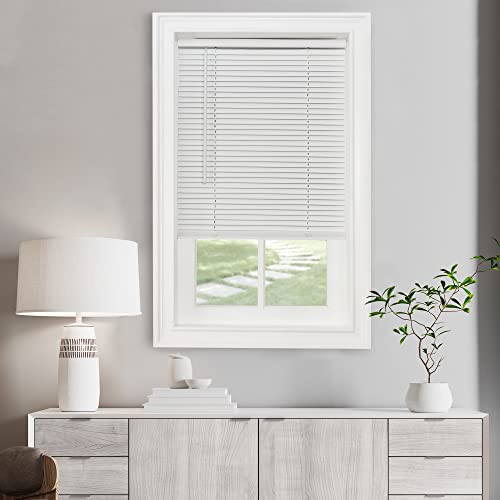
The Achim mini blind uses 1-inch vinyl slats, a narrower slat format than the 2-inch options, and filters light rather than providing the named allen + roth blind’s room-darkening style. Its actual width is 28.5 inches, while the product is sized as 29 inches; it is 64 inches high. Hidden brackets support inside, outside, or ceiling installation. The fit allowance is specific to this blind, so compare its actual width with your window rather than assuming the nominal 29-inch size is its finished width.
Bottom line: Pick this for 1-inch vinyl slats and light-filtering in a 29-inch nominal size.
BlindsAvenue Cordless Cellular Shade

The BlindsAvenue shade is the only cellular option in this group, with a honeycomb construction rather than slats or a roller panel. It is 27 inches wide by 72 inches high and uses cordless pull-down control. For inside mounting, the maker specifies a 27¼- to 27½-inch opening for this shade; for outside mounting, order the width of the area to cover. Buyers wanting an allen + roth slatted blind should choose another style, while this option suits those seeking a cellular shade at these dimensions.
Bottom line: Choose this for a 27-inch cellular shade and the specified inside-fit range.
How to Choose Blinds by Light Control and Style
Start with the light control and construction you want, then check the actual dimensions. Slatted blinds let you tilt slats to adjust light and privacy; roller shades cover the window with one fabric panel, while cellular shades use folded honeycomb cells. Room-darkening and blackout are not interchangeable terms: room-darkening reduces incoming light, while blackout fabric is intended to block it. Light-filtering styles soften daylight rather than making a room dark. For a bedroom where darkness is the priority, look for a blackout designation; if adjustable daylight matters more, a slatted or light-filtering style may be a better fit.
| Need | Style to consider |
|---|---|
| Tilting light control | Slatted blind |
| Continuous fabric coverage | Roller shade |
| Honeycomb shade construction | Cellular shade |
Slat width also changes the visual look: 1-inch slats create a finer pattern than 2-inch slats.
How to Measure for an Inside or Outside Mount
Measure the window before selecting a size; the nominal width may not equal the finished blind width. For an inside mount, measure the opening at the top, middle, and bottom, then use the narrowest width because frames can be uneven. Many inside-mount blinds need clearance, and the maker’s deduction varies by product, so compare the actual width and stated fit range rather than applying one rule to every blind. For outside mounting, measure the area you want covered, including enough overlap to reduce light gaps. Check both width and height, and make sure handles, trim, or other obstructions will not interfere with operation.
A measurable decision rule: if the opening is narrower than the product’s specified inside-fit range, do not assume the blind can be trimmed; choose a size or mount method that matches the maker’s fit guidance.
What Cordless Blind Safety Means
Cordless operation removes the looped lift cords that can create a strangulation hazard for young children. It does not make every part of installation or use risk-free: secure mounting matters, and loose hardware or a falling blind can cause injury. Follow the hardware instructions for the wall or frame material, use the brackets, and check that the blind stays firmly attached when raised and lowered. Keep children away while installing, and do not let them climb on a sill or pull on the shade. When a blind is installed near a bed or play area, keep furniture positioned so it cannot be used to reach the window or mounting hardware.
Common Blind Sizing Mistakes
The most common sizing mistake is choosing by the size printed in a product name instead of its actual width. Some blinds are deliberately narrower than the ordered width for inside mounting, while other cellular shades specify a narrow opening range. A second mistake is measuring only one point on an older window: frames may be out of square, so compare top, middle, and bottom widths. Also distinguish a shade’s height from the window opening height; a longer shade can extend beyond a sill, but a shorter one may leave a gap. Before ordering, confirm the width, height, mounting method, and whether the product gives its actual or nominal width.
Frequently Asked Questions
How much narrower should an inside-mount blind be?
A common allowance is about ¼ inch on each side, but the required deduction varies by blind. Use the product’s actual width and stated fit range, and measure the opening at three points.
Can blinds be mounted outside the window frame?
Many blinds support outside mounting, but not every model does. Measure the full area you want covered and check that the brackets and blind will clear nearby trim or handles.
Are cordless blinds safe around children?
Cordless designs avoid the looped lift cords associated with strangulation hazards. Secure installation is still essential, and children should not climb on windowsills or pull on the blind.
What is the difference between blackout and room-darkening blinds?
Blackout fabric is intended to block light, while room-darkening blinds reduce it without promising complete darkness. Edge gaps and the mount type can affect how much light enters around a window covering.
How do I measure an uneven window opening?
Measure width at the top, middle, and bottom, and use the narrowest measurement for an inside mount. Measure height from the top mounting point to the sill at more than one spot if the frame is uneven.