
Deep Pour Epoxy: 4 Kits Compared by Pour Depth

For a deep pour of up to 4 inches, Superclear Deep Pour Epoxy, 3 Gallon is a strong fit because its single-pour range covers that depth and its kit holds 3 gallons. Choose a different kit if you need a smaller quantity or want the included mixer named by unuaST Deep Pour Epoxy, 3.3 Gallon; the available product facts do not establish which option costs least.
We earn a commission if you buy through links on this page. As an Amazon Associate I earn from qualifying purchases. Products are compared on manufacturer specifications, not hands-on testing.
- Best overall: Superclear Deep Pour Epoxy, 3 Gallon – The 3-gallon kit supports stated single pours of 2–4 inches.
- Best for included mixing tool: unuaST Deep Pour Epoxy, 3.3 Gallon – Its name specifies a 3.3-gallon kit that includes a mixer.
- Best for smaller projects: LET’S RESIN Deep Pour Epoxy, 1.5 Gallon – The 1.5-gallon kit supports stated 2–4-inch pours.
| Product | Best for | Kit capacity | Single-pour depth | Mix ratio | Shop |
|---|---|---|---|---|---|
| Superclear Deep Pour Epoxy, 3 Gallon | Large castings | 3 gallons | 2–4 in | — | Check Price on Amazon |
| KISREL Deep Pour Epoxy, 3 Gallon | Hard cured surfaces | 3 gallons | Up to 4 in | 2:1 | Check Price on Amazon |
| unuaST Deep Pour Epoxy, 3.3 Gallon | Larger batch pours | 3.3 gallons | 2–4 in | 2:1 | Check Price on Amazon |
| LET’S RESIN Deep Pour Epoxy, 1.5 Gallon | Smaller castings | 1.5 gallons | 2–4 in | 2:1 | Check Price on Amazon |
Deep Pour Epoxy Kits
Compare the kit sizes, pour depths and mixing ratios that distinguish these casting resins.
Superclear Deep Pour Epoxy, 3 Gallon

Superclear pairs a 3-gallon kit with a 2–4-inch single-pour range, making it a fit for larger river tables, live-edge wood and molds. The maker says its low-viscosity resin releases trapped air during curing and describes the cured surface as hard and scratch-resistant for functional tops. It also says the formula is zero-VOC and safe for food contact after full cure. The main limitation is the larger kit size: a smaller casting project may not need this much resin. The food-contact claim applies only after the resin has fully cured.
Bottom line: Choose this for a large casting that needs a 2–4-inch pour and a 3-gallon kit.
KISREL Deep Pour Epoxy, 3 Gallon

KISREL specifies a 2:1 resin-to-hardener ratio and a single pour up to 4 inches, setting it apart for buyers who want a defined mixing ratio alongside a large kit. The 3-gallon package contains 2 gallons of resin and 1 gallon of curing agent. The maker claims a hardness index over 85D, UV protection and resistance to yellowing, and says the low-viscosity formula releases bubbles quickly. Those performance statements come from the maker; the facts do not provide a cure time. Measure the two components in the correct ratio before mixing, since an incorrect ratio can interfere with curing.
Bottom line: Pick this when the specified 2:1 ratio and 3-gallon capacity suit your casting plan.
unuaST Deep Pour Epoxy, 3.3 Gallon

At 3.3 gallons, unuaST provides the largest kit capacity here, and its product name says a mixer is included. The maker says the resin supports a single 2–4-inch pour and describes the result as clear and self-leveling. Its directions call for mixing Part A and Part B thoroughly until no strings remain. That mixing step matters: unmixed streaks can leave uncured areas. This kit is a less suitable fit when you need a precisely documented working or cure time.
Bottom line: Choose this for the largest batch and a kit that names an included mixer.
LET’S RESIN Deep Pour Epoxy, 1.5 Gallon
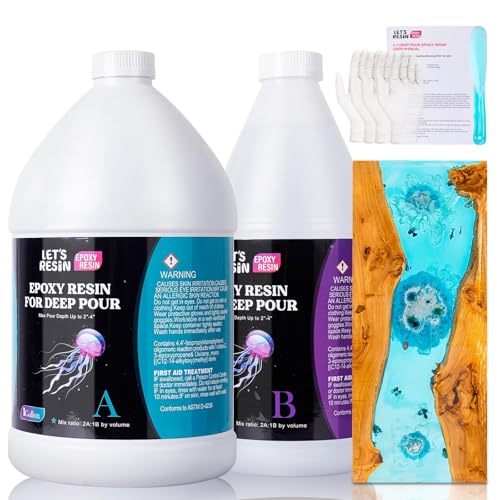
The maker describes the resin as low-odor, low-viscosity and UV resistant, and identifies flower preservation, molds and smaller river-table projects as uses. The mass cap is a separate constraint from depth, so a wide mold could reach 10 kilograms before reaching 4 inches. Plan the pour around both limits. The smaller capacity can suit a compact project, but may require more than one kit for a larger casting.
Bottom line: Pick this when 1.5 gallons is a better project quantity and the single-pour mass cap works.
How to Choose Deep Pour Epoxy
Start with the deepest single pour your project needs, then compare kit capacity and mixing ratio. These kits specify maximum depths from 2 to 4 inches, but a maximum is not a target for every mold: the pour’s footprint and resin volume also affect how much material is involved. Two-part epoxy cures through a chemical reaction that produces heat, and a larger or deeper mass can retain more heat than a thin coating. Follow the selected resin’s pour limit rather than assuming all deep pour products behave alike. For a mold under 4 inches deep, a resin rated up to 4 inches may cover the depth, but still check the maker’s maximum batch mass and mixing requirements before committing to the full pour.
Mixing Ratios and Preparation
Measure each component using the ratio and measurement basis provided for the exact resin; a 2:1 ratio means two parts resin to one part hardener only when the maker’s instructions define those parts on that basis. Mix thoroughly, scraping the container sides and bottom, because unmixed material can remain soft or tacky. For large batches, divide the measured material among clean containers only if the maker’s directions allow it. Set the mold level and seal seams before pouring; leaks are difficult to stop after resin escapes. Wear chemical-resistant gloves and eye protection, protect the work surface, and provide ventilation. Do not use an open flame around resin or its vapors.
Pour Depth, Heat and Curing
Respect the resin’s lift depth: the kits here specify single pours up to 4 inches, while one also names a 10-kilogram single-pour cap. Epoxy curing gives off heat, and deep or oversized batches can become hotter than a thin surface coating; excess heat can cause defects or damage nearby materials. Keep the room and materials within the resin maker’s temperature range, and avoid adding more resin than the instructions permit. A torch may help release surface bubbles on some projects, but applying flame to a deep mass is unsafe. Allow the casting to cure undisturbed for the full period specified for that product before sanding, handling or food contact.
Common Deep Pour Mistakes
The most common avoidable problems are exceeding the pour limit, measuring inaccurately, mixing incompletely and pouring into an unsealed or unlevel mold. A large casting also needs enough resin for its volume: estimate the mold’s dimensions before opening the kit, and leave room for waste and surface leveling. Avoid using a coating resin as a substitute for a casting resin; thin-coat products are designed for different layer thicknesses and heat behavior. Keep children and pets out of the work area, and use gloves and eye protection while mixing and pouring. Food-contact claims are product-specific and apply only after full cure when the maker says so; do not assume every cured epoxy is suitable for direct food contact.
Frequently Asked Questions
How deep can deep pour epoxy be poured at once?
The four kits here state single-pour depths of 2–4 inches or up to 4 inches. Follow the exact resin’s depth and batch-mass limits, because a deep curing mass can retain heat.
Why does deep pour epoxy get hot while curing?
Epoxy curing is an exothermic chemical reaction, so the resin releases heat as it hardens. Large, deep batches can retain more heat than thin coats; stay within the manufacturer’s depth and batch limits.
Do I need to mix deep pour epoxy by weight?
Use the measurement method specified for the exact product rather than assuming weight or volume. For example, KISREL gives a 2:1 ratio and identifies 2 gallons of resin with 1 gallon of hardener.
Can I use a torch to remove bubbles from deep pour epoxy?
Do not bring an open flame near a deep resin mass or its vapors. Some makers allow brief surface bubble treatment, but use only the product’s method and keep ignition sources away.
How do I prevent leaks in a deep pour mold?
Seal the mold seams and test the setup before pouring; even a small opening can let resin escape. Level the mold as well, because an uneven base can leave the cured surface sloped.