
Stainless Steel Apple Presses Compared by Capacity and Drive

For most home cider makers, EJWOX 3.69-Gallon Fruit Wine Press is a practical starting point: its 3.69-gallon stainless steel basket and manual T-handle suit modest batches. Choose Mosakar 10.6-Gallon Hydraulic Fruit Press instead if you need a 10.6-gallon basket and hydraulic operation; a larger basket takes more space and calls for more fruit per batch.
An apple press squeezes juice from crushed fruit; crushing is a separate preparation step unless the press includes a grinder.
We earn a commission if you buy through links on this page. As an Amazon Associate I earn from qualifying purchases. Products are compared on manufacturer specifications, not hands-on testing.
- Best overall: EJWOX 3.69-Gallon Fruit Wine Press – The 3.69-gallon stainless steel basket and manual T-handle fit home batches.
- Best for larger batches: Mosakar 10.6-Gallon Hydraulic Fruit Press – Its 10.6-gallon basket and 5-ton hydraulic jack suit higher-volume pressing.
- Best for filter-bag pressing: VEVOR 3.69-Gallon Fruit Wine Press – It includes two food-grade filter bags and a swing-open crossbeam.
| Product | Best for | Capacity | Drive | Juice-contact material | Shop |
|---|---|---|---|---|---|
| EJWOX 3.69-Gallon Fruit Wine Press | Home batches | 3.69 gal | Manual T-handle screw | Stainless steel basket | Check Price on Amazon |
| Mosakar 10.6-Gallon Hydraulic Fruit Press | Large batches | 10.6 gal | Hydraulic jack, 5 tons | AISI 304 stainless steel | Check Price on Amazon |
| VEVOR 3.69-Gallon Fruit Wine Press | Filter-bag use | 3.69 gal | Manual spiral screw | Stainless steel fruit-contact parts | Check Price on Amazon |
Stainless Steel Apple Presses
Compare basket capacity, pressing mechanism and the materials that touch juice before choosing a batch size.
EJWOX 3.69-Gallon Fruit Wine Press
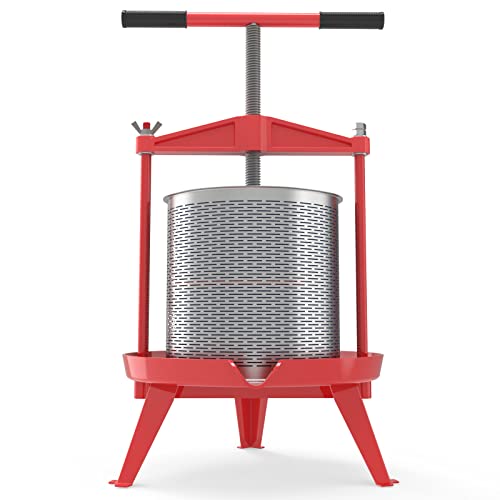
The EJWOX combines a stainless steel basket with a manual T-handle screw, making it a straightforward choice for home batches. Its basket holds 3.69 gallons, and the basket detaches from the plate for cleanup. The frame and stand are powder-coated. The maker says the large-diameter Acme screw creates high pressure with little effort; actual effort can vary with fruit preparation and how firmly it is packed. The press can handle fruit and other materials such as herbs or nut milk, but buyers seeking a hydraulic drive or substantially larger basket should consider a different option.
Bottom line: Choose this for a compact home setup with manual screw operation.
Mosakar 10.6-Gallon Hydraulic Fruit Press

The Mosakar stands apart with its 10.6-gallon capacity and hydraulic jack, which provides 5 tons of pressure. Its juice-contact parts—the pressing plate, basket and tray—are AISI 304 stainless steel. The juice-tray height adjusts for containers of different heights, and the beam turns 90 degrees to open the basket for loading. At 85 pounds, this is a substantial press to position and store, so it fits a dedicated orchard or cider-making workspace better than a small kitchen. Choose a smaller manual press if batches and available space are limited.
Bottom line: Pick this when a large batch and hydraulic pressing matter most.
VEVOR 3.69-Gallon Fruit Wine Press

The VEVOR includes two food-grade filter bags, a useful distinction for buyers who want to contain crushed fruit during pressing. Its 3.69-gallon capacity and manual spiral mechanism put it in the small-batch category. The cast-iron crossbeam swings open for loading, while the triangular base is designed for ground placement. The maker recommends pre-cutting fruit and placing it in a filter bag for better results. This press requires manual turning, so buyers looking for hydraulic operation or a larger batch capacity should choose another style.
Bottom line: Choose this if included filter bags suit your pressing routine.
How to Choose an Apple Press Capacity
Choose basket capacity around the amount of crushed fruit you can prepare and press in one batch. The capacities here range from 3.69 gallons to 10.6 gallons, so a larger press can reduce the number of batches but needs more fruit ready at once. A bushel of apples is commonly about 42 pounds, and juice yield varies with apple variety, ripeness, and how finely the fruit is milled; treat bushel counts as a planning estimate, not a guaranteed yield. Measure your storage and working area too: a press needs room for loading fruit, turning its handle or accessing its jack, and positioning a collection vessel. If you have less fruit than a full basket, smaller capacity is easier to manage.
Crushing Apples Before Pressing
Apples should be crushed or milled before pressing; whole apples do not release juice efficiently under a press plate. A typical small-scale workflow is to wash, sort out damaged fruit, cut large apples as needed, mill them into pulp, then press the pulp in manageable layers. A coarse pulp drains poorly, while an overly fine puree can clog drainage paths and slow pressing. Allow room in the basket for the pulp and filter material rather than packing fruit above the basket rim. A fruit crusher is a separate machine unless a press specifically includes one. Keep hands clear of the pressing plate and screw or jack whenever pressure is being applied.
Manual Screw and Hydraulic Presses Compared
Manual screw presses use a threaded spindle to move a plate downward; hydraulic presses use a jack to apply force. A screw press is mechanically simple and suitable when batches are smaller and the operator is comfortable turning the handle. Hydraulic force can suit larger baskets, but capacity alone does not determine juice yield: fruit preparation and drainage also matter. Check that the press sits on a firm, level surface before applying force, and use a vessel that fits beneath the juice outlet or tray. The comparison below maps common needs to the mechanism that can address them.
| Need | Press style | Trade-off |
|---|---|---|
| Smaller home batches | Manual screw | Requires turning the handle |
| Higher batch capacity | Hydraulic jack | Larger, heavier equipment |
Cleaning Stainless Steel Press Parts
Rinse juice-contact parts promptly after pressing, before dried pulp and sugar become harder to remove. Removable baskets and plates are easier to wash separately; clean filter bags according to their care directions and let them dry fully before storage. Stainless steel resists corrosion, but it is not a reason to leave acidic juice or wet pulp sitting on surfaces for long periods. Avoid abrasive tools that can scratch metal, and wipe the frame and threaded mechanism clean of juice and pulp. Inspect the screw, jack, and frame for visible damage before the next pressing session; never operate a press with a bent or unstable component.
Frequently Asked Questions
How many apples fit in a 3.69-gallon basket?
Basket volume does not convert to a fixed apple count because whole fruit and crushed pulp pack differently. A bushel of apples is commonly about 42 pounds, but milling, pulp texture, and basket loading affect how much fits.
What surface should an apple press sit on?
Use a firm, level surface that can support the press without rocking. Check stability before applying pressure, especially with a heavy hydraulic press.
How should I clean a stainless steel apple press?
Rinse juice-contact parts promptly after use so pulp and sugars do not dry onto them. Wash removable parts and filter bags separately, then dry them fully before storage.
Can an apple press grind whole apples?
A press squeezes juice; crushing is generally a separate step. Mill fruit before pressing, and cut large apples as needed for the grinder being used.