
Best 20-Inch Floor Fans for Airflow and Fit

iLIVING 20-Inch Heavy-Duty Fan suits most people who want a 20-inch floor fan because it combines a reported 5,750 CFM with three speeds and floor or wall mounting. Choose Amazon Basics 20-Inch High-Velocity Fan instead if you prefer a simpler floor-only setup, or PAMI Turbo 20-Inch Fan if a broad tilt range matters more than an airflow figure.
High-velocity floor fans move air around a space; they circulate air rather than lowering the room’s temperature.
We earn a commission if you buy through links on this page. As an Amazon Associate I earn from qualifying purchases. Products are compared on manufacturer specifications, not hands-on testing.
- Best overall: iLIVING 20-Inch Heavy-Duty Fan – The manufacturer reports 5,750 CFM, and the fan can be used on the floor or wall-mounted.
- Best for speed options: Tornado 20-Inch High-Velocity Fan – It gives airflow figures for all three speed settings: 3,800, 4,200 and 4,750 CFM.
- Best for broad tilt: PAMI Turbo 20-Inch Fan – Its head is adjustable through 300°, more than the tilt range of the other floor-only models.
| Product | Best for | Reported airflow | Tilt or mounting | Shop |
|---|---|---|---|---|
| iLIVING 20-Inch Heavy-Duty Fan | Large workspaces | 5,750 CFM | 360° tilt; floor or wall | Check Price on Amazon |
| Tornado 20-Inch High-Velocity Fan | Speed comparisons | 3,800–4,750 CFM | 120° tilt | Check Price on Amazon |
| Amazon Basics 20-Inch High-Velocity Fan | Simple floor setup | 3,542 CFM at high | Adjustable tilt | Check Price on Amazon |
| Simple Deluxe 20-Inch Metal Fan | Indoor workshops | 4,650 CFM | — | Check Price on Amazon |
| PAMI Turbo 20-Inch Fan | Wide tilt range | — | 300° tilt | Check Price on Amazon |
20-Inch Floor Fans Compared
Compare the reported airflow and adjustment options to match a fan to your room and how you plan to direct air.
iLIVING 20-Inch Heavy-Duty Fan

The iLIVING stands out for its reported 5,750 CFM and ability to mount on a wall as well as stand on the floor. The manufacturer reports 120 watts and describes a permanently lubricated motor, reinforced grilles and UL certification. Three speeds and a 360° tilt head let you direct airflow in different directions. This combination suits a garage or shop where floor space is limited. Its wall-mount option makes it less convenient if you want a floor-only fan with no installation step.
Bottom line: Choose this if you want the highest reported airflow here and the option to wall-mount.
Tornado 20-Inch High-Velocity Fan
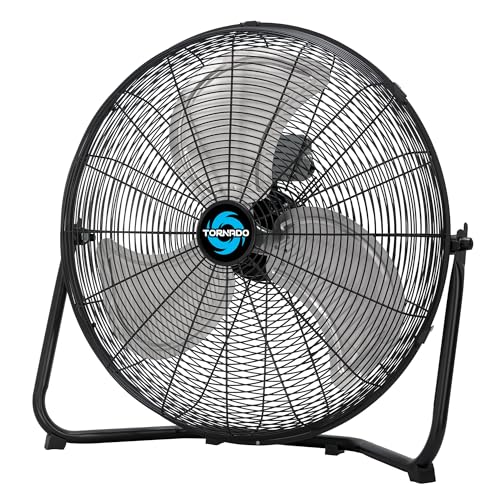
The Tornado is the only model here with a reported CFM figure for each speed: 3,800, 4,200 and 4,750. Its 120° adjustable head and 6-foot cord are useful when you want to aim airflow without moving the fan as often. The manufacturer describes aluminum blades, a powder-coated steel body and a rust-resistant grille. The three airflow figures make speed-by-speed comparison straightforward. Its maximum reported airflow is lower than the iLIVING’s, so consider another option if that figure is your main priority.
Bottom line: Choose this if you want airflow figures for each speed and a 120° tilt head.
Amazon Basics 20-Inch High-Velocity Fan

The Amazon Basics model keeps its controls simple: three speeds and an adjustable tilt head for directing airflow. The manufacturer reports 3,542 CFM at high speed and describes a metal housing with three aluminum blades. Its dimensions are 23.82 inches high, 23.43 inches long and 9.45 inches wide, which helps when planning a floor spot. This is a straightforward option for a garage or gym. The reported airflow is lower than the other models with CFM figures, so it may not suit buyers prioritizing the largest output.
Bottom line: Choose this for a basic floor fan with three speeds and adjustable tilt.
Simple Deluxe 20-Inch Metal Fan

The Simple Deluxe is distinguished by a reported 4,650 CFM and a permanently lubricated, three-speed motor. Its manufacturer describes an all-metal construction, aluminum blades and a reinforced wire grille, with indoor use specified. Those traits suit a workshop, basement or garage where an indoor fan is needed. The dimensions appear unusually small for a 20-inch fan, so confirm its actual footprint before choosing a spot.
Bottom line: Choose this for indoor use if its footprint and airflow suit your space.
PAMI Turbo 20-Inch Fan

The PAMI’s 300° adjustable tilt is its clearest distinction, allowing the head to angle through a broad range. It has three speed levels and a heavy-duty motor; the manufacturer also describes it as quiet. That makes it worth considering when directing air around a room matters more than comparing a CFM figure. The dimensions are 20 inches high, 20 inches wide and 5 inches long. Because no airflow figure is available for comparison, buyers prioritizing quantified output may prefer a model with a reported CFM.
Bottom line: Choose this when a broad adjustable tilt matters more than a CFM figure.
How to Choose a 20-Inch Floor Fan
Choose by airflow, direction control and where the fan can sit, not by blade diameter alone. CFM means cubic feet of air moved per minute; it is a useful comparison when figures use the same basis, but it does not tell you how evenly air reaches every part of a room. Three speeds let you trade stronger airflow for a gentler breeze. Tilt changes the direction of the air stream, while wall mounting frees floor space. If you want an airflow number, compare the CFM figures in the table; if you need mounting flexibility, pick a model that explicitly supports wall installation. Fan airflow moves room air but does not replace air conditioning or lower the room’s temperature.
The reported figures below are not directly comparable across different speed settings.
| Need | What to prioritize |
|---|---|
| Quantified airflow | Model with a CFM figure |
| Wall installation | Model that explicitly supports wall mounting |
| Angling the airflow | Model with a tilt range |
Where a 20-Inch Floor Fan Fits
Measure the floor area and clearance around the fan before choosing a location. The 20-inch label refers to blade diameter, not the full space the fan occupies; frames and stands extend beyond the blades. Check the height, length and width against the space, leaving room for the grille and airflow path. Keep the fan on a stable, level surface and away from doorways or walkways where someone could bump it or trip over its cord. Wall mounting can help in crowded workspaces, but only a model designed for that use should be installed that way. Keep fans and cords away from standing water, and do not operate a fan with a damaged cord, grille or housing.
What CFM and Tilt Tell You
CFM describes airflow volume, while a tilt range describes how far the fan head can angle; the two measures answer different questions. Higher reported CFM can indicate more air movement at the setting, but room layout, obstructions and distance affect the breeze a person feels. A fan with broad tilt can aim air higher or lower, but tilt is not the same as oscillation, which sweeps airflow side to side. Among these models, only the iLIVING specifies 360° tilt and wall mounting, while the Tornado gives three speed-specific CFM figures. Use stated specs to compare like with like, and avoid treating a high-speed figure as the output at every setting.
Safe Placement and Use
Set a floor fan where its grille cannot be reached by children and where the cord will not cross a walking route. Fan grilles reduce access to moving blades, but they are not a reason to let children touch or climb on the fan. A metal fan should remain dry and plugged into a suitable indoor outlet; keep it away from sinks, wet floors and outdoor weather unless its maker specifically permits those conditions. Turn off and unplug the fan before cleaning dust from its grille or blades, and let moving parts stop completely before handling them. A bent grille, loose blade or frayed cord is a reason to stop using the fan until it is repaired or replaced.
Frequently Asked Questions
Does a 20-inch floor fan cool a room?
A floor fan circulates air but does not lower the room’s temperature. Air movement can make people feel cooler, while air conditioning is needed to reduce indoor air temperature.
What does CFM mean on a floor fan?
CFM means cubic feet per minute, a measure of air volume moved. Compare figures at the same speed setting when possible, because a high-speed rating does not describe every speed.
Is tilt the same as oscillation on a fan?
No. Tilt angles the fan head up or down, while oscillation sweeps airflow from side to side. A tilt range does not establish whether a fan oscillates.
How much space does a 20-inch floor fan need?
The 20-inch measurement is blade diameter, not the fan’s full footprint. Measure the fan’s overall dimensions and leave clear space around its grille, base and cord route.
Can a floor fan be wall-mounted?
Only mount a fan if its manufacturer says it supports wall installation. Of these options, the iLIVING model is specified for floor or wall use; a suitable mounting point and secure installation are still necessary.