
Hole Saws for Plastic: 5 Kits Compared by Fit

Amazon Basics 9-Piece Bi-Metal Kit suits most people cutting plastic because its bi-metal saws are specified for plastic and span six sizes from 25/32 to 2-11/16 inches. Choose a carbon-steel kit instead if you need larger openings or a wider set of diameters; those kits are described for thin plastic and other soft materials.
We earn a commission if you buy through links on this page. As an Amazon Associate I earn from qualifying purchases. Products are compared on manufacturer specifications, not hands-on testing.
- Best overall: Amazon Basics 9-Piece Bi-Metal Kit – Bi-metal saws are specified for plastic, with six sizes from 25/32 to 2-11/16 inches.
- Best for large holes: KATA 25-Piece 3/4–6-Inch Kit – Its carbon-steel saws range from 3/4 to 6 inches for thin plastic and soft materials.
- Best for common sizes: KATA 8-Piece 1–2-1/8-Inch Kit – Five saw sizes cover 1 to 2-1/8 inches, with a case and accessories.
- Best for broad coverage: Luckyway Pro 24-Piece 3/4–6-Inch Kit – Fourteen sizes range from 3/4 to 6 inches, with a 1-inch cutting depth.
| Product | Best for | Saw sizes | Blade material | Cutting depth | Shop |
|---|---|---|---|---|---|
| Amazon Basics 9-Piece Bi-Metal Kit | Plastic sheet holes | 25/32–2-11/16 in. | Bi-metal HSS-M3 | — | Check Price on Amazon |
| KATA 25-Piece 3/4–6-Inch Kit | Large openings | 3/4–6 in. | Carbon steel | — | Check Price on Amazon |
| KATA 8-Piece 1–2-1/8-Inch Kit | Common small holes | 1–2-1/8 in. | Heat-treated carbon steel | 1 in. | Check Price on Amazon |
| Luckyway Pro 24-Piece 3/4–6-Inch Kit | Many hole sizes | 3/4–6 in. | Heat-treated carbon steel | 1 in. | Check Price on Amazon |
| 12-Piece 3/4–2-1/2-Inch Kit | Mid-size holes | 3/4–2-1/2 in. | Heat-treated carbon steel | — | Check Price on Amazon |
Hole saws for plastic
Match the saw material and diameter to the plastic sheet and opening you need.
Amazon Basics 9-Piece Bi-Metal Kit

This kit is the only bi-metal option in this group, and its saws are specified for plastic as well as mild steel, aluminum and plasterboard. It includes six saw sizes from 25/32 to 2-11/16 inches, two arbors, pilot drills and a hex key in a carrying case. That mix suits someone who wants plastic capability and may also cut the metals. The size range is narrower than the larger carbon-steel sets, so choose another option if your opening needs a saw wider than 2-11/16 inches.
Bottom line: Choose this if you need plastic-compatible bi-metal saws and openings no wider than 2-11/16 inches.
KATA 25-Piece 3/4–6-Inch Kit

The 3/4-to-6-inch range makes this the broadest option here for large round openings in thin plastic. The carbon-steel set also includes drill bits, mandrels, a wrench, an installation plate, a hex key and a storage case. The maker specifies wood, drywall, PVC and thin plastic, so this set suits DIY work across those soft materials. Its use is limited to thin plastic and similar materials; choose a different cutting method for thick plastic or material outside that scope.
Bottom line: Choose this for thin plastic openings up to 6 inches and a broad range of sizes.
KATA 8-Piece 1–2-1/8-Inch Kit

This compact size range focuses on smaller everyday openings, with five saws at 1, 1-1/4, 1-1/2, 2 and 2-1/8 inches. The heat-treated carbon-steel blades have a black coating, and the set includes mandrels, two drill bits, a hex key and a case. The maker specifies thin plastic, PVC board, drywall and soft wood, and gives a cutting depth of 1 inch. That depth and its limited diameter range make it a poor match for deep cuts or openings wider than 2-1/8 inches.
Bottom line: Choose this for thin plastic when your required hole is 1 to 2-1/8 inches wide.
Luckyway Pro 24-Piece 3/4–6-Inch Kit
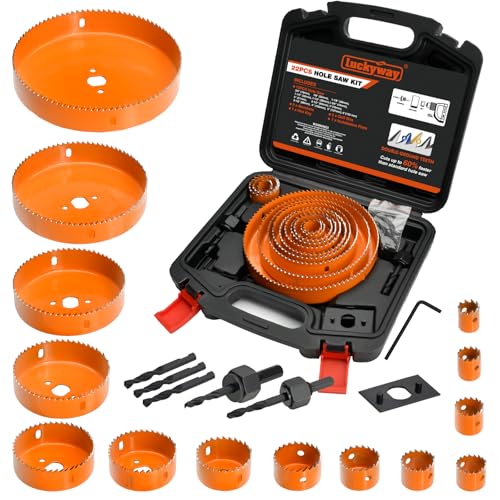
Fourteen saw sizes, from 3/4 to 6 inches, give this set broad coverage for round holes in thin PVC board, plastic board, softwood and drywall. It includes two mandrels, five drill bits, a hex key wrench and two installation pressure plates. The maker specifies a maximum cutting depth of 1 inch and says the set works with corded and cordless drills. That depth is the key limitation: it does not suit a cut that must pass through material more than 1 inch deep in a single pass.
Bottom line: Choose this for many diameter options in plastic board up to 1 inch deep.
12-Piece 3/4–2-1/2-Inch Kit

This set covers eight selected sizes from 3/4 to 2-1/2 inches, including 2-1/8 and 2-1/2 inches. Its heat-treated carbon-steel blades have a protective coating, and the kit includes arbors, drill bits and a hex key in a case. The maker specifies soft wood, plywood, PVC board and plastic sheets, making it a fit for common sheet-plastic openings within its diameter range. The sizes are not continuous, so verify that one of the eight included diameters matches your needed opening.
Bottom line: Choose this for sheet plastic when one of its eight sizes matches your hole.
How to choose a hole saw for plastic
Choose a saw by the exact hole diameter, plastic type and sheet thickness. A hole saw cuts a circular kerf around a pilot bit; the center plug remains inside the saw cup, so clear it before it packs with chips. For thin sheets, place a sacrificial backing board beneath the plastic and clamp both pieces securely. Use a drill without hammer action, start slowly, and keep the saw moving without forcing it; heat buildup can soften plastic and weld chips to the teeth. If a sheet is under 1/8 inch thick, sandwich it between backing boards to reduce chatter and edge breakout. Use a hole saw only when the material and thickness fall within the tool’s application and cutting depth.
Plastic cutting speed and heat control
Keep the cut cool by using a low drill speed, light pressure and frequent pauses to clear chips. Plastic has a lower melting point than steel, and friction at the saw teeth can melt the kerf even when the cut begins cleanly. Use a steady speed rather than repeatedly stopping and restarting within the cut; withdraw the saw periodically to release chips and let the work cool. Clamp the sheet close to the cut, but keep clamps outside the saw path. For acrylic, heat and vibration can cause cracks; a sharp cutter, rigid support and a pilot hole placed accurately help reduce stress. Wear eye protection, since both plastic chips and the center plug can eject from the cut.
Match saw material and size to the job
Bi-metal saws combine a high-speed-steel cutting edge with a tougher backing, while carbon-steel sets here are specified for softer materials such as thin plastic, wood and drywall. The intended material matters more than the number of accessories: do not use a soft-material carbon-steel saw on metal, tile or masonry. Measure the required opening and compare it with the saw’s actual diameter; pipe and cable holes often need clearance beyond the object’s outside diameter. This table narrows the choice by use and size.
| Need | Consider |
|---|---|
| Plastic plus listed metal materials | Bi-metal saw specified for those materials |
| Opening wider than 2-11/16 inches | A set that includes the required larger diameter |
| Hole deeper than 1 inch | Verify the saw’s cutting depth before starting |
Support, fit and safe cutting
Support the plastic sheet fully and clamp it so the saw cannot catch and spin the work. A drill press provides better alignment than a hand drill for repeatable holes, but either setup needs a stable workpiece and a clear path beneath the cut. Keep hands away from the saw and secure loose clothing and hair; unplug a corded drill or remove its battery before changing saws or clearing a jam. For a hole close to a sheet edge, leave enough material outside the cut to prevent the remaining strip from breaking away. If the plastic is thicker than the saw’s cutting depth, do not assume the saw will pass through safely; confirm the usable cutting depth first.
Frequently Asked Questions
How do I stop a hole saw from melting plastic?
Use a low drill speed, light pressure and short pauses to clear chips and dissipate heat. Melting at the teeth is a sign to stop, let the work cool and check that chips are not packed in the kerf.
Should I use a pilot hole in plastic?
A hole saw’s pilot bit centers the cut, so use it with the work clamped and supported. On thin sheet, sandwiching the material between backing boards helps prevent the pilot and saw from grabbing or chattering.
Can a hole saw cut acrylic without cracking it?
Acrylic can crack from heat or vibration, so support the sheet closely and use a sharp saw at low speed with light pressure. For sheet under 1/8 inch thick, sandwich it between backing boards before cutting.
How much clearance should a plastic pipe hole have?
Measure the pipe’s outside diameter and allow enough clearance for the pipe to pass without binding; a hole equal to the pipe’s diameter may be too tight. Test the fit on a scrap piece when the opening must be precise.
Can I use a plastic hole saw on thick plastic?
Only if the saw’s usable cutting depth exceeds the plastic thickness. Some sets specify a 1-inch cutting depth, so confirm that limit and do not force a saw through material deeper than its cutting capacity.