
Best Texturizer for Natural Hair: 5 Kits Compared

Beautiful Textures Naturally Straight Kit is the best texturizer for natural hair for people transitioning from relaxed to natural hair, because its maker says it is intended for use from roots to ends and includes shampoo and conditioner. Choose another kit if you want a no-lye, no-mix formula, or a product with a specific oil blend.
Texturizers are chemical treatments that loosen or soften a curl pattern; they do not create a uniform curl. Check the kit’s chemistry and application timing before using it, especially on previously processed hair.
We earn a commission if you buy through links on this page. As an Amazon Associate I earn from qualifying purchases. Products are compared on manufacturer specifications, not hands-on testing.
- Best overall: Beautiful Textures Naturally Straight Kit – Its maker positions the kit for transitioning hair and includes shampoo and conditioner.
- Best for no-mix use: Pro-Line Comb-Thru Regular Texturizer – Its maker identifies a no-lye, no-mix cream and a two-step system.
- Best for oil blend: Curls & Naturals Argan Oil Softener Kit – The maker highlights Moroccan argan and Abyssinian oils in a 5-ounce softener kit.
| Product | Best for | Product format | Stated differentiator | Shop |
|---|---|---|---|---|
| Beautiful Textures Naturally Straight Kit | Transitioning hair | Texturizer kit | Transitioning from relaxed to natural hair | Check Price on Amazon |
| Pro-Line Comb-Thru Regular Texturizer | No-mix application | Texturizer kit | No-lye, no-mix cream | Check Price on Amazon |
| Curls & Naturals Argan Oil Softener Kit | Oil blend | Softener kit | Moroccan argan and Abyssinian oils | Check Price on Amazon |
| African Pride Olive Miracle Curls and Coils | Simple curl care | Texturizer | Curls and coils focus | Check Price on Amazon |
| Luster’s SCurl Regular Strength Texturizer | Wave enhancement | Texturizer | Regular strength; enhances wave or curl | Check Price on Amazon |
Texturizers for natural hair
Compare each kit’s format and stated purpose to find a curl-softening treatment that matches your priorities.
Beautiful Textures Naturally Straight Kit

For transitioning hair, this kit is the only option here whose maker specifically describes use from roots to ends while moving from relaxed to natural hair. The 25.6-ounce kit includes shampoo and conditioner, and the maker says it supports long-lasting detangling. The maker also describes the formula as having no harsh chemicals. That phrase does not identify the treatment chemistry, so check the kit’s application directions and ingredient information if chemical type matters to you. This larger kit may be more than needed if you want a compact, single-treatment product.
Bottom line: Choose this if transitioning support and included wash-day products matter most.
Pro-Line Comb-Thru Regular Texturizer

For a no-mix formula, this is the clearest match: the maker calls it a regular-strength, no-lye texturizer cream that requires no mixing. The kit includes neutralizing shampoo and Hair Moisturizing Complex conditioner, with a two-step system described as working in minutes. The maker says the cream is formulated for sensitive scalps; that does not remove the need to follow its directions and avoid irritated or broken skin. Unlike the oil-focused option, this kit emphasizes a simpler application format and conditioning products rather than a named botanical blend.
Bottom line: Pick this if avoiding a mixing step is your main requirement.
Curls & Naturals Argan Oil Softener Kit

For a named oil blend, this 5-ounce softener kit stands apart with Moroccan argan oil and Abyssinian oil in its maker’s ingredient claims. The maker says the formula is intended to soften hair and loosen the natural curl pattern, and positions it for curly and coarse hair. It is described as a no-mix texturizer, so it differs from kits that emphasize bundled cleansing and conditioning products. The oil claims do not establish how strongly the treatment will loosen an individual curl pattern; use the timing and strand-test guidance provided with the product.
Bottom line: Choose this if a compact softener with named oils fits your priorities.
African Pride Olive Miracle Curls and Coils
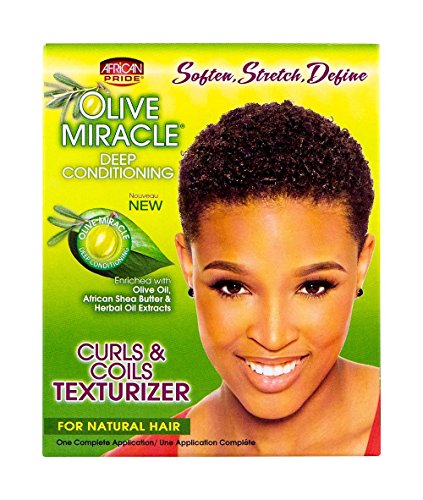
African Pride’s Olive Miracle Curls and Coils Texturizer is a straightforward choice if you are seeking a product named for curls and coils rather than a kit with extensive stated components. Its maker describes it as easy to use and says it is manufactured in the United States. The product name makes the curl-and-coil focus clear, but the claims do not spell out formula chemistry or included aftercare. That makes it less informative for shoppers choosing by lye type or bundled neutralizing products; verify those points in the product’s directions before committing to a chemical treatment.
Bottom line: Pick this if you want a curl-and-coil-focused product and will verify its use directions.
Luster’s SCurl Regular Strength Texturizer

For a product explicitly framed around enhancing a natural wave or curl pattern, Luster’s SCurl is the distinct option. Its maker says it works in minutes and offers manageability and styling versatility, and identifies it as regular strength. The maker’s claim about its audience does not establish that it is suitable for every hair texture or prior chemical treatment. Unlike the transitioning-focused kit, its purpose centers on wave enhancement rather than a transition from relaxed to natural hair. Check the application instructions and compatibility guidance before using it on processed hair.
Bottom line: Choose this if wave enhancement is your priority and regular strength suits your needs.
How to choose a texturizer for natural hair
Start with the result you want: a texturizer loosens curl, while a styling product coats or shapes hair without chemically changing its pattern. Chemical texturizers can contain hydroxide or thioglycolate chemistry; those systems are not interchangeable, so identify the chemistry before choosing a product. A no-lye claim only identifies one formulation category and does not mean a treatment is risk-free. Match the kit to your hair’s prior chemical history, scalp condition and the amount of curl change you want. If you cannot identify the chemistry or whether the product can overlap prior treatment, check before applying it. Avoid choosing solely by an oil or conditioning claim: those do not establish how much the curl will loosen.
Texturizer safety and application
Keep chemical texturizer off irritated, scratched or sunburned scalp; chemical processing can cause irritation or burns. Apply only as directed and do not extend the processing time to seek a stronger result. A strand test on a small section helps reveal the result and condition before treating the full head, while a skin test can identify possible sensitivity where the manufacturer directs one. Do not overlap a relaxer or texturizer onto previously processed hair unless the kit explicitly permits it; overlapping can weaken and break hair. Neutralizing shampoo is important for hydroxide relaxer systems because it stops the alkaline process, but the product chemistry determines the correct aftercare. Follow the kit’s included sequence rather than substituting a regular shampoo.
Texturizer kits compared by use
Choose by the feature that changes your routine most: transition guidance, mix-free application, a named oil blend or wave emphasis. Kit contents matter because post-treatment washing and conditioning are separate steps from loosening the curl pattern. The table summarizes the product claims most useful for narrowing the options.
| Need | Closest match | Deciding feature |
|---|---|---|
| Transitioning support | Beautiful Textures Naturally Straight Kit | Maker describes use from roots to ends |
| No mixing | Pro-Line Comb-Thru Regular Texturizer | No-lye, no-mix cream |
| Named oils | Curls & Naturals Argan Oil Softener Kit | Moroccan argan and Abyssinian oils |
| Wave enhancement | Luster’s SCurl Regular Strength Texturizer | Maker says it enhances natural wave or curl |
Do not treat “natural ingredients” or “sensitive scalp” language as a substitute for checking the treatment chemistry and directions.
How to maintain texturized hair
Texturized hair needs gentle handling because chemical processing can reduce strength and increase dryness. Use a wide-tooth comb and detangle in sections, starting at the ends rather than pulling from the roots; wet hair is especially vulnerable to stretching and breakage. Condition after cleansing, and limit repeated heat styling and additional chemical services while the hair is recovering. There is no universal retouch interval that safely fits every product and hair growth pattern, so do not schedule another application by a fixed calendar alone. Follow the treatment maker’s retouch guidance and avoid applying new product over previously treated lengths. If hair becomes unusually brittle or the scalp reacts, stop chemical processing and seek professional advice.
Frequently Asked Questions
How long should a texturizer stay in natural hair?
Use the processing time printed for the specific kit rather than a generic minute count, because formulas differ. Do not extend the time to make curls looser; longer exposure can increase irritation and breakage.
Can I texturize hair that has been relaxed before?
Avoid overlapping texturizer onto relaxed lengths unless the kit explicitly says that use is safe. Combining or layering chemical processes can weaken the hair shaft and lead to breakage.
Does a texturizer make natural hair straight?
A texturizer is intended to loosen a curl pattern, not reliably make all hair straight. The result varies with the formula, starting texture and processing, so test a small strand first.
Should I wash my hair before texturizing?
Do not assume freshly washed hair is the safest starting point; many chemical kits direct users to avoid shampooing immediately beforehand because scalp irritation raises burn risk. Follow the kit’s pre-application timing and never apply to an irritated or scratched scalp.
How often can I retouch a texturizer?
Use the specific kit’s retouch interval and only apply new product to new growth where its directions permit. Applying chemicals over previously treated hair can weaken the hair, so a calendar interval alone is not enough to determine safe timing.