
Anchors for Stone Walls: 5 Types Compared by Fit

For a stone wall, Ahniiqo 3/8 x 3-Inch Wedge Anchors is the clearest match because its maker says it is suitable for natural stone and gives a 3/8-by-3-inch size. Choose another type if the wall is brick or concrete, or if you need a plastic sleeve for a TV mount; anchor suitability and size depend on the wall material and mounting hardware.
We earn a commission if you buy through links on this page. As an Amazon Associate I earn from qualifying purchases. Products are compared on manufacturer specifications, not hands-on testing.
- Best overall: Ahniiqo 3/8 x 3-Inch Wedge Anchors – The maker identifies natural stone as a suitable substrate and provides a 3/8-by-3-inch wedge anchor.
- Best for TV mounts: Mounting Dream 10 x 50 mm Anchors – Six 10-by-50 mm plastic anchors are intended for concrete or brick TV installations.
- Best for assorted hanging: KURUI 180-Piece Masonry Anchor Kit – The 180-piece kit combines plastic masonry anchors, screws and drill bits for wall décor.
| Product | Best for | Anchor size | Material | Quantity | Shop |
|---|---|---|---|---|---|
| Ahniiqo 3/8 x 3-Inch Wedge Anchors | Solid stone walls | 3/8 x 3 in | Galvanized metal | 6 | Check Price on Amazon |
| Mounting Dream 10 x 50 mm Anchors | Concrete or brick | 10 x 50 mm (0.39 x 1.97 in) | Plastic | 6 | Check Price on Amazon |
| KURUI 180-Piece Masonry Anchor Kit | Wall décor | Assorted; 1.5 in size listed | PE plastic; carbon steel screws | 180 | Check Price on Amazon |
| 12-Piece Concrete Wall Anchor Set | Two sleeve lengths | 10 x 50 mm and 10 x 60 mm | Polypropylene | 12 | Check Price on Amazon |
| fischer DuoPower 1/4 x 1 3/16-Inch Plugs | Mixed substrates | 1/4 x 1 3/16 in | — | 100 | Check Price on Amazon |
Anchors for Stone Walls
Match the anchor type and dimensions to the stone and the load before choosing a kit.
Ahniiqo 3/8 x 3-Inch Wedge Anchors

Ahniiqo 3/8 x 3-Inch Wedge Anchors is the only option here whose maker specifically includes natural stone among suitable substrates. Each galvanized wedge anchor measures 3/8 inch in diameter by 3 inches long, and the kit includes nuts and spacers. The maker recommends a carbide impact bit with the same 3/8-inch diameter. This is a fit for dense, solid stone where an expansion anchor is appropriate, not a default choice for thin, fractured or soft stone: wedge anchors expand against the hole walls and can stress brittle material.
Bottom line: Choose this for dense natural stone when its expansion style and dimensions suit the wall.
Mounting Dream 10 x 50 mm Anchors
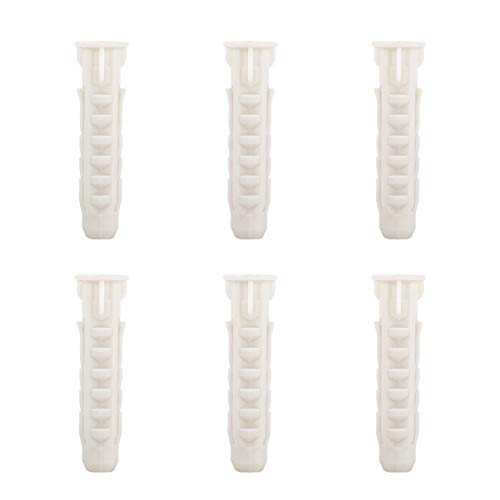
Mounting Dream 10 x 50 mm Anchors is a plastic sleeve anchor aimed at TV mounting on concrete or brick, rather than a stone-specific wedge anchor. It measures 10 mm by 50 mm (about 0.39 by 1.97 inches), and the maker calls for a 3/8-inch masonry pilot hole. Its suitable surfaces exclude drywall, stucco and plaster. Consider it only where the wall is solid and compatible with the sleeve and where the TV mount’s lag bolt fits; a size match alone does not establish a safe load capacity for a particular stone wall.
Bottom line: Choose this for compatible concrete or brick installations, not when you need an explicitly stone-rated option.
KURUI 180-Piece Masonry Anchor Kit

KURUI 180-Piece Masonry Anchor Kit stands out as a mixed wall-hanging assortment rather than a dedicated heavy masonry anchor. It contains 90 blue PE anchors, 90 galvanized carbon-steel Phillips screws and two drill bits; the kit is described for drywall, masonry, stucco and brick. The maker’s installation sequence is to drill, insert and tap an anchor flush, then drive the screw. That broad assortment may suit picture frames or décor on compatible masonry, but the size information does not establish a specific anchor diameter for matching to a stone-wall hole.
Bottom line: Choose this for assorted décor fasteners when the included anchor dimensions suit the stone and screw.
12-Piece Concrete Wall Anchor Set

12-Piece Concrete Wall Anchor Set offers two sleeve lengths for cement or brick installations: six 10-by-50 mm anchors and six 10-by-60 mm anchors. The product says the sleeves fit M7 or M8 lag bolts and are made from virgin polypropylene. The two lengths can help when the mounting assembly needs a different embedment depth, but they do not make the kit universally suitable for stone. Confirm the wall’s solid material and the screw’s fit; the dimensions are metric, so use the actual anchor and bolt sizes rather than estimating by appearance.
Bottom line: Choose this for a compatible cement or brick setup needing either of the two sleeve lengths.
fischer DuoPower 1/4 x 1 3/16-Inch Plugs

fischer DuoPower 1/4 x 1 3/16-Inch Plugs differs from the other choices by using a universal plug designed to adapt to different substrate types. The maker describes its action as folding, expanding or knotting, and names solid, perforated and panel building materials as application categories. Each plug is 1/4 inch by 1 3/16 inches, with 100 in the package. Those categories do not specifically identify natural stone, so this is a less direct match than a product expressly intended for stone. Its short length also makes careful matching to the planned embedment especially important.
Bottom line: Choose this for a mixed-substrate project only after confirming the plug suits the specific stone.
How to choose anchors for stone walls
Start with the stone itself: dense, intact stone can accept some expansion anchors, while soft, thin or cracked stone can split under outward pressure. A wedge anchor expands as its nut is tightened, so reserve it for solid material and avoid placing it close to an edge or an existing crack. For stone veneer or a thin facing over another material, the anchor must engage the structural backing rather than rely on the facing alone. Match the drill diameter to the anchor’s specified hole size; the 3/8-inch wedge option here calls for a same-diameter bit. Also check the screw or bolt diameter and required embedment before drilling, because a sleeve that fits the hole can still mismatch the mounting hardware.
Stone varies in hardness and thickness, so a product intended for concrete or brick is not automatically suitable for every stone wall. When the wall type or thickness is uncertain, identify the stone and its backing before selecting an expansion style.
Anchor types and sizes compared
Wedge anchors and plastic sleeves work differently: wedge anchors expand in dense solid material, while a plastic sleeve grips as its matching screw or bolt is driven. Universal plugs use different actions depending on the substrate. Use this table to narrow the type, then verify the exact hole and fastener dimensions for the selected anchor.
| Wall or task | Anchor type to consider | Key fit rule |
|---|---|---|
| Dense natural stone | Wedge anchor | Match hole diameter to anchor diameter; avoid cracked or edge-near stone |
| Concrete or brick TV mount | Plastic sleeve | Match the pilot hole and lag bolt to the sleeve |
| Mixed building materials | Universal plug | Confirm the specific substrate is supported |
Length matters as much as diameter: an anchor must fit the wall thickness and intended embedment without bottoming out or breaking through a thin facing.
Drilling into stone without damaging it
Use a masonry bit suited to the anchor’s required hole diameter, and drill into sound stone rather than a mortar joint when the mount needs to hold in the stone. Mortar joints are often less dense and can crumble under concentrated anchor pressure. Keep the hole straight and clear drilling dust before inserting the anchor, since packed debris can prevent full seating. For brittle, thin or visibly fractured stone, do not assume a larger expansion anchor is safer; its outward force can worsen a split. Check for hidden wiring or plumbing before drilling, and use eye protection because masonry drilling produces sharp dust and chips. A hammer drill may be useful in hard masonry, but use a mode appropriate to the stone to limit chipping.
Common anchor-fitting mistakes
The most common error is choosing by bolt diameter alone: anchor diameter, hole diameter, sleeve length and usable embedment must all work together. A 3/8-inch bit is called for by the 10 mm plastic sleeve option here, while its anchor diameter is metric; follow the anchor’s specified pilot-hole size rather than rounding based on the fastener. Another mistake is treating a concrete or brick claim as proof of suitability for natural stone. Stone can be softer, layered or brittle, and no single anchor style fits every wall. Do not overtighten an expansion anchor in fragile material, and keep anchors away from edges and cracks. For heavy overhead or safety-critical mounts, use a mounting system with a published load rating for the actual substrate and installation.
Frequently Asked Questions
Can I use a concrete anchor in a stone wall?
Sometimes, but stone type and condition determine whether the anchor can hold without splitting the wall. Use a concrete-style expansion anchor only in dense, sound stone with the specified hole diameter and adequate edge distance.
Should a wall anchor go into stone or mortar?
For a load-bearing mount, anchor into sound stone rather than a mortar joint because mortar can be weaker and more prone to crumbling. If the wall is veneer, the fastener needs to reach suitable structural backing.
What size drill bit do stone anchors need?
Use the hole diameter specified for the exact anchor; the 3/8-inch wedge-anchor option calls for a 3/8-inch bit. A pilot hole that is too large can reduce grip, while an undersized hole can keep the anchor from seating.
Can wedge anchors split natural stone?
Yes, expansion force can crack brittle, thin or already fractured stone. Avoid wedge anchors near edges or cracks, and choose a different fastening approach if the stone cannot tolerate that outward pressure.
How deep should an anchor go into stone?
The usable embedment must meet the anchor’s installation requirements and leave enough sound stone around it. Account for the mounting bracket and any wall facing; a longer anchor is not automatically safer if the stone is thin.