
Best Heat Gun for Epoxy Resin: 4 Craft Models Compared

For most epoxy resin projects, Resiners 350W Mini Heat Gun is the best fit because its dual settings top out at 350°C and it comes with three nozzles for directing airflow. Choose LET’S Resin 350W Dual-Temp Heat Gun if you want a 400°C high setting, or Bubble Removing Tool for Epoxy Resin if a built-in stand matters more than multiple heat settings.
A craft heat gun blows hot air across resin to help release surface bubbles; it is not a substitute for mixing carefully or controlling a deep pour’s heat.
We earn a commission if you buy through links on this page. As an Amazon Associate I earn from qualifying purchases. Products are compared on manufacturer specifications, not hands-on testing.
- Best overall: Resiners 350W Mini Heat Gun – Two heat settings and three nozzle shapes offer useful control for craft pours.
- Best for hands-free pauses: Bubble Removing Tool for Epoxy Resin – The retractable stainless-steel stand supports hands-free placement between passes.
- Best for higher heat: LET’S Resin 350W Dual-Temp Heat Gun – Its two settings reach 400°C on high, above the other resin-focused mini guns.
| Product | Best for | Heat settings | Power | Included features | Shop |
|---|---|---|---|---|---|
| Resiners 350W Mini Heat Gun | Everyday resin crafts | 250°C / 350°C | 350 W | 3 nozzles; overheat protection | Check Price on Amazon |
| LET’S Resin 350W Dual-Temp Heat Gun | Higher heat setting | 250°C / 400°C | 350 W | Multiple nozzles; silicone covers | Check Price on Amazon |
| Bubble Removing Tool for Epoxy Resin | Stand-supported work | Up to 200°C | — | Retractable stainless-steel stand | Check Price on Amazon |
| Mini Dual-Temp Craft Heat Gun | Variable airflow needs | Dual temperature | Dual speed | Wire stand; shield | Check Price on Amazon |
Heat guns for epoxy resin
Compare the heat range and handling features that matter when removing bubbles from craft pours.
Resiners 350W Mini Heat Gun
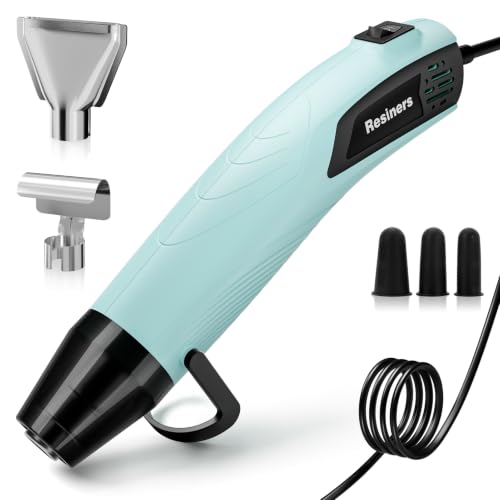
Three nozzle shapes and a 350°C high setting distinguish this mini heat gun for resin work. It has 250°C and 350°C temperature options, a 350W rating, and built-in overheat protection; the included silicone finger covers are intended as protection during crafting. That combination suits small pours where directing heat over a limited area is useful. The limitation is the 350°C ceiling: choose another model if you specifically need a higher listed maximum, and remember that more heat is not automatically better for epoxy.
Bottom line: Pick this for small craft pours where nozzle choice and a moderate high setting are useful.
LET’S Resin 350W Dual-Temp Heat Gun

A 400°C high setting separates this 350W tool from the other small resin-oriented models here. The two options are 250°C and 400°C, and the maker gives airflow rates of 150L/min and 350L/min for the respective settings. Multiple nozzles and washable silicone covers are included. It suits a buyer who wants that higher maximum for varied craft tasks, but the 400°C setting can be excessive near epoxy; use the lowest effective setting and keep the nozzle moving rather than lingering over a pour.
Bottom line: Choose this if the 400°C maximum is useful for your broader craft projects.
Bubble Removing Tool for Epoxy Resin

The retractable stainless-steel stand is the distinguishing feature of this epoxy and acrylic-art tool. Its maker says the gun reaches up to 200°C/390°F, and the compact body measures 8.8 inches long and 1.8 inches wide. That lower maximum than the other heat guns in this group may suit careful surface bubble work, while the stand can free a hand between passes. The trade-off is that the features identify a single maximum rather than multiple temperature settings, so it offers less heat-selection flexibility.
Bottom line: Pick this for a compact bubble-removal tool with a built-in stand.
Mini Dual-Temp Craft Heat Gun

Variable heat and speed settings set this craft gun apart from models whose features give specific temperature steps. Its low speed and heat are intended for detail work, while the high setting is positioned for heavier or higher-volume work; the included shield and wire stand add handling options. It suits crafters who value changing airflow as well as heat for tasks such as resin, embossing, and shrink wrapping. The limitation is that no temperature figures or wattage are provided in the specifications, so it is harder to compare precise heat output with the other tools.
Bottom line: Choose this when adjustable airflow matters more than a temperature range.
How to choose a heat gun for epoxy resin
Choose the lowest setting that releases surface bubbles without keeping heat in one spot. For small art pours, a compact craft heat gun with a low setting and controllable airflow is generally more manageable than a high-powered 1800W tool. Heat guns direct hot air; they do not remove bubbles trapped deep in resin or correct inaccurate mixing. A torch is a different tool and can create an open-flame hazard around solvents, paper, and other combustibles. Consider nozzle shape and stand design alongside temperature: a broad deflector spreads air, while a narrower nozzle concentrates it. For a pour thinner than 1/4 inch, use brief moving passes; for deeper pours, do not use prolonged heat to compensate for trapped bubbles.
Temperature figures are tool output settings, not a safe resin surface temperature. Resin formulation, room temperature, pour depth, and working time all affect the result, so a tool’s maximum temperature is not a target.
How to remove bubbles without overheating epoxy
Move the heat source continuously and make short passes rather than holding it over a single bubble. A practical starting distance is about 6 to 8 inches from the surface, adjusted cautiously for the gun’s airflow and the resin maker’s directions. Watch the surface as you work; stop if the resin ripples, smokes, or begins to discolor. Heat can thin epoxy temporarily, but excess heat can damage the finish and accelerate curing unevenly. Mix slowly and scrape the sides and bottom of the mixing cup, since vigorous stirring introduces bubbles that surface heating cannot reliably fix. For deep casts, use resin formulated for that depth instead of repeatedly applying heat.
Keep the hot nozzle away from skin, silicone molds, and flammable materials, and set the tool on a heat-resistant surface between passes. Use ventilation and protective gloves appropriate to the resin’s safety guidance.
Heat gun features compared for resin crafts
The useful distinction is not simply the highest temperature: a lower setting, airflow control, or a stand may matter more for surface bubble work. This comparison separates the main feature trade-offs without treating each tool’s maximum as a recommended working temperature.
| Need | Feature to prioritize | Trade-off |
|---|---|---|
| Small surface bubbles | Low setting and controlled passes | May not reach deep bubbles |
| Different craft tasks | More than one heat setting | Higher settings need extra care |
| Hands-free pauses | Stable built-in stand | Does not control heat output |
| Airflow adjustment | Variable speed | Exact output may be harder to compare |
Temperature and airflow interact: a stronger stream can disturb a liquid surface even when the heat setting is modest. Use a test piece when changing tools or resin formulas, and keep the work area clear of paper towels, solvents, and other combustible items.
Resin heat gun safety and common mistakes
A hot-air tool can burn skin and ignite nearby combustibles, so keep its nozzle pointed away from hands and the workbench. Do not use a heat gun near flammable vapors, including solvent fumes, and avoid using it in a confined, unventilated space. Epoxy mixing can produce its own exothermic heat; deeper or larger batches may heat more than thin surface coatings. Follow the resin manufacturer’s maximum pour depth rather than using a gun to force a thick layer to cure. Avoid touching the nozzle or placing a hot tool on a plastic mat. A built-in stand or wire stand is useful only on a stable, heat-resistant surface, and the gun should cool before storage.
Stop heating if the resin smokes, changes color, or rapidly ripples. These are signs to step back and reassess instead of applying more heat.
Frequently Asked Questions
Can a heat gun remove bubbles inside cured epoxy?
No, a heat gun works on bubbles that reach the liquid surface before the epoxy cures. Once epoxy has hardened, surface heat will not remove an enclosed bubble; for a future pour, mix slowly and use a resin rated for the intended depth.
How far should a heat gun be from resin?
About 6 to 8 inches is a cautious starting distance for a moving pass, not a universal safe setting. Keep the gun in motion and increase the distance if the resin ripples, smokes, or discolors.
Can a heat gun make epoxy cure faster?
Heat can accelerate epoxy’s reaction, but uneven or excess heat can damage the finish and cause uneven curing. Room temperature and pour depth also affect cure behavior, so use the resin maker’s temperature and depth limits rather than trying to speed a deep pour with prolonged heat.
Is a heat gun safer than a torch for resin?
A heat gun avoids an open flame, but its hot nozzle and hot airflow can still burn skin or ignite combustible materials. Keep it away from flammable vapors, paper, and solvents, and use ventilation while working with resin.
Should I use a heat gun on a deep epoxy pour?
A heat gun is mainly for surface bubbles, not for controlling heat inside a deep pour. Use resin formulated for the depth you need; epoxy’s curing reaction generates heat, and deeper batches can build more heat than thin coatings.