
Castrol EDGE 0W-30: Compare Euro Oil Specifications

For a vehicle requiring BMW Longlife-III (LL III) in SAE 0W-30, Castrol EDGE Professional 0W-30 LL III is the direct match because it meets that specification. The other 0W-30 option is an A3/B4 formulation with different approvals, while the 5W-30 and 0W-40 oils are different grades; choose an alternative only if your vehicle manual calls for its exact grade and approval.
We earn a commission if you buy through links on this page. As an Amazon Associate I earn from qualifying purchases. Products are compared on manufacturer specifications, not hands-on testing.
- Best overall: Castrol EDGE Professional 0W-30 LL III – It is the only option here identified as SAE 0W-30 and meeting BMW Longlife-III.
- Best for A3/B4 requirements: Castrol EDGE Euro 0W-30 A3/B4 – It is a 0W-30 Euro oil with ACEA A3/B4 and multiple listed European approvals.
| Product | Best for | SAE grade | Approvals or specifications | Package size | Shop |
|---|---|---|---|---|---|
| Castrol EDGE Professional 0W-30 LL III | BMW LL III engines | 0W-30 | BMW Longlife-III | 1 quart | Check Price on Amazon |
| Castrol EDGE Euro 0W-30 A3/B4 | A3/B4 applications | 0W-30 | ACEA A3/B4; BMW LL-01 | 6 quarts | Check Price on Amazon |
| Castrol EDGE 5W-30 | 5W-30 applications | 5W-30 | API SQ/SP/SN PLUS/SN; dexos1 Gen 3 | 5 quarts | Check Price on Amazon |
| Castrol EDGE Euro 0W-40 A3/B4 | 0W-40 applications | 0W-40 | ACEA A3/B4 | 5 quarts | Check Price on Amazon |
Castrol EDGE 0W-30 and related grades
Match the oil’s viscosity grade and approval to the exact requirements in your vehicle manual.
Castrol EDGE Professional 0W-30 LL III

Castrol EDGE Professional 0W-30 LL III is the only option here that pairs SAE 0W-30 with BMW Longlife-III (LL III), making that approval the deciding distinction. The full synthetic oil comes in a 1-quart container and uses Castrol’s Fluid Titanium Technology, which Castrol says is engineered to reduce metal-to-metal contact and maintain an oil film under stress. Its 0W-30 grade is intended for engines specifying that viscosity, not a substitute for another grade simply because the brand is the same. The single-quart package may be inconvenient when a vehicle needs more for a complete fill.
Bottom line: Choose this when your engine calls for SAE 0W-30 and BMW LL III.
Castrol EDGE Euro 0W-30 A3/B4

Castrol EDGE Euro 0W-30 A3/B4 differs from Castrol EDGE Professional 0W-30 LL III through its A3/B4 approval family and listed BMW Longlife-01 specification, rather than BMW LL III. This advanced full synthetic 0W-30 is sold as six 1-quart bottles, a useful format for buyers who need several quarts. Its specifications also include GM-LL-A-025, GM-LL-B-025, Mercedes-Benz 229.1, 229.3 and 229.5, and Volkswagen 502.00 and 505.00. Castrol reports a 42 percent better rating in fighting power-robbing deposits; that claim does not establish compatibility with an engine requiring a different approval.
Bottom line: Pick this only when the required 0W-30 approvals match its A3/B4 specifications.
Castrol EDGE 5W-30

Castrol EDGE 5W-30 is a different viscosity grade, 5W-30, and therefore is not a direct 0W-30 replacement. Its five-quart container and listed API, ILSAC GF-7, GM dexos1 Gen 3, Chrysler and Ford specifications make it relevant only when those requirements and 5W-30 are appropriate for the engine. Castrol claims 20,000 miles between oil changes or one year, whichever comes first; maintenance intervals still need to suit the vehicle maker’s requirements and operating conditions. Buyers seeking an oil specifically requiring 0W-30 should not choose this grade based on shared EDGE branding.
Bottom line: Consider it for an engine specifying 5W-30 and compatible listed approvals.
Castrol EDGE Euro 0W-40 A3/B4
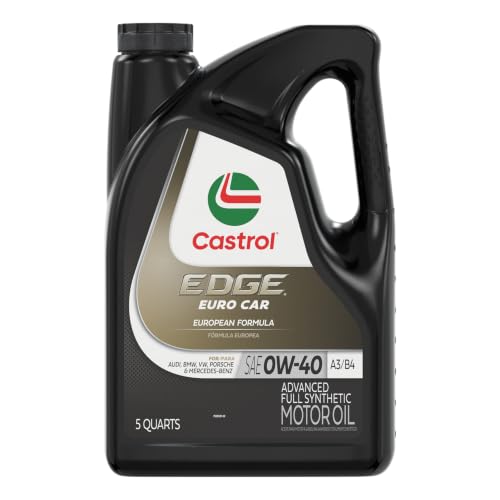
Castrol EDGE Euro 0W-40 A3/B4 keeps the Euro A3/B4 positioning but changes the viscosity to 0W-40, so its key distinction is the grade rather than a match for a 0W-30 requirement. It comes in a five-quart container. Castrol reports 1.5 times better viscosity control and 1.5 times better piston cleanliness in its cited tests; those performance claims do not make 0W-40 interchangeable with 0W-30. The maker identifies ACEA A3/B4 but do not give the broader approval list shown for the other Euro oil, so match the exact required approval before selecting it.
Bottom line: Choose it only when your engine specifies 0W-40 and ACEA A3/B4.
How to choose Castrol EDGE 0W-30
Start with the vehicle maker’s required viscosity and approval, not the EDGE name or the oil’s intended market. SAE 0W-30 and SAE 5W-30 share the same winter grade number but differ in their operating-temperature viscosity grade; 0W-40 is also a distinct hot-grade. European specifications such as ACEA A3/B4 and manufacturer approvals such as BMW Longlife-III or Longlife-01 are separate compatibility checks. The same grade can therefore come in formulations that are not interchangeable. If your manual names a specific manufacturer approval, select an oil that explicitly carries that approval rather than assuming another listed standard is equivalent.
Understanding 0W-30, 5W-30 and 0W-40
The SAE grade describes how motor oil flows at cold and operating temperatures, with the number before W relating to cold-temperature performance and the second number identifying the hot viscosity class. A 0W oil is formulated for colder starting conditions than a 5W grade, but the vehicle’s specified grade remains controlling. For a measurable choice, if the manual requires 0W-30, rule out both 5W-30 and 0W-40 regardless of their brand or synthetic formulation. Do not infer that oils with a shared “30” or “0W” are identical: the other grade component and required approvals both matter.
What European oil approvals mean
European engine oil labels combine industry categories and vehicle-maker approvals, and those labels serve different purposes. ACEA A3/B4 identifies a performance category; BMW Longlife-III and Longlife-01 are manufacturer specifications, not alternate names for A3/B4. Product labels can carry several approvals, but an engine’s required approval is the match to verify. For example, a vehicle requirement for BMW LL III does not automatically match an oil listing BMW LL-01. Use the exact wording in the owner’s manual or oil cap, and check the bottle for that approval before filling. Never select solely by a broad term such as “European.”
Buying and handling motor oil
Estimate the quantity from the engine’s specified oil capacity, then account for the package size; one quart is 32 fluid ounces, while a five-quart container holds 160 fluid ounces. Keep the container sealed and store it upright in a cool, dry place away from children and pets. Used motor oil is hazardous waste: collect it in a closed, labeled container and take it to an oil-recycling collection point rather than pouring it into a drain or onto the ground. Avoid overfilling; check the dipstick on level ground after allowing oil to settle, and add small amounts if the level is below the proper range.
Frequently Asked Questions
Can I use 0W-30 instead of 5W-30?
Use 0W-30 instead of 5W-30 only when the vehicle maker permits both grades and the required oil approvals match. The shared “30” does not by itself establish compatibility.
What does the 0W mean in 0W-30 oil?
The “0W” is the winter viscosity grade and relates to cold-temperature flow performance. It does not replace the need to match the manual’s full grade and approval.
Is BMW Longlife-III the same as BMW Longlife-01?
No. LL III and LL-01 are distinct BMW oil specifications, so match the exact one required by the engine rather than treating them as interchangeable.
How many quarts does a typical oil change need?
Many passenger-car engines take roughly 4 to 6 quarts, but capacity varies by engine and whether the filter is changed. Check the vehicle’s capacity before opening containers and avoid filling above the dipstick’s full mark.
How often should synthetic motor oil be changed?
Many vehicles using synthetic oil have intervals around 7,500 to 10,000 miles under normal service, while severe driving can require shorter intervals. The vehicle maker’s maintenance schedule and any oil-life monitor take priority over a general range.