
Dog Chain Collar No Choke: Martingale Options Compared

For a dog chain collar that limits tightening, choose Mystercome Metal Martingale Collar, Medium: its martingale design has a limited closure and fits necks measuring 16 to 19 inches. TagME Alloy Steel Slip Chain, 4 mm, Freezx Alloy Chain Collar, 3 mm, and Heavy Duty Metal Slip Collar, 2.5 mm are slip collars that tighten under leash tension; SGODA Stainless Steel Chain Collar, 26 in uses both choke and martingale wording, so its closure behavior is less clear.
Choose a different design if you want a clearly identified slip chain or need a size outside the 16- to 19-inch range.
We earn a commission if you buy through links on this page. As an Amazon Associate I earn from qualifying purchases. Products are compared on manufacturer specifications, not hands-on testing.
- Best overall: Mystercome Metal Martingale Collar, Medium – Its limited-closure martingale design is the clearest match for a collar that does not tighten without limit.
- Best for stainless steel: SGODA Stainless Steel Chain Collar, 26 in – It uses 304 stainless steel and specifies a 22-inch maximum neck size, but is also described as a choke collar.
- Best for smaller necks: Heavy Duty Metal Slip Collar, 2.5 mm – Its size fits necks up to 16 inches, though it is a slip-style collar that tightens under leash tension.
| Product | Best for | Collar style | Link diameter | Neck fit | Shop |
|---|---|---|---|---|---|
| Mystercome Metal Martingale Collar, Medium | Limited-closure fit | Limited-closure martingale | — | 16–19 in | Check Price on Amazon |
| SGODA Stainless Steel Chain Collar, 26 in | Stainless steel chain | Choke / martingale wording | 4 mm | Neck max 22 in | Check Price on Amazon |
| TagME Alloy Steel Slip Chain, 4 mm | Larger neck fit | Slip / choke chain | 4 mm | Neck max 22 in | Check Price on Amazon |
| Freezx Alloy Chain Collar, 3 mm | Medium neck fit | Slip / choke chain | 3 mm | Neck max 18 in | Check Price on Amazon |
| Heavy Duty Metal Slip Collar, 2.5 mm | Small neck fit | Slip collar | 2.5 mm | Neck max 16 in | Check Price on Amazon |
Dog chain collars with no-choke and slip designs
Compare the closure style and neck fit carefully, since several chain collars here tighten under leash tension rather than limiting closure.
Mystercome Metal Martingale Collar, Medium

Unlike the slip collars in this group, this metal martingale has a limited closure intended to prevent a dog from backing out of a traditional collar. The medium size fits a 16- to 19-inch neck and uses double-link chrome-plated steel. Its design is intended for walking, showing, and obedience training, with no sharp points or rough edges to snag fur or chafe skin. Measure both your dog’s neck and head before choosing a size: the head must pass through the collar, while the fitted neck range should match. This option is not suitable if your dog measures outside that range.
Bottom line: Choose this for a limited-closure chain martingale if your dog’s measurements fall within the medium range.
SGODA Stainless Steel Chain Collar, 26 in
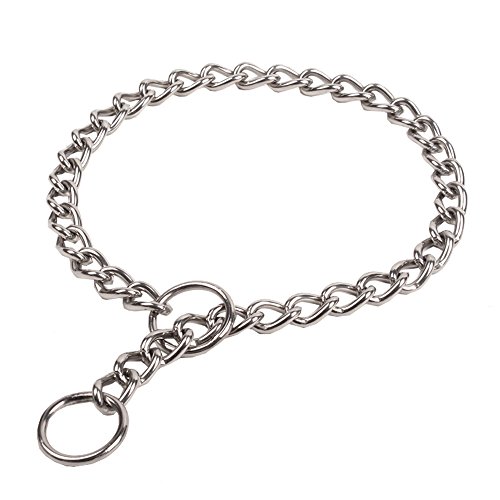
SGODA Stainless Steel Chain Collar, 26 in is the only option here specifying 304 stainless steel, but its labeling mixes choke and martingale terminology. The 26-inch chain is sized for a maximum 22-inch neck, and the collar is formed by sliding the chain through a loop. The maker calls it a training collar and recommends measuring the dog’s neck and adding 2 inches for initial collar length. That combination makes the closure behavior less clear than a limited-closure martingale. Choose it only if you are comfortable verifying how its loop limits tightening; avoid it if you want an unambiguous no-choke design.
Bottom line: Consider it if stainless steel matters and you can confirm the collar’s closure behavior before use.
TagME Alloy Steel Slip Chain, 4 mm

TagME Alloy Steel Slip Chain, 4 mm has the thickest links among the slip collars here at 4 mm, and its size is recommended for a maximum 22-inch neck. The collar uses alloy steel with chrome plating; the maker presents it for leash training and daily walks. Unlike a no-choke martingale, its slip-chain construction can tighten when leash tension passes through the loop. Its sizing text gives more than one length and neck measurement, so verify that the actual collar length and your dog’s measured neck are compatible before ordering. This is not the right choice if your priority is limiting tightening.
Bottom line: Pick it only if you want a slip chain and accept that it tightens under leash tension.
Freezx Alloy Chain Collar, 3 mm

Freezx Alloy Chain Collar, 3 mm is the slimmer 3 mm chain option sized for a maximum 18-inch neck. It has chrome plating and is presented for training and leash control on medium dogs. The maker lists several strong breeds as suitable, but breed labels cannot replace measuring the individual dog’s neck. This is a chain slip collar, not a limited-closure martingale: pulling through the loop tightens the collar, which conflicts with a no-choke requirement. Its neck range is also narrower than the larger options, so choose it only when the measurements and intended slip-collar function both fit.
Bottom line: Choose it only for an 18-inch-or-smaller neck when a tightening slip collar is intended.
Heavy Duty Metal Slip Collar, 2.5 mm

Heavy Duty Metal Slip Collar, 2.5 mm gives the smallest neck limit in this group: up to 16 inches, with 2.5 mm links. The maker describes seamless-welded, chrome-plated metal links and an easy-on, easy-off slip design. That construction may suit a buyer seeking a narrow chain size, but the collar tightens as a slip collar rather than limiting closure like a martingale. Measure your dog’s neck instead of relying on the broad small, medium, or large labels; this size is not for a neck over 16 inches. It does not meet a strict no-choke preference.
Bottom line: Consider it only for a neck up to 16 inches if a slip-style chain is acceptable.
How to choose a no-choke dog chain collar
A limited-closure martingale is the relevant chain style when you want a collar that tightens only to a set limit. A slip collar, by contrast, can keep tightening as leash tension increases, so the name “chain collar” alone does not tell you whether it meets a no-choke requirement. Check the product’s construction and confirm that a stop or limited closure prevents further tightening. Measure the dog’s neck where the collar will sit; for a martingale, also check that the opening can pass over the head. Use the neck range rather than a breed recommendation, because dogs of the same breed can have different neck measurements. If a product uses both “choke” and “martingale” wording, confirm its closure behavior before choosing it.
Martingale versus slip chain collar
A martingale limits how far the collar closes, while a slip chain has no such limit unless its design adds a stop. That distinction matters because a slip chain tightens when leash tension draws its loop, whereas a correctly adjusted martingale should stop before excessive constriction. Neither a broad breed list nor a thicker chain establishes that a collar is no-choke; look at the closure mechanism and size. For a dog that backs out of ordinary collars, a martingale may help keep the collar from slipping off when properly fitted, but it still needs to be adjusted to the dog’s measurements. Do not use either style as an unattended collar: collars that can tighten or catch on objects create a strangulation and entanglement hazard.
| Style | Closure behavior | Fit check |
|---|---|---|
| Limited-closure martingale | Stops at a set limit | Neck fits range and head passes through |
| Slip chain | Tightens with leash tension | Confirm the intended neck fit |
How to measure a dog’s neck for a chain collar
Measure around the neck where the collar will rest, keeping the tape snug but not tight, then compare that number with the collar’s neck range. A martingale must also pass over the dog’s head, so measure the widest part of the head if it is larger than the neck. As a practical fit check, a properly adjusted everyday collar should allow two fingers between collar and neck; a martingale’s stop should engage before the collar can constrict the throat. Do not choose by chain length alone: overall chain length and maximum neck size are not interchangeable. If a size range does not include the measurement, select another size or design rather than assuming extra chain length will improve fit.
Safe use of chain collars on walks
Use a chain collar only during supervised leash handling and remove it when the dog is unattended, because chain links can snag and tightening collars can cause injury. Attach the leash to the intended ring and check the fit before each walk; a collar that is too loose can slip off, while one too tight can press on the neck. A chain slip collar is not a substitute for a well-fitted harness when a dog pulls strongly, and leash corrections can put force on the throat. Keep sessions short and gentle, and stop if the dog coughs, gags, or shows distress. For frequent pulling or escape behavior, consult a qualified trainer about a fit-safe setup instead of increasing leash force.
Frequently Asked Questions
How should a martingale collar fit a dog?
A martingale should sit snugly with its tightening loop able to close only to a safe limit, not constrict the throat. Measure the neck and ensure the collar can pass over the widest part of the head.
Can a dog wear a chain collar all day?
No, remove chain collars when the dog is unattended because links can catch on objects and tightening designs can create a strangulation hazard. Use them only during supervised leash handling.
Does a slip chain collar stop pulling?
A slip collar tightens with leash tension, but that does not teach loose-leash walking by itself. Reward-based training and a well-fitted walking setup are safer than increasing correction force.
How much room should a dog collar have?
For an everyday collar, a common fit check is that two fingers slide between the collar and the neck. A martingale also needs a stop that prevents its loop from closing tightly around the throat.
Should I size a martingale by neck or head?
Use both measurements: the dog’s neck determines the adjusted fit, and the head measurement confirms the collar can be put on and removed. A collar that fits the neck but cannot pass over the head is not a workable size.