
Correctional Officer Duty Belt: 3 Options Compared

For a correctional officer duty belt, the TACNEX stands out for its hook-lined outer belt and separate inner belt, a practical setup for frequently removing the outer rig. Choose a complete kit instead if you need pouches included; first confirm belt sizing and which accessories your facility permits.
A duty belt is a load-bearing waist belt for carrying work equipment, and correct fit matters more than the number of included holders.
We earn a commission if you buy through links on this page. As an Amazon Associate I earn from qualifying purchases. Products are compared on manufacturer specifications, not hands-on testing.
- Best overall: TACNEX Hook-Lined Duty Belt – The hook lining mates with a loop inner belt, and the 2-inch webbing has an interior stiffener.
- Best for molded pouch kit: Molded Tactical Duty Rig – The 35–45-inch rig includes molded holders and four belt keepers.
- Best for basketweave style: LytHarvest Basketweave Duty Belt Kit – The 2-inch basketweave belt comes in medium and large size ranges.
| Product | Best for | Belt width | Fit range | Included gear | Shop |
|---|---|---|---|---|---|
| TACNEX Hook-Lined Duty Belt | Inner-belt setup | 2 in | Medium | Outer and inner belt; 4 keepers | Check Price on Amazon |
| Molded Tactical Duty Rig | Molded pouch set | 2 in | 35–45 in | Handcuff, radio, light, baton, MK3 | Check Price on Amazon |
| LytHarvest Basketweave Duty Belt Kit | Basketweave finish | 2.17 in | M: 34–40 in; L: 40–46 in | Handcuff, radio, light, baton, MK3 holders | Check Price on Amazon |
Correctional Officer Duty Belts
Compare belt construction, sizing, and included holders before choosing a setup for your approved equipment.
TACNEX Hook-Lined Duty Belt

The TACNEX is the only belt-only option here with a separate inner belt, making it the clearest fit for officers who want to remove the loaded outer belt while leaving the under belt in place. Its full-length hook lining is designed to mate with a soft-loop inner belt; the 2-inch double-layer nylon webbing has an interior polymer stiffener to help retain shape under equipment. The tradeoff is that the size is identified only as Medium, so officers between sizes or needing a precise waist range should verify fit before ordering.
Bottom line: Choose this if your setup relies on a separate loop inner belt.
Molded Tactical Duty Rig

The molded pouch assortment sets this rig apart: it includes handcuff, radio, light, baton, MK3, and glove holders alongside a 2-inch belt and four keepers. The maker describes the pouches as high-density nylon with double stitching at stress points, and the belt as dual-layer nylon with anti-slip loop lining. That breadth suits someone assembling a full rig from one set, but a fixed assortment can leave unused holders or omit a facility-required item; check the permitted equipment list and whether 35–45 inches covers your waist over work clothing.
Bottom line: Pick this when the included molded holders match your approved loadout.
LytHarvest Basketweave Duty Belt Kit
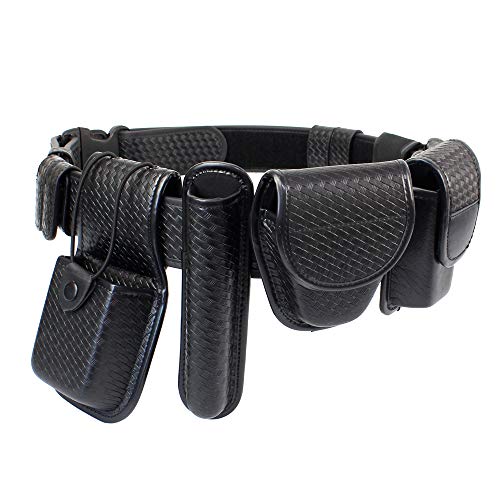
The basketweave finish and two stated size bands distinguish this kit from the adjustable plain-nylon rigs. The set pairs a 2.17-inch belt with a loop inner and holders for handcuffs, radio, light, baton, and MK3 spray; its triple-release polymer buckle uses a three-point release. The medium band covers 34–40 inches and large 40–46 inches, so the ranges meet at 40 inches. The limitation is the narrower stated maximum compared with the 35–45-inch sets; measure over the clothing you will wear on shift.
Bottom line: Choose this for a basketweave belt within its size range.
How to choose a correctional officer duty belt
Start with facility-approved equipment, then choose between a belt-only foundation and a kit with holders already attached. Duty belts commonly use 2-inch webbing; measure over the uniform or clothing worn on shift, because belt length around the waist is not the same as a pants size. Hook-and-loop inner/outer systems can help keep a loaded rig aligned while allowing the outer belt to come off separately. A belt with an interior stiffener is intended to resist sag under gear, but equipment weight and attachment compatibility still matter. Make a list of every required holder before choosing an all-in-one kit, since more included pouches do not guarantee the right configuration.
Duty belt sizing and fit
Measure the waist at the belt line over the clothing you will wear, then compare that measurement with the maker’s range; do not assume a pants label equals belt fit. For the two available adjustable-kit ranges here, 35–45 inches leaves less room at either extreme than 28–55 inches. The basketweave kit separates medium at 34–40 inches from large at 40–46 inches, with both covering 40 inches, so select based on actual worn measurement and buckle adjustment room. Keep sufficient overlap for secure fastening without an uncomfortable pinch or a buckle that sits off-center. With a fixed labeled size such as Medium, confirm the actual fit range before ordering.
Duty belt kits compared by setup
Kit format determines whether the buyer is mainly selecting a belt foundation or a preassembled group of holders. A separate inner belt is useful when a loaded outer belt needs to come off without removing the under belt; molded kits instead bundle a selection of pouches for a quicker start. Compare assortments by holder type rather than total count, because a radio pouch cannot substitute for a holder made for another item. The table summarizes the primary setup distinction.
| Setup | What it provides | Best fit condition |
|---|---|---|
| Outer and inner belt | Hook-lined outer belt with loop inner | You need a removable loaded outer rig |
| Molded pouch kit | Multiple shaped holders and keepers | The included holders match approved gear |
| Adjustable modular set | Detachable accessory holders | You want to configure the holder mix |
Duty belt safety and equipment checks
A duty belt must stay fastened and keep each item retained during movement, so verify buckle closure and pouch compatibility before a shift. Training guidance for law-enforcement duty gear commonly emphasizes balancing the load and keeping frequently used equipment accessible; follow your facility’s placement rules rather than rearranging required tools for convenience. Nylon construction and molded pouches do not establish a universal load rating, so do not exceed a maker’s limits or assume an accessory fits every model of equipment. Check that the belt does not obstruct safe movement, seating, or required protective equipment. Facility policy takes precedence over a kit’s included assortment, especially for weapon-related holders.
Frequently Asked Questions
How wide should a correctional officer duty belt be?
A 2-inch belt is a common duty belt width and is the width of several options here. A belt around 2 inches wide will not necessarily fit every keeper or pouch, so match attachment widths before building a rig.
How do I measure for a duty belt?
Measure around the waist at the belt line over the uniform or clothing worn on shift. Compare that number with the belt’s range and leave enough adjustment for a secure buckle position.
What does a hook-lined duty belt do?
A hook-lined outer belt attaches to the loop side of a compatible inner belt to help keep the two aligned. Confirm that the inner belt is the correct width and has the matching loop surface before pairing them.
How many belt keepers does a duty belt need?
Four keepers are included with one of the full rigs here, but the right number depends on belt length and the need to control movement between outer and inner belts. Distribute keepers around the belt so the rig stays positioned without interfering with the buckle or access to gear.
Can I use any pouch on a 2-inch duty belt?
No; a pouch or keeper must be designed to fit the belt width and attachment style. Measure the belt and check the pouch’s mounting method, especially when mixing molded holders with hook-and-loop systems.