
Terracotta Air Drying Clay: 5 Options Compared

For most pottery makers who want a larger supply, 10 lb Terracotta Natural Air-Dry Clay stands out with 10 pounds of clay and individually sealed pieces. Choose Crayola Terra Cotta Air Dry Clay, 5 lb instead for a reusable bucket aimed at kids’ projects, or a smaller block if you want less clay on hand.
Air-drying clay hardens as moisture evaporates, so the size and thickness of a project affect drying time and cracking risk.
We earn a commission if you buy through links on this page. As an Amazon Associate I earn from qualifying purchases. Products are compared on manufacturer specifications, not hands-on testing.
- Best overall: 10 lb Terracotta Natural Air-Dry Clay – Its 10-pound supply and individually sealed pieces suit frequent pottery work and storage.
- Best for kids: Crayola Terra Cotta Air Dry Clay, 5 lb – The 5-pound bucket is made for kids’ crafts and can be softened with water.
- Best for portioning: Aujazyble Terracotta Natural Clay, 3.3 lb – Three separate 1.1-pound packs let you open smaller amounts as needed.
| Product | Best for | Weight | Package format | Kiln use | Shop |
|---|---|---|---|---|---|
| 10 lb Terracotta Natural Air-Dry Clay | Pottery studios | 10 lb | Individually sealed pieces | Air-dry or kiln-fire | Check Price on Amazon |
| Crayola Terra Cotta Air Dry Clay, 5 lb | Kids’ projects | 5 lb | Reusable bucket | Air-dry | Check Price on Amazon |
| Aujazyble Terracotta Natural Clay, 3.3 lb | Fresh portions | 3.3 lb | Three sealed packs | Air-dry or kiln-fire | Check Price on Amazon |
| ReArt Terracotta Air-Dry Clay, 2.2 lb | Fine sculpting | 2.2 lb | Single pack | Air-dry; kiln-dry option | Check Price on Amazon |
| DAS Terra Cotta Modeling Clay, 1.1 lb | Small projects | 1.1 lb | Single block | Air-dry | Check Price on Amazon |
Terracotta Air Drying Clay Options
Compare clay quantity, storage format and stated firing options to match your project and workspace.
10 lb Terracotta Natural Air-Dry Clay

The 10-pound quantity and individually sealed pieces make this the largest option here for studios, classes or artists who work through clay regularly. The maker says it is made from natural kaolin and clay, can be air-dried and painted, or glazed and kiln-fired. That flexibility suits projects that may move from hand-building to a kiln finish. Its larger total weight is less practical for someone who only needs enough for a small figure or occasional craft; consider a smaller block if storage space or project scale is limited.
Bottom line: Pick this for regular pottery work when you want a larger supply and the option to kiln-fire.
Crayola Terra Cotta Air Dry Clay, 5 lb
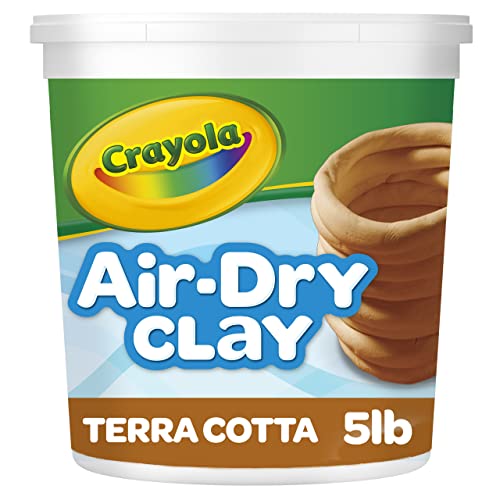
The reusable bucket and kid-focused positioning set this 5-pound option apart for family craft sessions or classroom projects. The maker says it needs no baking, can be softened with water and works with Crayola Project Paints and acrylic paints. A bucket is convenient for keeping a larger amount together between projects, though it is a less portioned format than individually sealed packs. Choose this option when ease of use and a kids’ craft supply matter more than an explicitly stated kiln-firing path.
Bottom line: Choose this for kids’ modeling projects and a clay supply that can be softened with water.
Aujazyble Terracotta Natural Clay, 3.3 lb

Three separately vacuum-sealed 1.1-pound packs distinguish this 3.3-pound set from bulk clay in a single container. The maker says the natural kaolin clay can air-dry or be kiln-fired, and presents the formula as designed to resist cracking. Smaller sealed portions can help limit how much clay is exposed during a session. The no-cracking language is a maker claim rather than a guarantee for every shape or drying condition, so this set may not suit buyers who need a predictable crack-free result.
Bottom line: Pick this when you prefer opening clay in smaller sealed portions and want a kiln option.
ReArt Terracotta Air-Dry Clay, 2.2 lb

The maker emphasizes fine grain and detail, which sets this 2.2-pound clay apart for sculpting or hand-modeling smaller forms. It is described as self-hardening and workable for carving, sanding and drilling after curing; the maker also gives a drying example of 24 hours for a 1/4-inch thickness. It can be kiln-dried if desired. At 2.2 pounds, it offers less material than the larger studio and classroom-oriented options, so it is a more sensible fit for focused projects than repeated large batches.
Bottom line: Choose this for detailed sculpting in a moderate quantity, especially if post-cure carving matters.
DAS Terra Cotta Modeling Clay, 1.1 lb

The 1.1-pound block is the smallest quantity in this group, making it the simplest fit for a limited project or a first try with air-hardening clay. The maker says it has a smooth, even texture, stays malleable for forming, and hardens without oven baking. The line is presented for kids and adults and for figures, decorations and jewelry. Its compact amount may run short for larger pieces or several people working at once; choose a larger pack when you expect to build multiple substantial forms.
Bottom line: Pick this for a small sculpture or a single craft session that needs only a little clay.
How to Choose Terracotta Air Drying Clay
Choose by project quantity first, then by whether your finished piece needs a kiln. Small blocks suit one or two modest projects, while a multi-pound supply is more useful for classes or repeated work. Air-dry clay hardens as water leaves the material; thick forms and humid rooms take longer to dry than thin forms in dry air. Build hollow forms with walls of even thickness rather than a solid mass to help moisture escape more evenly. For a piece that must be kiln-fired or glazed, select a clay whose maker expressly allows that process and confirm the firing requirements before using a kiln. Do not assume every air-dry clay tolerates kiln heat.
Drying and Joining Terracotta Clay
Dry pieces slowly and evenly to reduce stress from one surface shrinking faster than another. Keep unfinished work loosely covered between sessions, then uncover it gradually as it firms; rapid drying near a heater or in direct sun can encourage cracks and warping. When joining two parts, scratch or score both contact surfaces and add a thin layer of water-thinned clay as slip, then press the joint firmly together. Support projecting parts while they dry, since soft clay can slump under its own weight. A useful decision rule is to avoid adding a thick solid lump to a thin wall: redesign the form hollow or build the area in layers so thickness stays more consistent.
Air-Dry Clay Versus Kiln-Fired Pottery Clay
Air-dry clay hardens without a kiln, while kiln-fired clay requires a compatible clay body and a controlled firing process. Air-dried objects are generally more vulnerable to water than properly fired ceramic, and paint or a surface sealer should not be treated as proof of food safety or waterproofing. Use fired, food-safe ceramics for dishes that contact food or drink; choose craft clay for decorative work unless the maker provides suitable firing and use guidance. The options here differ in stated kiln use, so check that point before planning a fired finish. A classroom without kiln access should prioritize an air-dry-only workflow and keep the finished object decorative.
Painting and Storing Terracotta Air Drying Clay
Let a project dry completely before painting so trapped moisture does not interfere with the finish. Water-based paint can add color, and a compatible clear sealer can help protect decorative pieces from light handling or splashes, but sealing does not make an object reliably waterproof or food-safe. Unused clay needs an airtight wrap or container to slow moisture loss; reseal opened portions promptly rather than leaving them exposed during cleanup. If clay starts to stiffen, add water gradually and knead it in instead of soaking the whole batch. Avoid returning paint-contaminated scraps to clean clay, since the added material can change its texture and color.
Frequently Asked Questions
How long does terracotta air-dry clay take to dry?
Drying time depends on thickness, humidity and airflow; a thin piece dries sooner than a thick solid form. One maker gives 24 hours for a 1/4-inch thickness, but that timing should not be applied to every clay or project.
Can air-dry clay be used for food or drink?
Treat ordinary air-dry clay pieces as decorative, not food-contact surfaces. Air drying does not create the fired ceramic surface associated with food-safe pottery, and paint or sealer alone is not a substitute.
How do you keep air-dry clay from cracking?
Keep the form’s walls even and dry it gradually, since uneven moisture loss can create stress and cracks. Score both surfaces and use slip when attaching parts so the joint is not just pressed onto a smooth surface.
Can terracotta air-dry clay go in a kiln?
Only use a kiln when the clay maker says that product is suitable for firing. Confirm the required firing conditions before use, because air-dry formulations do not all have the same firing suitability.
How should opened air-dry clay be stored?
Wrap unused clay airtight or seal it in a container as soon as a session ends to slow drying. Individually sealed portions can limit exposure of the remaining supply, while water can be kneaded in gradually if clay begins to stiffen.