
Best Around-the-Ear Earbuds for Different Needs

For most people seeking around-the-ear earbuds, bmani Wireless Earbuds with Over-Ear Hook is the clearest match because its over-ear hook is explicit and each earbud is claimed to play for up to 8 hours per charge. Choose JBL Soundgear Clips instead if an open-ear design and hearing your surroundings matter more than a hook fit.
We earn a commission if you buy through links on this page. As an Amazon Associate I earn from qualifying purchases. Products are compared on manufacturer specifications, not hands-on testing.
- Best overall: bmani Wireless Earbuds with Over-Ear Hook – It has an explicit over-ear hook and maker-claimed 8-hour playback per charge.
- Best for noise reduction: occiam Active Noise Cancelling Earbuds – Its maker claims active noise cancellation reduces ambient noise by up to 45 dB.
- Best for open-ear awareness: JBL Soundgear Clips – Its open-ear construction leaves the ear canal unobstructed.
| Product | Best for | Wearing style | Playback claim | Shop |
|---|---|---|---|---|
| bmani Wireless Earbuds with Over-Ear Hook | Hook-secured workouts | Over-ear hook | Up to 8 hours per charge; 80 hours total | Check Price on Amazon |
| occiam Active Noise Cancelling Earbuds | Noise reduction | Over-ear hooks | Up to 8 hours per charge; 48 hours with case | Check Price on Amazon |
| JBL Soundgear Clips | Open-ear awareness | Open-ear clip design | Up to 8 hours; 32 hours total | Check Price on Amazon |
Around-the-Ear Earbuds Compared
Choose by whether you want a hook-secured fit or open-ear listening, then weigh the battery and protection claims.
bmani Wireless Earbuds with Over-Ear Hook

bmani Wireless Earbuds with Over-Ear Hook is the most direct match for shoppers seeking a hook that wraps around the ear, rather than a conventional in-ear-only shape. The maker claims up to 8 hours of playback from each earbud and up to 80 hours using the charging case; dual LED indicators show case power and earbud charging status. Dual microphones and button controls are also included. This design suits runners who prioritize a more secure-feeling fit and physical controls. The maker does not establish a water-resistance rating, so verify that rating before choosing it for wet-weather training.
Bottom line: Choose this if an over-ear hook and button controls matter most.
occiam Active Noise Cancelling Earbuds

occiam Active Noise Cancelling Earbuds combines over-ear hooks with an IPX7 rating, making it the choice here for buyers who want that fit plus a water-protection class. The maker claims active noise cancellation can reduce ambient noise by up to 45 dB, and claims 8 hours from a charge or 48 hours with the case when both earbuds are used together. Those noise-reduction and playback figures are manufacturer claims, not guarantees for every setting. This model suits workouts where cutting surrounding sound is a priority; that same isolation may be a poor choice when you need to hear traffic or other cues.
Bottom line: Pick this when noise reduction and an IPX7 rating are priorities.
JBL Soundgear Clips
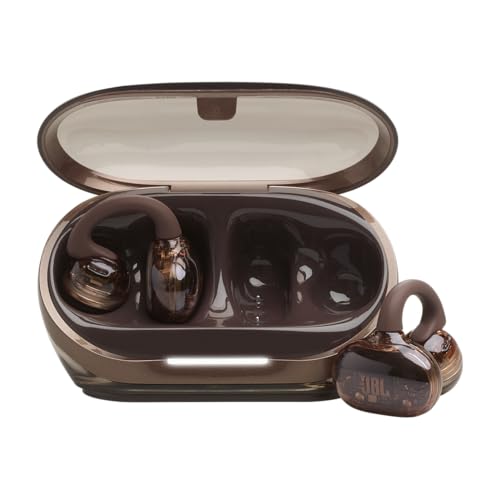
JBL Soundgear Clips differs from the hook-style sports earbuds: it uses an open-ear clip design that does not obstruct the ear canal. JBL says its OpenSound technology is intended to preserve situational awareness, while the 11 mm dynamic driver includes Adaptive Bass Boost. JBL claims up to 8 hours of playback from the earbuds and 24 additional hours from the case, for up to 32 hours total. The IP54 rating covers water and dust resistance, but this is not the same protection class as IPX7. Choose this style for awareness rather than a sealed, noise-isolating fit.
Bottom line: Choose this for open-ear listening and awareness over a hook fit.
How to choose around-the-ear earbuds
Start by deciding whether you want a hook-secured fit or an open-ear clip. Over-ear hooks loop around the outer ear and can help keep earbuds in place during movement; open-ear designs sit outside the canal and leave environmental sound easier to hear. For running near roads, favor awareness over noise reduction. For indoor workouts where external sound is less important, a hook style may suit your preference.
Compare per-charge playback separately from total case playback: a larger case total does not mean a single charge lasts that long. Treat noise cancellation, audio performance and battery runtime as maker claims, since listening volume, connection features and use patterns can affect actual runtime. If you need a specific water rating for training, select a model with a rating explicitly given rather than assuming all sports earbuds provide the same protection.
| Need | Style to consider |
|---|---|
| Earbud held by an outer-ear loop | Over-ear hook |
| Ear canal left unobstructed | Open-ear clip |
| Reduced ambient sound | Noise cancelling hook style |
What water-resistance ratings mean
IP ratings describe protection against defined dust and water exposure, not permission to submerge electronics without limit. IPX7 indicates water-ingress protection under specified temporary immersion conditions; IP54 indicates dust protection and resistance to water splashes, a lower water-exposure category. The letter X means no dust-protection number is provided in that rating, as with IPX7.
Use the rating to match the likely exposure: sweat and rain are different from swimming or prolonged immersion. A water rating also does not establish that a charging case is protected. Dry earbuds before charging and keep moisture away from the case contacts; charging wet electronics can cause damage. If a workout requires a particular protection level, check that the rating applies to the earbuds themselves.
How to compare earbud battery claims
Earbud runtime figures usually separate listening time on one charge from total time with the case. In these options, the claimed per-charge figures top out at 8 hours, while case-assisted totals range from 32 to 80 hours. Compare the single-charge figure if you spend long stretches away from charging; compare the case total if you can recharge the buds between sessions.
Actual runtime can change with volume, call use and enabled sound features, so leave a buffer rather than planning to use every claimed hour. A case display can help track remaining case power, but it does not lengthen an individual earbud charge. For a long event, estimate the listening window and choose a model whose claimed per-charge runtime exceeds it.
Open-ear and hook styles for running
Open-ear earbuds leave the ear canal clear, while hook-style models secure around the outer ear and may still use an in-ear listening piece. That distinction matters more than the general label “sports earbuds”: an open-ear fit supports awareness, while noise cancellation is designed to reduce ambient sound. Neither style guarantees a secure fit for every ear shape, so check fit during low-risk activity before relying on it for a run.
Outdoor runners should retain awareness of vehicles, cyclists and other people; audio should not mask audible hazards. Keep volume low enough to hear surroundings, and obey local rules governing headphone use. For indoor training, environmental awareness may be less important, but comfort and stability still depend on fit, not battery capacity or water-resistance rating.
Frequently Asked Questions
Do over-ear hook earbuds stay in place while running?
An ear hook wraps around the outer ear and can help resist movement, but fit still depends on ear shape and adjustment. Test the fit during an easy workout before using the earbuds on a road run.
Can IPX7 earbuds be used for swimming?
IPX7 indicates protection under specified temporary immersion conditions, but it does not guarantee suitability for swimming or underwater audio use. Check the maker’s specific use guidance and keep the charging case dry.
Does a case playback total mean one charge lasts that long?
No; total playback includes recharging from the case, while per-charge runtime applies to the earbuds between case visits. For a session away from charging, use the per-charge figure to judge fit.
Are open-ear earbuds better for running near traffic?
Open-ear designs do not obstruct the ear canal, which can make surrounding sound easier to hear than with isolating earbuds. Keep volume low and stay alert, because no earbud style replaces watching for hazards.