
RC ERA C189 MD500 Helicopters Compared by Fit

Actualia RC ERA C189 MD500 is the closest match for an RC ERA C189 MD500 because its name identifies the model and its features include 6-axis gyro stabilization. Choose another C189 variant if you specifically want barometric and optical-flow positioning or a brushless motor.
We earn a commission if you buy through links on this page. As an Amazon Associate I earn from qualifying purchases. Products are compared on manufacturer specifications, not hands-on testing.
- Best overall: Actualia RC ERA C189 MD500 – It explicitly names the RC ERA C189 MD500 and includes a 6-axis gyro.
- Best for optical flow: Ssccgym C189 MD500 Green, 2 Batteries – It combines barometric and optical-flow positioning with two batteries.
- Best for 6-axis and optical flow: Dodoore C189 MD500 Red, 2 Batteries – It pairs a 6-axis gyroscope with optional optical-flow positioning.
| Product | Best for | Stabilization | Shop |
|---|---|---|---|
| Actualia RC ERA C189 MD500 | Named model match | 6-axis gyro | Check Price on Amazon |
| Ssccgym C189 MD500 Green, 2 Batteries | Optical-flow positioning | Barometric and optical flow | Check Price on Amazon |
| C189 MD500 Brushless, 1 Battery | Brushless motor | Barometric and optical flow | Check Price on Amazon |
| Ssccgym C189 MD500 Red, 2 Batteries | Advanced stunt option | Barometric and optical flow | Check Price on Amazon |
| Dodoore C189 MD500 Red, 2 Batteries | Optional optical flow | 6-axis gyro; optional optical flow | Check Price on Amazon |
RC ERA C189 MD500 Helicopters
Compare the rotor dimensions and stabilization features to choose a C189 configuration that suits your flying space and priorities.
Actualia RC ERA C189 MD500

Unlike the other options, this model explicitly identifies itself as an RC ERA C189 MD500 and lists a 6-axis gyro. It is a 4-channel, 2.4 GHz single-rotor helicopter with one-key takeoff and landing, according to its features. Choose it if the named model and simplified takeoff and landing controls matter more than optical-flow positioning. The product features also give a 100–120 m control range; that figure is a maker claim, not a guarantee for every setting. The battery count is unclear, so confirm the package configuration before ordering.
Bottom line: Pick this if the RC ERA C189 MD500 name and one-key takeoff and landing are your priorities.
Ssccgym C189 MD500 Green, 2 Batteries

This green C189 package stands out for pairing barometric and optical-flow positioning with two batteries. Its rotor diameter is 320 mm, body length is 335 mm, and the features identify a double brushless motor. The maker says the positioning works best in well-lit indoor spaces and describes calm-wind outdoor use as suitable. That makes this option a fit for pilots prioritizing sensor-assisted positioning, rather than an one-key takeoff feature. Optical flow needs visible surface detail and light to estimate movement, so dim or visually plain indoor areas can limit the benefit.
Bottom line: Choose this if you want optical-flow positioning and two included batteries.
C189 MD500 Brushless, 1 Battery
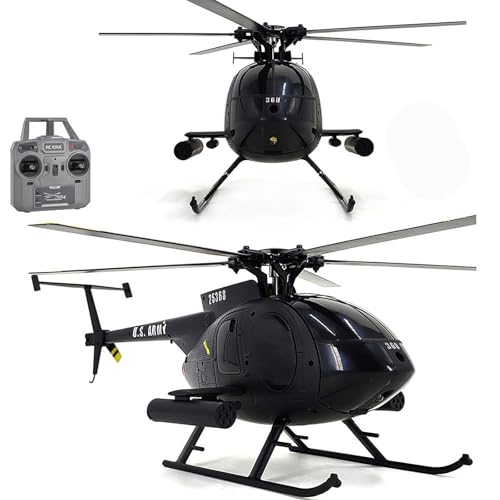
This version pairs a double brushless motor with barometric and optical-flow positioning, while its package specifies one battery. The 320 mm rotor and 335 mm body length match the dimensions given for the other C189 variants, so its distinction is its motor and battery configuration rather than a different size. It is suited to a buyer who wants the brushless specification but does not need a two-battery package. The manufacturer notes that horizontal drift can occur and may need transmitter-stick correction; positioning assistance should not be treated as hands-off hovering.
Bottom line: Pick this if a double brushless motor matters more than an extra battery.
Ssccgym C189 MD500 Red, 2 Batteries

This red variant is distinguished by its two-battery package and an explicit warning that 3D stunt flying is not beginner-friendly. It shares a 320 mm rotor diameter and 335 mm body length with the other C189 options, and its features describe barometric and optical-flow dual stabilization. The maker says drift can occur and can be corrected with transmitter joysticks. Choose this configuration if you want the red version and already have the skill to approach advanced stunt functions cautiously. New pilots should prioritize basic control practice and avoid attempting stunts.
Bottom line: Choose this if you want the red two-battery version and can skip advanced stunts while learning.
Dodoore C189 MD500 Red, 2 Batteries

This Dodoore variant combines a 6-axis gyroscope with optional optical-flow positioning, rather than making optical flow its only distinction. Its features also describe a 4-channel variable-pitch structure, altitude hold, and a brushless motor; the red package specifies two batteries. It suits buyers looking for both gyro stabilization and an optical-flow option. The features describe optical flow as optional, so do not assume the function is active in every configuration. A 320 mm rotor diameter also means you need clear space around the rotor, not just room for the 335 mm body.
Bottom line: Pick this if you want a red two-battery model with 6-axis gyro and optional optical flow.
How to choose an RC ERA C189 MD500
Choose by stabilization, included battery count, and the controls you value; the shared C189 size does not distinguish these variants. Optical flow uses visual input from the surface below to estimate movement, so bright lighting and visible texture matter. Barometric altitude hold uses pressure changes to help maintain height, but it does not prevent horizontal drift. A 6-axis gyro senses rotation and helps stabilize attitude; it is not the same as position hold. If a feature is essential, select a model that names it explicitly rather than assuming all C189 versions have the same sensors. For a first helicopter, prioritize basic hovering and directional control before attempting stunts.
Room and rotor clearance for C189 helicopters
A 320 mm rotor spans about 12.6 inches, so allow substantially more than 12.6 inches of open width for movement and correction. A practical decision rule is to use an area at least 3 feet wide for basic indoor practice, with more space preferable for turns. Keep the rotor path clear of people, pets, curtains, and loose objects; small helicopter blades can still cause injury or damage. These models are described as working best in well-lit indoor environments, and calm conditions are the outdoor limit for the sensor-positioning versions. Do not treat a stable hover feature as permission to fly near faces or over fragile objects.
What 4 channels control on a single-rotor helicopter
A 4-channel helicopter typically separates lift, forward and backward pitch, left and right roll, and yaw rotation into four control inputs. On a single-rotor model, changing one input can affect how much correction is needed from the others, so practice with small stick movements in a clear area. The C189 features include ascent, descent, forward and backward travel, sideways movement, and rotation. Optical-flow positioning can assist movement estimation over a visible surface, but it cannot remove the need for active control. Start with gentle takeoff, hovering, landing, and heading changes; leave aerobatics until you can reliably manage those basics.
Battery and stunt choices
Two-battery packages provide a spare pack, but the features do not give flight time or charging time, so those figures should not drive a comparison here. A spare battery is useful only when it is compatible with the transmitter-aircraft set and charged according to the battery maker’s instructions. Stunt functions require more control skill than hovering: the red Ssccgym variant explicitly cautions that 3D stunts are not beginner-friendly. If you are learning, avoid stunt inputs until you can take off, hold position, and land consistently in an open area. Remove or disconnect the battery before handling the rotor or working near the drive system.
Frequently Asked Questions
How much room does a 320 mm rotor need?
A 320 mm rotor is about 12.6 inches across, and a clear area at least 3 feet wide is a sensible starting point for basic indoor practice. More space helps leave room for drift and corrections.
Does optical flow work in a dark room?
Optical-flow positioning needs light and visible surface texture to estimate movement. These C189 feature descriptions say performance is best in well-lit indoor environments, so dim or plain floors can reduce assistance.
Can beginners fly the C189 MD500?
Beginners can start with basic hovering and direction control, but the red Ssccgym version warns that 3D stunt flying is not beginner-friendly. Practice takeoffs and landings in a clear area before attempting advanced maneuvers.
What does a 6-axis gyro do on an RC helicopter?
A 6-axis gyro senses rotation and helps stabilize the helicopter’s attitude; it is not the same as optical-flow position holding. Positioning features still cannot guarantee a drift-free hover.
Is calm weather enough for outdoor C189 flights?
The optical-flow C189 features describe calm-wind outdoor flight as suitable, while also identifying well-lit indoor use as best. Avoid flying near people or obstacles, since rotor clearance and active control remain important.