
Bionaire Twin Window Fan: Fit and Airflow Compared

The Bionaire twin window fan suits buyers who want separate blade control and a programmable thermostat, and whose window is 24 to 37 inches wide. Choose a different model if your window is narrower or you prefer rotating fan heads or a removable bug screen.
We earn a commission if you buy through links on this page. As an Amazon Associate I earn from qualifying purchases. Products are compared on manufacturer specifications, not hands-on testing.
- Best overall: Bionaire Reversible Window Fan – Independent blade controls, automatic modes, and a programmable thermostat distinguish it from the manual-reverse alternatives.
- Best for remote control: Comfort Zone Reversible Twin Fan, 3-Speed – This model has three speeds, intake, exhaust, and circulate modes, plus a remote.
- Best for directional airflow: Comfort Zone Twin Fan with Rotating Heads – Its two fan heads rotate independently through 180 degrees and can face opposite directions.
| Product | Best for | Window width | Speeds | Airflow control | Shop |
|---|---|---|---|---|---|
| Bionaire Reversible Window Fan | Thermostat control | 24–37 in. | 3 | Independent blades; automatic modes | Check Price on Amazon |
| Comfort Zone Reversible Twin Fan, 2-Speed | Simple ventilation | 22¼–33 in. | 2 | Manually reverse unit | Check Price on Amazon |
| Comfort Zone Reversible Twin Fan, 3-Speed | Remote mode changes | 22¼–33 in. | 3 | Intake, exhaust, circulate; remote | Check Price on Amazon |
| EZ-CHILL 9-Inch Twin Window Fan | Two-speed airflow | — | 2 | Manually reversible | Check Price on Amazon |
| Comfort Zone Twin Fan with Rotating Heads | Directional airflow | 21.6–33 in. | 2 | 180° rotating heads | Check Price on Amazon |
Bionaire Twin Window Fans and Alternatives
Compare window fit and airflow controls first, since those determine whether a twin fan suits your window and how you can direct air.
Bionaire Reversible Window Fan

The Bionaire stands apart with a programmable thermostat and remote control, rather than only manual airflow reversal. Its two blades can be controlled independently, and the fan can draw air in, exhaust it, or run both directions at once. It fits double-hung, vertical slider, and casement windows 24 to 37 inches wide. Choose it if you want thermostat-based operation and flexible airflow; the window range is wider than the other models’ 33-inch maximum, so it may not fit a narrower opening.
Bottom line: Choose this if your window fits and thermostat control matters more than a bug screen or rotating heads.
Comfort Zone Reversible Twin Fan, 2-Speed

The two-speed Comfort Zone is a straightforward manual-reversal option with a removable bug screen and fabric cover, features that separate it from the thermostat-equipped Bionaire. Its accordion expanders lock automatically across a 22¼- to 33-inch width range, and removable feet let it sit on a tabletop. Turn the fan around in the window to change between drawing air in and pulling air out. Choose it for basic ventilation and the included barrier accessories; it lacks the Bionaire’s remote and programmable thermostat.
Bottom line: Choose this for two speeds, a removable screen, and a cover rather than thermostat control.
Comfort Zone Reversible Twin Fan, 3-Speed

The three-speed Comfort Zone adds a remote and three airflow modes, unlike the two-speed manually reversed models. Its modes are intake, exhaust, and circulate, with Low, Medium, and High settings; locking accordion expanders adjust from 22¼ to 33 inches. It also includes a removable bug screen and dust cover. Choose it when changing modes from across the room is useful. The maximum width is 33 inches, so a window wider than that falls outside its expansion range.
Bottom line: Choose this if you want remote mode selection and your window is no wider than 33 inches.
EZ-CHILL 9-Inch Twin Window Fan

The EZ-CHILL provides two speeds and manually reversible airflow in a black, 9-inch twin fan design. The product name also gives an airflow figure of 9.84 feet per second. Consider it if two speed choices and manual reversal meet your needs; confirm the required window width before ordering, since fit is essential for a window-mounted fan.
Bottom line: Choose this for a two-speed, manually reversible fan after confirming your window width.
Comfort Zone Twin Fan with Rotating Heads
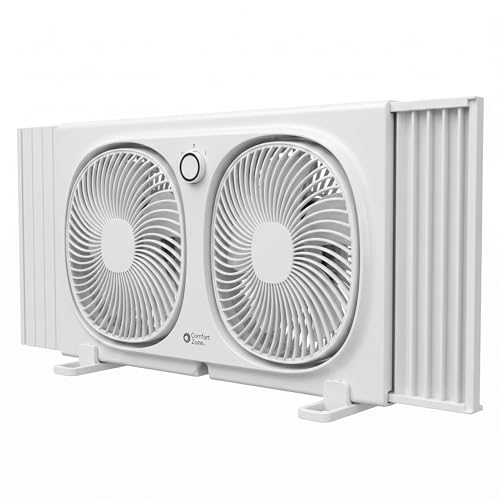
The rotating-head Comfort Zone differs from the other models by letting each 9-inch fan head pivot independently through 180 degrees. Set both for intake or exhaust, or point them in opposite directions for cross-ventilation. It has two speeds and auto-locking expanders for windows 21.6 to 33 inches wide. Choose it when directing air toward different parts of a room matters more than remote or thermostat operation. Its manual push-to-reverse adjustment is less convenient for changing airflow than a remote-controlled model.
Bottom line: Choose this if adjustable fan-head direction is more useful than remote or thermostat operation.
How to choose a twin window fan
Start with window width and the control style you will actually use. Measure the opening where the fan will sit, then compare that width with the model’s range; do not assume a fan that is close to the opening will fit securely. Manual-reverse models change airflow by turning the fan or adjusting its heads, while models with separate intake and exhaust modes can change direction without moving the whole unit. Thermostat control is useful when you want a selected comfort level maintained automatically, while a remote is useful when the fan is hard to reach. For a room with two windows, intake at one and exhaust at the other can create cross-ventilation.
Window fit and safe installation
Measure the clear width of the window opening and check the sash style before choosing a twin window fan. A range such as 22¼ to 33 inches is a width-fit guide, not a promise that every window configuration will secure the fan equally well. Keep the fan stable in the opening and close or secure the sash against its frame; do not rely on a loose fit to hold a powered appliance. Window fans are not substitutes for air conditioning during extreme heat, and a fan moving outdoor air can bring in smoke, pollen, or high humidity. If outdoor air quality is poor, keep the fan off and use another cooling strategy.
Airflow modes and ventilation strategy
Intake brings outdoor air in, exhaust pushes indoor air out, and cross-ventilation uses both paths to move air through a room or home. A fan that can set its two sides in opposite directions offers a way to combine intake and exhaust at one window, while a second window can provide a separate outlet. Use exhaust near a heat source or stale-air area and intake where outdoor air is cooler and cleaner. Close other openings that short-circuit the intended airflow, such as a nearby door between the intake and exhaust paths. Thermostat features control operation around a selected comfort level, but they do not make outdoor air cooler or remove humidity.
Twin window fan types at a glance
Choose a fan by the task its controls solve rather than by speed count alone. Manual reversal is simple but requires a physical adjustment; remote modes reduce trips to the window, and rotating heads add directional flexibility. A thermostat is a distinct control feature, not an airflow direction. Use the table to match a ventilation need with the control that addresses it.
| Need | Control to prioritize | Trade-off |
|---|---|---|
| Automatic comfort setting | Programmable thermostat | Requires a compatible window fit |
| Change modes from across the room | Remote control | Check the width range |
| Direct air in different directions | Independently rotating heads | Direction is adjusted manually |
| Basic intake or exhaust | Manual reversal | Requires physical adjustment |
Frequently Asked Questions
How do I measure a window for a twin fan?
Measure the clear width of the opening at the point where the fan will sit, then compare it with the fan’s adjustment range. Also check the window style and how the sash can secure the installed unit.
Can a twin window fan cool a room without air conditioning?
A window fan can improve ventilation and perceived comfort when outdoor air is cooler than indoor air. It does not cool below outdoor temperature, so close windows when outside air is hotter than the room.
Should a window fan face in or out?
Use intake when outdoor air is cooler and clean, and exhaust to push indoor air out. For through-flow, use an intake opening on one side of the room or home and an exhaust opening elsewhere.
Can I use a window fan during wildfire smoke?
Avoid drawing smoky outdoor air indoors; close windows and turn off intake airflow while smoke is present. A fan that exhausts indoor air can still pull replacement air through gaps, so sealing openings matters.
When should I clean a window fan?
Unplug the fan before cleaning its accessible surfaces, and remove accumulated dust regularly so it does not obstruct airflow. Keep moisture away from the motor and electrical controls.