
Tim Hortons Coffee: 4 Formats Compared for Home

Tim Hortons Original Blend ground coffee suits most home brewers because it works in automatic coffee makers, French presses, pour-over and cold brew. Choose Tim Hortons Original Blend K-Cup Pods, 100 ct instead if you use a compatible Keurig brewer, or Tim Hortons Original Whole Bean Coffee, 32 oz if you want whole beans to grind fresh.
We earn a commission if you buy through links on this page. As an Amazon Associate I earn from qualifying purchases. Products are compared on manufacturer specifications, not hands-on testing.
- Best overall: Tim Hortons Original Blend Ground Coffee, 48 oz – Ground Original Blend is usable in automatic coffee makers, French presses, pour-over and cold brew.
- Best for Keurig: Tim Hortons Original Blend K-Cup Pods, 100 ct – The 100-count single-serve pods are compatible with Keurig brewers.
- Best for whole-bean brewing: Tim Hortons Original Whole Bean Coffee, 32 oz – Whole beans let you grind coffee to suit your preferred brew method.
| Product | Best for | Format | Roast | Package size | Shop |
|---|---|---|---|---|---|
| Tim Hortons Original Blend Ground Coffee, 48 oz | Flexible brewing | Ground | Medium | 48 oz | Check Price on Amazon |
| Tim Hortons Original Blend K-Cup Pods, 100 ct | Keurig brewing | Single-serve pods | Medium | 100 pods | Check Price on Amazon |
| Tim Hortons Original Blend Ground Coffee, 30 oz | Smaller ground can | Ground | — | 30 oz | Check Price on Amazon |
| Tim Hortons Original Whole Bean Coffee, 32 oz | Grinding fresh | Whole bean | Medium | 32 oz | Check Price on Amazon |
Tim Hortons Coffee Formats Compared
Choose by how you brew and whether you prefer ground coffee, pods or whole beans.
Tim Hortons Original Blend Ground Coffee, 48 oz
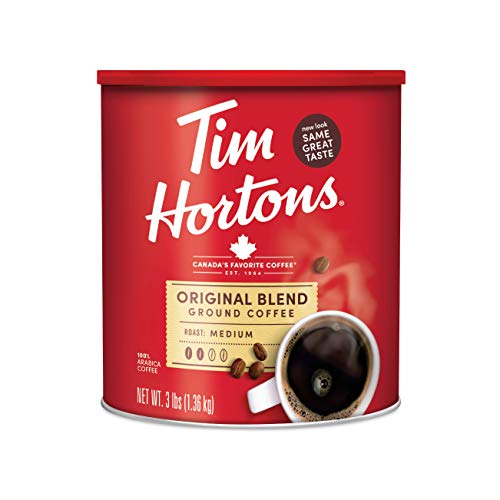
Among these four formats, the 48-ounce canister offers the widest range of brewing methods: automatic coffee makers, French presses, pour-over and cold brew. Tim Hortons says the Original Blend is a medium roast made with 100% Arabica beans from Central and South America, with a smooth finish. The three-pound canister suits households that want ground coffee ready to brew without a grinder. Ground coffee gives up the option to grind immediately before brewing, so choose whole beans if that step matters to your routine.
Bottom line: Pick this for ground coffee that can serve several brew methods.
Tim Hortons Original Blend K-Cup Pods, 100 ct

The 100-count pod package is the only single-serve option among these choices, and it is made for compatible Keurig brewers. Tim Hortons describes the coffee as its medium-roast Original Blend, made with 100% Arabica beans from Central and South America. The pods suit one-cup-at-a-time brewing without measuring loose grounds. They are less useful for households brewing with a French press, pour-over cone or automatic drip machine that does not accept compatible pods; select a ground format for those setups.
Bottom line: Choose these when your brewer accepts compatible Keurig pods.
Tim Hortons Original Blend Ground Coffee, 30 oz

The 30-ounce canister provides a smaller ground coffee package than the 48-ounce option, which can suit buyers who want less coffee on hand at once. Its name identifies it as Tim Hortons Original Blend ground coffee, and the package weighs 1.875 pounds. The specifications do not specify its roast, so compare roast preference using the package before choosing if that distinction is important to you. Ground coffee is ready to measure into a brewer, but it does not offer the grind adjustment available with whole beans.
Bottom line: Choose this if you want a smaller ground coffee canister.
Tim Hortons Original Whole Bean Coffee, 32 oz

Whole beans make this two-pound bag the distinct choice for anyone who wants to grind coffee immediately before brewing. Tim Hortons identifies it as a medium-roast Original Blend made with 100% Arabica beans and says it is ideal for automatic coffee makers. Unlike the ground formats, it requires a grinder, and the grind size must suit the brewing method: coarse for a French press and finer for many drip brewers. Choose a ground canister or compatible pods if you do not have a grinder.
Bottom line: Pick this if you own a grinder and want whole-bean coffee.
How to choose a Tim Hortons coffee format
Start with your brewer: the format must match its brewing system. Ground coffee works across common methods when the grind suits the brewer, single-serve pods require a compatible pod machine, and whole beans need a grinder. For drip coffee, a medium grind is typical; French press brewing generally calls for coarse grounds. A finer grind exposes more surface area and can make a long-steeped brew taste over-extracted. Use this quick match before picking a package.
| Brewing setup | Format to choose |
|---|---|
| Automatic drip, French press, pour-over or cold brew | Ground coffee, with grind matched to method |
| Compatible Keurig brewer | Single-serve pod |
| Grinder available, grind control wanted | Whole beans |
For cold brew, coarse grounds are commonly steeped in cold water for about 12 to 24 hours, then filtered.
Ground, pod and whole-bean coffee differences
Ground coffee is the most direct option when you want to measure and brew without extra equipment. Whole beans preserve the ability to choose grind size and are typically ground just before brewing; a burr grinder produces more even particle sizes than a blade grinder. Pods simplify single-cup portions, but they commit you to a compatible machine and a fixed serving format. Consider what happens after opening, too: oxygen, heat, moisture and light dull coffee aroma, so keep beans or grounds sealed in a cool, dry cupboard rather than near a stove.
Choose the format that fits the equipment you already use rather than assuming all Original Blend packages brew the same way. A bag of whole beans cannot be used directly in a drip basket, and pods are not interchangeable with every single-serve brewer.
Roast, grind and brew strength
Medium roast describes roast level, not how strong a finished cup tastes; brew strength is mainly affected by the coffee-to-water ratio, grind and contact time. A common starting point for brewed coffee is about 1 to 2 tablespoons of grounds per 6 ounces of water, then adjust to taste. Weighing coffee is more repeatable: roughly 1 gram of coffee per 15 to 18 grams of water is a typical starting range. Use a coarser grind for immersion brewing and a medium grind for drip, then adjust one variable at a time.
If roast level is a deciding factor, verify the package before choosing that canister.
Keeping coffee fresh after opening
Store coffee airtight, dry and away from heat; avoid the refrigerator, where condensation and nearby food odors can affect the coffee. Buy a package size you can use while its aroma is still fresh, and close the container promptly after measuring. Whole beans generally retain aroma longer than pre-ground coffee because less surface area is exposed to air, though they still lose freshness over time. Do not leave a scoop inside an open can if it prevents a tight seal. For pods, keep the package dry and follow the brewer’s handling guidance.
For the best repeatable cup, use fresh water and rinse reusable equipment regularly; residue from old coffee oils can add stale flavors. Match the grind and brewing time to the method instead of compensating for an unsuitable grind by steeping much longer.
Frequently Asked Questions
How much coffee should I use per cup?
A common starting point is 1 to 2 tablespoons of ground coffee for each 6 ounces of water. For more consistent results, try about 1 gram of coffee per 15 to 18 grams of water and adjust to taste.
What grind works best for a French press?
Use a coarse, fairly even grind for French press coffee, which typically steeps for about 4 minutes before plunging. Fine grounds can pass through the mesh and leave more sediment in the cup.
Can I use ground coffee for cold brew?
Yes; coarse-ground coffee is a common choice for cold brew. Steeping for roughly 12 to 24 hours in cold water is a typical range, followed by filtering.
How should I store coffee after opening?
Keep coffee in an airtight container in a cool, dry, dark cupboard. Heat, moisture, light and oxygen speed aroma loss, so avoid storing it beside a stove or in the refrigerator.
Do K-Cup pods work in every single-serve brewer?
No; pod systems are not universally interchangeable. Check that the brewer is compatible with Keurig-style pods before choosing a K-Cup format.