
Difeel Hair Oil: 5 Formulas Compared by Use

For Difeel hair oil, choose Difeel Rosemary and Mint with Biotin if you want a rosemary-and-mint blend with biotin; its focus is lightweight moisture, shine, and manageability. Choose a different formula if coconut conditioning, a multi-use oil, or a two-piece collection better matches your routine.
Hair oils coat strands or the scalp to add slip and reduce the feel of dryness; they do not replace shampoo or conditioner.
We earn a commission if you buy through links on this page. As an Amazon Associate I earn from qualifying purchases. Products are compared on manufacturer specifications, not hands-on testing.
- Best overall: Difeel Rosemary and Mint with Biotin – Combines rosemary and mint oils with biotin and a lightweight-moisture focus.
- Best for coconut conditioning: Difeel Coconut Hair Oil Blend – The coconut blend focuses on soft, smooth-looking strands and frizz.
- Best for routine flexibility: Difeel Pro-Growth Hair Oil Blend – Its uses include daily scalp care, hot-oil treatment, and overnight care.
| Product | Best for | Size | Formula | Stated use | Shop |
|---|---|---|---|---|---|
| Difeel Rosemary and Mint with Biotin | Lightweight moisture | 7.1 fl oz | Rosemary, mint, biotin | Moisture and shine | Check Price on Amazon |
| Difeel Pro-Growth Hair Oil Blend | Flexible routines | 7.78 fl oz | Vitamin- and nutrient-enriched blend | Scalp and hair care | Check Price on Amazon |
| Difeel Biotin Hair Oil Blend | Frizz and flyaways | 7.1 fl oz | Biotin and botanical oils | Styling and scalp moisture | Check Price on Amazon |
| Difeel Coconut Hair Oil Blend | Coconut conditioning | 7.1 fl oz | Coconut oil blend | Conditioning and shine | Check Price on Amazon |
| Difeel Castor Oil Pro-Growth 2-Piece Set | Two-oil variety | 2-piece set | Castor oil; basil and castor blend | Dry-scalp care | Check Price on Amazon |
Difeel hair oils compared
Choose by the formula and application routine that best match your hair-care priorities.
Difeel Rosemary and Mint with Biotin

Difeel Rosemary and Mint with Biotin is the rosemary-and-mint option, pairing those oils with biotin in a 7.1-fluid-ounce bottle. Difeel says the blend helps moisturize dry hair, soften strands, reduce the look of frizz, and add shine without weighing hair down. That makes it a fit for someone seeking a scented botanical blend with a lightweight feel rather than a single-ingredient oil. The product’s benefits concern appearance and manageability, not guaranteed hair growth. Anyone sensitive to scented or botanical hair products should patch-test a small area before broader use.
Bottom line: Choose it for a rosemary-and-mint blend with a lightweight-moisture focus.
Difeel Pro-Growth Hair Oil Blend

Difeel Pro-Growth Hair Oil Blend stands out for its range of suggested routines: Difeel says it can be used as a daily scalp treatment, moisturizing oil, hot-oil treatment, or overnight treatment. The 7.78-fluid-ounce size is the largest single bottle among these blends. Its focus is moisture and fuller-looking hair, with a lightweight feel for dry hair and scalp. This is the most adaptable choice for someone who wants to vary application, but it is not a targeted botanical formula like rosemary-and-mint or coconut. Follow the product’s directions for any heated application; do not heat oil in a microwave.
Bottom line: Pick it if you want one blend for several application routines.
Difeel Biotin Hair Oil Blend

Difeel Biotin Hair Oil Blend puts biotin and botanical oils at the center of a blend intended for hair and scalp moisture, with frizz and flyaway control as a styling focus. Difeel says the oil is non-greasy and weightless, and that it helps improve the appearance of shine and manageability. Compared with the rosemary-and-mint option, this formula does not specify those two oils; it suits buyers who prioritize biotin and smoothing. The use text begins to describe multiple applications but does not establish a complete routine, so use it according to the package directions rather than assuming an overnight or heated treatment.
Bottom line: Choose it when smoothing and flyaway control are your main goals.
Difeel Coconut Hair Oil Blend

Difeel Coconut Hair Oil Blend is the coconut-focused option, with conditioning and smoother-looking strands as its distinguishing aims. Difeel says the blend moisturizes dry hair and scalp and helps tame the look of frizz while adding natural-looking shine. Its suitability includes curly, coily, wavy, straight, natural, color-treated, and chemically treated hair, making it the broadest explicit hair-type match in this group. The formula is a blend rather than a pure coconut oil. Anyone wanting biotin or a rosemary-and-mint scent should compare the other formulas instead.
Bottom line: Pick it for a coconut blend aimed at conditioning and smoother-looking hair.
Difeel Castor Oil Pro-Growth 2-Piece Set
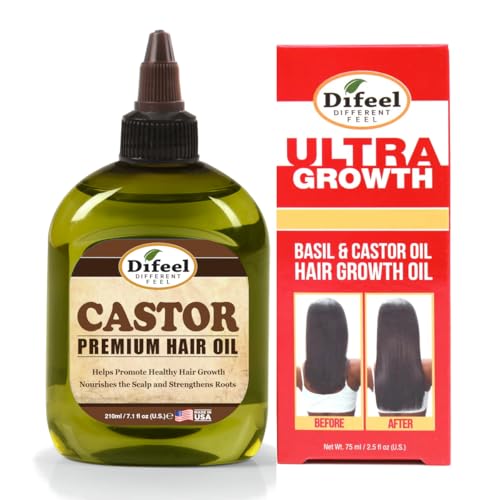
Difeel Castor Oil Pro-Growth 2-Piece Set differs from the single-bottle blends by combining two castor-oil products: an 8-ounce 99% natural castor hair oil and a 2.5-ounce growth oil infused with basil and castor oil. The set description emphasizes dry-scalp care and scalp nourishment. Its two formulas suit someone who wants both a castor oil and a separate basil-and-castor blend in one collection. The set’s claims about circulation and follicles are not a basis for expecting hair growth; use the oils for cosmetic care and follow each package’s directions.
Bottom line: Choose the set if you want two distinct castor-oil formulas.
How to choose a Difeel hair oil
Start with the result you want: conditioning, smoothing, or a particular ingredient blend. Hair oils are leave-on products, so a small amount is usually more manageable than saturating the hair; for fine or straight hair, start with 1–2 drops on the ends, while thicker or coily hair may need more. Add gradually rather than applying a large amount at once. Oils can leave residue on the scalp and strands, so wash buildup out with shampoo when hair starts to feel coated or look limp. A hair oil can support softness and shine, but it does not replace a conditioner or resolve a medical scalp concern. If irritation occurs, stop using the product and rinse the area.
Where and how to apply hair oil
Apply styling oil mainly to mid-lengths and ends when the goal is smoother-looking hair; use scalp application only when the product directions support it. A practical starting point is 1–2 drops for short or fine hair, then add a drop at a time if the ends still feel dry. Rub the oil between your palms and distribute it lightly to avoid concentrated greasy patches. For scalp use, part hair into sections and use a small amount rather than pouring it over the whole head. Keep oils away from the eyes, and do not apply heated oil directly to skin. A hot-oil routine should use gentle warming and a comfortable temperature, never boiling or microwave-heated oil.
Hair oil formulas compared by need
Formula and routine are the useful distinctions across these Difeel options: a blend name can help narrow the choice, but start with the use you want. Use this guide to match the focus to a routine before choosing a bottle.
| Need | Formula direction | Application consideration |
|---|---|---|
| Botanical blend and shine | Rosemary, mint, and biotin | Check tolerance to scented botanicals |
| Several routine options | Pro-growth blend | Use product directions for heated or overnight care |
| Frizz and flyaway styling | Biotin blend | Start with a small amount on lengths |
| Conditioning focus | Coconut blend | Adjust amount to hair texture |
| Two castor-oil formulas | Castor oil set | Check directions for each product separately |
Hair oil safety and buildup
Patch-test a new hair oil on a small area of skin and wait 24–48 hours before broader use, especially if you have reacted to fragrance or plant oils before. Stop use and rinse if itching, redness, or burning develops; avoid the eyes and broken skin. Hair oils can build up with repeated application, particularly at the scalp, so shampoo when residue makes hair feel waxy, heavy, or difficult to style. Keep oil away from open flames and hot tools until it has been washed out, since oil can be flammable. Do not heat oil in a microwave, which can create uneven hot spots; use only the product’s directions for any warming step.
Frequently Asked Questions
How much hair oil should I start with?
Start with 1–2 drops for short or fine hair and add gradually if the ends still feel dry. Thicker or coily hair may need more, but excess oil can leave a coating that takes shampooing to remove.
Can hair oil replace conditioner?
No, hair oil is not a substitute for conditioner. Use conditioner after shampooing for detangling and softness, and add a small amount of oil separately if you want extra slip or shine.
How often should I apply hair oil?
Begin with once or twice a week and adjust based on how your hair responds. If the scalp feels coated or the strands look limp, reduce use and shampoo away buildup.
Is it safe to heat hair oil at home?
Do not microwave hair oil because uneven heating can create hot spots. If the package permits warming, warm it gently in a container of hot water and check the temperature before application.
Should hair oil go on the scalp or ends?
For smoother-looking lengths, start at mid-lengths and ends, where dryness and flyaways are often most noticeable. Apply oil to the scalp only when the product directions allow it, and use a small amount to limit residue.