
Invisible Waterproof Anti-Leakage Agent: 5 Options

A water-based transparent coating is the closest match for an invisible waterproof anti-leakage agent, and 300g Invisible Waterproof Agent is a 300-gram option with a clear finish. Choose another product if your repair needs a conventional visible patch or a coating made for a specific substrate; these products’ stated use cases do not establish compatibility with every surface.
We earn a commission if you buy through links on this page. As an Amazon Associate I earn from qualifying purchases. Products are compared on manufacturer specifications, not hands-on testing.
- Best overall: 300g Invisible Waterproof Agent – Its 300-gram size and transparent, water-based coating align with the request for an invisible anti-leakage agent.
- Best for broad surface use: 300g Transparent Waterproof Coating – It names roofs, walls, basements, sheds, gardens, gutters, skylights, pipes, bathrooms, chimneys and window sills.
- Best for larger package size: 21 oz Transparent Waterproof Sealant – The product name specifies 21 ounces, larger than the other package amounts.
| Product | Best for | Package size | Base | Color | Shop |
|---|---|---|---|---|---|
| 300g Invisible Waterproof Agent | Clear home repairs | 10.6 oz | Water-based | Transparent | Check Price on Amazon |
| 300g Transparent Waterproof Coating | Multiple repair areas | 10.6 oz | Water-based | Clear | Check Price on Amazon |
| 300g Transparent Waterproof Sealant | Temperature exposure | 10.6 oz | Water-based, solvent-free | Colorless | Check Price on Amazon |
| 10.5 oz Invisible Waterproof Sealant | Brush-on application | 10.5 oz | Water-based | Transparent | Check Price on Amazon |
| 21 oz Transparent Waterproof Sealant | Larger stated size | 21 oz; 2-pack | Water-based | Clear | Check Price on Amazon |
Invisible Waterproof Anti-Leakage Agents
Compare package size, coating base and use cases before choosing a clear sealant for a repair.
300g Invisible Waterproof Agent

300g Invisible Waterproof Agent is the compact 10.6-ounce option, with a transparent water-based coating intended for bathroom and roof repairs. The product’s claims describe a thin film for air, water and moisture insulation, with overlapping layers forming a bond. Its clear finish may suit repairs where preserving the surface appearance matters. The uses center on home bathroom and roof work, so this is a narrower fit than products naming many indoor and outdoor surfaces. Before applying any coating, remove loose material and dirt, and let the surface dry; a coating cannot reliably bond to a wet or crumbling base.
Bottom line: Choose it for a transparent, water-based coating in a 300-gram package.
300g Transparent Waterproof Coating
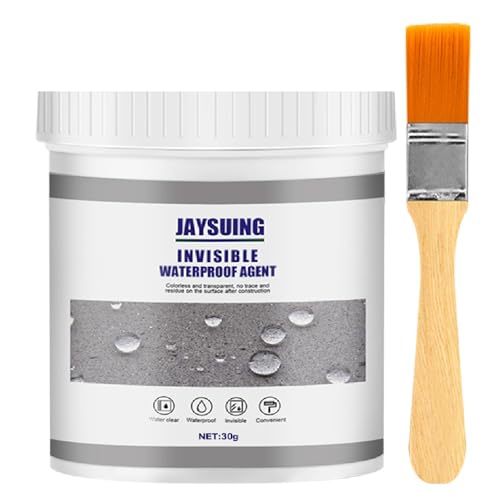
300g Transparent Waterproof Coating is distinguished by its broad set of named repair areas, including roofs, walls, basements, sheds, gutters, skylights, pipes, bathrooms, chimneys and window sills. It is a clear, water-based coating in a 10.6-ounce package. The manufacturer describes overlapping layers as forming a protective film, but the breadth of those uses does not prove suitability for every material or joint. For a leak at a moving seam or a connection under pressure, a brush-on film may not be the right repair type. Check the substrate and whether the leak area stays still before choosing this coating.
Bottom line: Choose it when you need a clear coating and the repair surface matches a named use.
300g Transparent Waterproof Sealant

300g Transparent Waterproof Sealant stands out for its solvent-free water-based formula and claims about resisting hot and cold conditions without sagging, cracking or flaking. The 10.6-ounce product is colorless, which may matter on a surface where tinted coatings would show. This option suits buyers prioritizing a transparent finish and the temperature-resistance feature.
Bottom line: Choose it if colorless appearance and the temperature-resistance claims matter.
10.5 oz Invisible Waterproof Sealant
10.5 oz Invisible Waterproof Sealant is the only product whose provided use directions specifically say to brush the coating onto ceramic tile, floor tile, wall tile or cement. Its clear, water-based formula is packaged in a 10.5-ounce size and is intended for indoor and outdoor repair. The manufacturer describes the coating as penetrating cracks and joints, then forming a protective layer nearby. No coverage rate is provided, so the package size alone cannot establish how much area it will cover. This is a practical candidate for a brush-applied tile or cement repair, but not necessarily for surfaces outside those named examples.
Bottom line: Choose it for a brush-applied repair on a compatible tile or cement surface.
21 oz Transparent Waterproof Sealant

21 oz Transparent Waterproof Sealant has the largest package amount stated in a product name: 21 ounces, with the package details also identifying a two-pack. The clear water-based coating is described for roofs and walls, indoors and outdoors. Its application methods include brushing, rolling, wiping, dipping or pouring, a wider set of approaches than the brush-specific guidance provided for 10.5 oz Invisible Waterproof Sealant. Mixing thoroughly is part of the manufacturer’s directions. The package wording leaves the per-container amount unclear, so confirm the amount per container if that affects how much work you plan to do.
Bottom line: Choose it if the 21-ounce size and multiple application methods fit your repair.
How to choose an invisible waterproof coating
Choose by substrate, leak location and application method before comparing package size. A coating film is best suited to a stable surface; a moving joint, loose masonry or active water flow can undermine adhesion. Brush-on liquid coatings also need a continuous film, so corners, seams and edges require careful coverage. For a leak that appears only during rain, first trace water uphill: water can travel along framing or a roof deck before it becomes visible indoors. A clear finish describes appearance, not compatibility with glass, plastic, painted metal or any other material. When the surface is not one of the examples named for the product, verify compatibility and whether the area must be dry before application.
Surface preparation and application
Prepare a surface by removing dust, grease, loose coating and any crumbling material; a sound, dry base gives a liquid film a better chance to adhere. Thin, even coats are generally easier to control than one heavy pour, especially on vertical surfaces where excess liquid can run. The products describe overlapping layers, but none gives a coverage rate or cure time, so plan the repair around the coating’s directions rather than assuming a fixed number of coats. Keep the work area ventilated, wear gloves and eye protection, and prevent skin or eye contact. Do not coat over active leaks unless the product directions expressly allow application in wet conditions.
Waterproof coatings versus other leak repairs
A clear coating is not interchangeable with every roof, plumbing or bathroom repair. Coatings create a surface film, while tapes, flashing, caulk and replacement parts address different shapes and movement. Use the repair type that matches the failure: a small stable surface crack may accept a coating, but a loose pipe connection or deteriorated flashing calls for correcting the underlying joint. The table helps match the visible problem to a repair approach; it is a starting point, not a material-compatibility guarantee.
| Repair condition | Typical approach | Key check |
|---|---|---|
| Stable surface crack | Coating or patch | Compatible substrate and dry surface |
| Moving joint | Flexible joint sealant | Movement rating and joint width |
| Pipe connection leak | Repair or replace connection | Source of leak and fitting type |
| Roof edge or flashing failure | Repair flashing or roof assembly | Water entry point and roof material |
Safety and common application mistakes
Protect skin and eyes when applying a liquid coating, and keep children and pets away until the treated area is fully dry or cured according to its directions. Water-based does not mean harmless or suitable for drinking-water contact. Avoid sealing over trapped moisture, mold, loose paint or debris; a top film can conceal a problem without fixing the source. Do not assume that “transparent” means UV-stable, paintable or safe for every surface. If water is near electrical wiring or fixtures, shut off power to the affected circuit when safe and have the hazard assessed before applying a coating.
Frequently Asked Questions
Can a clear waterproof coating stop an active leak?
Do not assume a brush-on coating can seal water that is actively flowing through a crack. Many surface films need a clean, dry base, so stop the water source and dry the repair area unless the product directions explicitly allow wet application.
How many coats of transparent sealant are needed?
Apply even layers and allow each layer to dry or cure as directed before adding another.
Can waterproof coating be applied over wet concrete?
A wet or saturated surface can interfere with adhesion for a coating that needs a dry base. Let concrete dry and remove loose particles first, unless the specific product directions clearly permit application to damp concrete.
Will invisible waterproof agent work on every surface?
No coating should be assumed compatible with every material. Confirm fit for the specific substrate—especially plastic, painted metal, glass or specialty roofing—before covering a large area.
Is water-based waterproof sealant safe around pets?
Water-based does not establish pet safety. Keep pets away during application and until the coating is fully dry or cured, and prevent licking or contact with wet product.