
Light Bulbs That Don’t Need Electric: 4 Options Compared

For a bulb that can light a fixture without household power, choose Rechargeable 9W Emergency Bulb, 6-Pack if you want outage backup and ordinary daily use; its built-in battery is 1,200mAh. For a lamp or sconce with no wiring, Rechargeable Remote Bulb, 2,200mAh is designed for wireless use and adds remote and touch controls.
Choose a standard wired bulb instead if you need dependable continuous room lighting; rechargeable bulbs need charging and their runtime depends on brightness and use.
We earn a commission if you buy through links on this page. As an Amazon Associate I earn from qualifying purchases. Products are compared on manufacturer specifications, not hands-on testing.
- Best overall: Rechargeable 9W Emergency Bulb, 6-Pack – Its built-in 1,200mAh battery supports emergency lighting, while the bulb also works for daily use.
- Best for unwired fixtures: Rechargeable Remote Bulb, 2,200mAh – Designed for lamps and sconces without power wiring, with a remote and touch controls.
- Best for outage runtime: Kimjo Rechargeable Bulb, Remote, 6-Pack – The maker says its 2,600mAh battery can provide 3–20 hours of light.
- Best for USB-C charging: Yochoice A19 Rechargeable Bulb, 2-Pack – Uses USB-C and the maker says a full charge provides approximately 8–10 hours.
| Product | Best for | Battery capacity | Charging method | Light controls | Shop |
|---|---|---|---|---|---|
| Rechargeable 9W Emergency Bulb, 6-Pack | Outage backup | 1,200mAh | Auto-recharges in use | 3 brightness levels | Check Price on Amazon |
| Rechargeable Remote Bulb, 2,200mAh | Unwired fixtures | 2,200mAh | Rechargeable | Remote, touch, dimming | Check Price on Amazon |
| Kimjo Rechargeable Bulb, Remote, 6-Pack | Long backup range | 2,600mAh | Auto-recharges in use | 3 colors, dimming, timer | Check Price on Amazon |
| Yochoice A19 Rechargeable Bulb, 2-Pack | USB-C charging | 2,500mAh | USB-C | Remote, dimming, 15 colors | Check Price on Amazon |
Light bulbs that don’t need electric power at the fixture
Compare emergency backup bulbs with rechargeable wireless options, and choose based on how you will power and control them.
Rechargeable 9W Emergency Bulb, 6-Pack

Rechargeable 9W Emergency Bulb, 6-Pack combines ordinary wired-bulb use with emergency battery lighting, making it a fit for households that want backup in existing fixtures. The maker says it automatically activates during a power outage when the fixture switch is on, and the built-in 1,200mAh battery supplies the emergency power. It comes as a six-count pack in 6000K daylight white, with three brightness levels. This is less suited to a fixture that has no household power during normal use, because daily charging depends on connection to a power source.
Bottom line: Choose this if outage backup in everyday fixtures matters more than wireless operation.
Rechargeable Remote Bulb, 2,200mAh

Rechargeable Remote Bulb, 2,200mAh is aimed at unwired sconces and lamps rather than serving mainly as an outage bulb; its defining feature is wireless fixture use with remote and touch control. The bulb has a 2,200mAh battery and includes three white color temperatures, nine RGB colors, dimming, timers, and a hook. Its E26 base is intended for compatible fixtures. The product states 400 lumens, so it is better suited to accent or local lighting than a buyer seeking brighter room-wide illumination.
Bottom line: Choose this for an unwired lamp or sconce where remote color and brightness control is useful.
Kimjo Rechargeable Bulb, Remote, 6-Pack

Kimjo Rechargeable Bulb, Remote, 6-Pack distinguishes itself with the largest battery capacity among these options: 2,600mAh, with the maker claiming 3–20 hours of emergency lighting. It works as a regular LED bulb and auto-recharges during daily use, then lights during an outage when the fixture switch is on. The six-pack includes remote control, three color choices, dimming, a timer, and a hook. The wide runtime range means buyers should not assume the longest duration at every brightness setting; select a lower output when extending backup time matters.
Bottom line: Choose this if you want a multi-bulb backup set and variable emergency runtime.
Yochoice A19 Rechargeable Bulb, 2-Pack
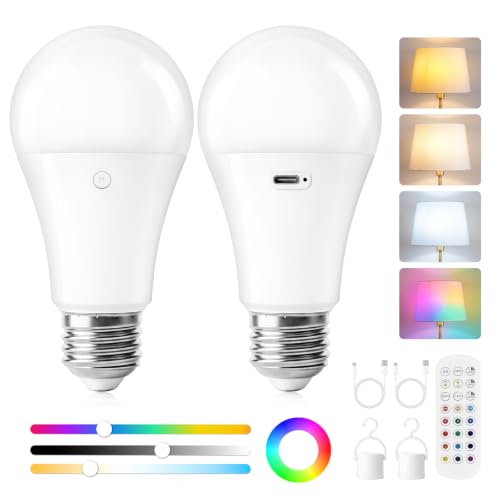
Yochoice A19 Rechargeable Bulb, 2-Pack stands out for USB-C charging and a portable hook, with a 2,500mAh battery in a two-pack. The maker estimates approximately 8–10 hours of continuous illumination per charge. Remote controls, dimming, a timer, 12 RGB colors, and three white color temperatures support both task-area and accent use in a shed, tent, or sconce. Charge it fully before first use, as the maker recommends. Its runtime is shorter than the maximum claim for Kimjo Rechargeable Bulb, Remote, 6-Pack, so it may not suit buyers prioritizing the longest possible outage duration.
Bottom line: Choose this when USB-C charging and portable use are priorities.
How to choose a rechargeable bulb
Start by deciding whether the bulb must work in a fixture without wiring or provide backup in a normally powered fixture. Emergency bulbs recharge while connected to household power and commonly turn on only when the wall switch remains on during an outage; wireless bulbs rely on their internal battery for everyday use. Check the bulb base and fixture type before choosing: E26 is the common medium screw base in US household lamps, but the fixture must also hold the bulb securely. For a room’s main light, look for a lumen figure rather than watt equivalence; around 800 lumens is a typical 60W-replacement target, while 400 lumens is more appropriate for localized or accent lighting.
Battery capacity and runtime
Battery capacity in milliamp-hours (mAh) is useful for comparing similar batteries, but it does not directly determine hours of light: brightness, electronics, and battery voltage also affect runtime. Among these bulbs, compare maker-provided runtime claims only where available, and expect dimming to trade brightness for longer operation. A practical rule is to select a bulb with a runtime longer than the outage you need to cover, then keep a charged spare for extended outages. Rechargeable bulbs are not substitutes for a generator or other backup for critical equipment.
Wireless bulbs versus outage bulbs
Wireless rechargeable bulbs solve different problems from emergency bulbs. Use a wireless design for a fixture that has no power connection; use an auto-recharging emergency design when a wired fixture should continue working during a blackout. A removable hook can let a bulb serve as a portable light, but it does not make the bulb weatherproof. For outdoor camping or sheds exposed to moisture, verify an appropriate damp or wet-location rating before use. Keep battery-powered lighting away from heat sources and never use a bulb in a fixture whose heat rating or enclosure is incompatible.
| Need | Choose | Key check |
|---|---|---|
| Unwired lamp or sconce | Wireless rechargeable bulb | Base compatibility and runtime |
| Lighting during outages | Auto-recharging emergency bulb | Wall switch must remain on |
| Portable tent or shed light | Rechargeable bulb with hook | Moisture rating and charge level |
Charging and safe use
Rechargeable bulbs need a charged battery before they can provide light without household power. Charge USB-C models with a compatible cable and allow charging to finish before relying on them; for auto-recharging designs, use them in a powered fixture as directed by the maker. Avoid leaving battery products in hot vehicles or near heaters, since heat can shorten rechargeable battery life. If a bulb becomes swollen, unusually hot, damaged, or leaks, stop using it and follow local battery-disposal guidance rather than placing it in household trash.
Frequently Asked Questions
Will a rechargeable bulb work when the power goes out?
An emergency rechargeable bulb can work during an outage if it has charged and the fixture’s wall switch is on. Runtime depends on brightness and battery condition, so keep a charged portable light for longer outages.
Can I use a battery bulb in any lamp?
No; match the bulb base and physical size to the fixture, and confirm that the fixture can safely support the bulb. E26 is a common US medium screw base, but not every fixture uses it.
How long do rechargeable light bulbs last?
Runtime varies with capacity and brightness; one bulb here has a maker-claimed range of 3–20 hours, while another claims approximately 8–10 hours. Lower brightness generally uses less battery power.
Can rechargeable bulbs replace wired lighting?
Rechargeable bulbs can provide light without active household power, but their battery runtime is limited. For regular room lighting, wired bulbs avoid the need to recharge after each battery-powered use.
Are rechargeable bulbs safe to use outdoors?
Use an outdoor bulb only if it has a suitable moisture rating for the location; a hook alone does not provide water protection. Keep rechargeable bulbs away from excessive heat and inspect them for battery damage.