
Heat Lamps for Animals Outside: 5 Coop Heaters

For a chicken coop, 400W Carbon Fiber Coop Heater is the closest fit because its heat output switches between 200W and 400W, but verify that its outdoor rating matches your installation before use. These hanging heaters are intended to warm poultry and other animals; choose a different product if you need a heater with confirmed wet-location approval or a clearly specified mounting system.
We earn a commission if you buy through links on this page. As an Amazon Associate I earn from qualifying purchases. Products are compared on manufacturer specifications, not hands-on testing.
- Best overall: 400W Carbon Fiber Coop Heater – Two settings, 200W and 400W, allow adjustment for changing brooder needs.
- Best for lower settings: 350W Adjustable Coop Heater – Its two settings are 150W and 350W, with an included waterproof controller.
- Best for tip-over shutoff: 600W Carbon Fiber Heater with Shutoff – The heater has automatic tip-over shutoff and 300W and 600W settings.
| Product | Best for | Heat settings | Dimensions | Shop |
|---|---|---|---|---|
| 400W Carbon Fiber Coop Heater | Adjustable output | 200W / 400W | 14 × 5.5 × 3.8 in | Check Price on Amazon |
| 350W Adjustable Coop Heater | Lower heat mode | 150W / 350W | 8.7 × 8.7 × 6.3 in | Check Price on Amazon |
| VORIGY 600W Red Heat Lamp | High-power brooding | 100W / 600W | — | Check Price on Amazon |
| HOSASSPER 400W Carbon Fiber Heater | No-light warmth | 400W | 14 × 5 × 2 in | Check Price on Amazon |
| 600W Carbon Fiber Heater with Shutoff | Tip-over shutoff | 300W / 600W | 15.75 × 4 × 6 in | Check Price on Amazon |
Heat Lamps for Animals Outside
Compare the heater settings and physical size, then confirm that the intended installation is suitable for outdoor exposure.
400W Carbon Fiber Coop Heater

Two selectable outputs distinguish this heater: 200W for gentler warmth or 400W for more heat. The carbon fiber bulb, frame and tube suit buyers looking for a hanging brooder-style heater, and the unit measures 14 × 5.5 × 3.8 inches. The maker says the bulb lasts up to 12,000 hours and heats in 1–2 seconds. Its heating coverage is up to 5,000 cm². The limitation for outdoor use is that the facts do not establish the heater’s wet-location rating, so verify that rating before installing it where weather can reach it.
Bottom line: Choose this if you want two heat outputs and can verify outdoor suitability.
350W Adjustable Coop Heater

The 150W low setting is the key distinction for buyers who want a lower output than the 200W minimum of some alternatives. This hanging heater measures 8.7 × 8.7 × 6.3 inches and includes a waterproof controller; the maker describes it as distributing heat evenly for chick brooding. Its second setting is 350W. The limitation is that a waterproof controller does not establish that the whole heater is rated for outdoor or wet-location use. Confirm the complete unit’s rating and protect the installation from exposure as required before using it outside.
Bottom line: Pick this when a 150W low mode is useful and the whole unit’s rating checks out.
VORIGY 600W Red Heat Lamp

The 600W high setting makes this the highest-output option among these heaters, while its 100W setting gives a substantial reduction for lower heat needs. The red-spectrum lamp has an adjustable-height chain and metal guard, and the maker says it can provide targeted warmth for 100 or more chicks. The maker also describes the heater as UL tested. Those claims do not establish outdoor or wet-location approval, and the size values are not useful dimensions. Verify its installation rating and measure the mounting space before choosing it for an exposed area.
Bottom line: Choose this for the 600W setting and chain adjustment after confirming outdoor suitability.
HOSASSPER 400W Carbon Fiber Heater
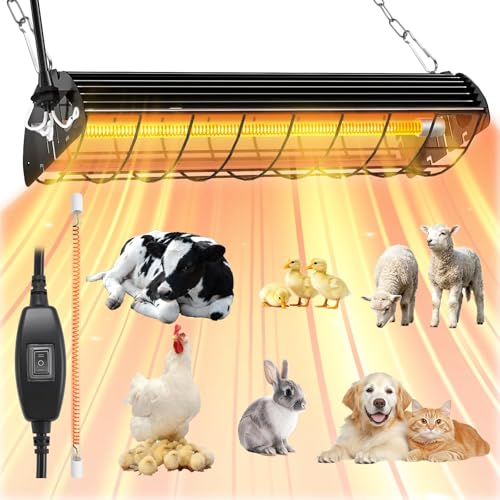
The maker describes this 400W carbon fiber heater as producing warmth without light, which differentiates it from the red-spectrum lamp. It measures 14 × 5 × 2 inches, and the maker says it heats in 1–2 seconds and has a 12,000-hour lifespan. The maker also describes the product as UL tested and gives it five protection layers, including waterproofing. That claim does not by itself establish approval for an exposed outdoor installation or every wet condition. Verify the rating for your specific location, especially if rain or washing can reach the heater.
Bottom line: Choose this if no-light warmth matters and its rating covers your outdoor setup.
600W Carbon Fiber Heater with Shutoff

Automatic tip-over shutoff is the defining feature here; it cuts power if the heater overturns, according to the product’s feature. The carbon fiber heater measures 15.75 × 4 × 6 inches and offers 300W and 600W settings. The maker says it delivers 90% heat output and has a 12,000-hour lifespan. Shutoff is a backup feature, not a substitute for stable mounting or clearance from bedding and other combustibles. Outdoor suitability is not established by the facts, so confirm the full heater’s rating before placing it where moisture can reach it.
Bottom line: Pick this if tip-over shutoff is a priority, while still securing it safely.
How to choose an outdoor animal heat lamp
Choose by animal, heat setting and verified exposure rating before comparing extra features. Newly hatched chicks are commonly brooded at about 95°F during their first week, with the target lowered by roughly 5°F each week until they are feathered or the temperature reaches about 70°F. A thermometer at chick level is more useful than judging warmth by the lamp’s wattage alone. Outdoor installations add a separate requirement: the heater, cord, controller and outlet must be suitable for the actual exposure, not just described as waterproof in one component. If weather can reach the setup, confirm the unit’s outdoor or wet-location rating before purchase. For chicks, choose a setup whose heat can be measured and adjusted without forcing animals to crowd directly beneath the source.
Brooder temperature and lamp height
Use chick behavior and a thermometer together to adjust a brooder: chicks spread comfortably across the warm area when conditions are suitable, while huddling under the lamp can indicate they are cold and avoiding the heated zone can indicate excess warmth. A common brooding schedule begins near 95°F and drops about 5°F each week, but drafts and outdoor temperatures can change the heat required. Raising a radiant heater generally reduces warmth at animal level; lowering it increases warmth and fire risk. Keep lamps securely suspended, not balanced on a surface, and maintain the clearance from bedding specified for the actual heater. Measure temperature at chick height after adjustments rather than assuming a particular wattage produces a fixed temperature.
Heat lamp safety in an outdoor coop
Secure suspension and dry, correctly rated electrical connections matter because a fallen hot heater can ignite bedding. Use a stable hanging point, keep the heat source clear of straw, shavings and other combustible material, and protect cords from pecking, chewing and abrasion. A tip-over shutoff is a backup, not a reason to leave a lamp unsecured. Outdoor exposure can affect the controller, plug, cord and outlet as well as the lamp; verify ratings for every exposed part and use a ground-fault circuit interrupter (GFCI) for outdoor receptacles. Do not use a heater in rain or wet conditions unless its full installation is rated for that exposure. Check the setup for damage and loose mounting before each use.
Heat lamp settings compared by brooding need
Match the available output to the warmth needed at animal level, rather than treating a higher wattage as automatically better. The lower setting can help reduce heat as chicks grow, but the thermometer remains the deciding check. This comparison shows the available settings and a practical decision rule.
| Need | Setting to consider | Decision rule |
|---|---|---|
| Gentler warmth | 100W–200W | Start with the lower mode and measure at chick height. |
| Adjustable brooding | 150W–400W | Use the setting that maintains the target temperature without crowding. |
| Higher available output | 600W | Choose only if mounting and temperature checks show it is appropriate. |
Frequently Asked Questions
What temperature should a chick brooder start at?
A common starting target is about 95°F during the first week. Lower it by roughly 5°F each week as chicks grow, checking the temperature at chick level.
How far should a heat lamp be from bedding?
Use the clearance specified for the particular heater, because lamp designs and heat outputs differ. Keep it securely suspended and well away from straw, shavings and other combustible material.
Can a waterproof heat lamp stay outside in rain?
Only if the complete heater and its electrical connections are rated for that exposure. A waterproof controller alone does not establish that the lamp, cord, plug and outlet are suitable for rain.
How can I tell if chicks are too cold under a heat lamp?
Chicks that huddle tightly beneath the heat source may be cold; chicks avoiding the warm zone may be too hot. Check the temperature at their level and adjust the heater rather than relying on wattage alone.
When should brooder heat be reduced for chicks?
A common schedule reduces the target by about 5°F each week after a starting temperature near 95°F. Outdoor drafts and changing weather can alter the heat needed, so measure at chick height after adjustments.