
Motion Sensor Plug-In Night Lights: 5 Picks Compared

AUVON Backlit Warm White 4-Pack is the strongest fit for most people because it combines motion activation, dusk-to-dawn sensing and adjustable 1–50-lumen brightness. Choose another option if you want a different pack size, brightness range or selectable lighting mode.
A plug-in motion sensor night light turns on when it senses movement, often only when the room is dark; the sensor and light sensor behavior varies by mode.
We earn a commission if you buy through links on this page. As an Amazon Associate I earn from qualifying purchases. Products are compared on manufacturer specifications, not hands-on testing.
- Best overall: AUVON Backlit Warm White 4-Pack – Offers motion and dusk-to-dawn modes with adjustable brightness from 1 to 50 lumens.
- Best for simple controls: L LOHAS LED Motion Sensor Night Light 30/60LM – Has three selectable modes and two brightness levels of 30 or 60 lumens.
- Best for larger packs: ZISUYU Color-Changing 6-Pack – Includes six lights with adjustable 10–60-lumen output and multiple modes.
| Product | Best for | Brightness | Modes | Pack size | Shop |
|---|---|---|---|---|---|
| AUVON Backlit Warm White 4-Pack | Soft adjustable glow | 1–50 lm | Motion, dusk-to-dawn | 4 lights | Check Price on Amazon |
| L LOHAS LED Motion Sensor Night Light 30/60LM | Two brightness settings | 30 or 60 lm | On, off, auto | 2 lights | Check Price on Amazon |
| AUVON Mini Warm White 4-Pack | Fine brightness control | 1–50 lm | Motion, dusk-to-dawn | 4 lights | Check Price on Amazon |
| DORESshop Black 3-Mode 2-Pack | Three brightness levels | 3 levels | Motion, dusk-to-dawn, modes | 2 lights | Check Price on Amazon |
| ZISUYU Color-Changing 6-Pack | More room coverage | 10–60 lm | Multi-mode | 6 lights | Check Price on Amazon |
Motion Sensor Plug-In Night Lights
Compare brightness controls, operating modes and pack size to find the right light for each outlet and room.
AUVON Backlit Warm White 4-Pack

AUVON Backlit Warm White 4-Pack pairs backlit illumination with two sensor modes, giving it a different approach from the straightforward selectable modes on other options. The maker says its 16 LEDs reflect light onto the wall, and the brightness adjusts from 1 to 50 lumens. In Auto mode, its sensor detects motion within 3–5 meters and a 120-degree angle in darkness or low ambient light, then turns off after 60 seconds without motion. The four-light pack suits several rooms. Choose another light if you need a brighter output above 50 lumens.
Bottom line: Pick this if you want adjustable brightness and both motion and dusk-to-dawn operation.
L LOHAS LED Motion Sensor Night Light 30/60LM

L LOHAS LED Motion Sensor Night Light 30/60LM stands out for its explicit always-on and off settings alongside automatic motion sensing. The maker says Auto mode detects movement within 3–5 meters and 120 degrees in darkness, then switches off after 60 seconds without activity. A slider selects 30 or 60 lumens, so this light offers two fixed levels rather than a continuous dimming range. Its two-light pack suits a pair of outlets where uncomplicated controls matter. The limitation is the narrower brightness choice; someone seeking a very low glow or finer adjustment should compare the dimmable alternatives.
Bottom line: Choose this for simple on/off/auto control and two defined brightness levels.
AUVON Mini Warm White 4-Pack

AUVON Mini Warm White 4-Pack differs from the backlit alternative through its five-step and stepless brightness controls, which can suit a room where the preferred glow needs fine adjustment. The maker says it retains the last brightness setting while power remains connected and identifies a maximum consumption of 1.3 watts. Its two sensor modes operate independently, and the four-pack works for spreading lights across multiple spaces. Its output tops out at 50 lumens, so choose another option if you need more illumination than that range provides.
Bottom line: Pick this when retaining a chosen brightness and fine dimming are priorities.
DORESshop Black 3-Mode 2-Pack
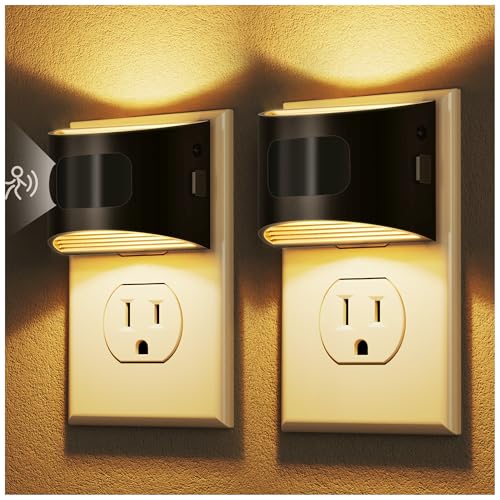
DORESshop Black 3-Mode 2-Pack offers three adjustable brightness levels and a black finish, distinguishing it from the warm white options with specified lumen ranges. The maker says its motion and light sensors turn the light on in darkness when movement is detected within 2–5 meters and shut it off after 60 seconds without activity. Its two-light pack suits buyers who prefer level-based brightness controls and a dark-colored fixture. The exact brightness output is not included in the specifications, so this is a weaker choice if comparing output by lumen number is essential.
Bottom line: Choose this if you want three brightness levels and a black fixture.
ZISUYU Color-Changing 6-Pack

ZISUYU Color-Changing 6-Pack is the only six-pack here and combines adjustable 10–60-lumen output with color-changing capability. Its range reaches 60 lumens, above the 50-lumen maximum of the two AUVON options, while starting at 10 lumens rather than 1. This can suit buyers outfitting several outlets or wanting color options. Look elsewhere if a documented sensing range or precise auto mode behavior is important.
Bottom line: Pick this to cover more outlets with adjustable output and color options.
How to Choose a Motion Sensor Plug-In Night Light
Start with the sensor behavior and the amount of light you want, not just the pack count. Motion-only operation is useful along a route where the light should activate as someone passes; dusk-to-dawn sensing responds to ambient light and can keep a light on through the dark period. Some models combine these modes, while others add always-on or off settings. Lumens measure visible light output: lower settings create a gentler glow, while higher settings make a path easier to see. If a room needs subtle light, favor a model adjustable down to 1 lumen; if you need brighter output, compare the maximums rather than assuming all night lights are alike.
Check the outlet location before choosing a fixture. A large plug-in light can block the neighboring receptacle, and the sensor works best when its face is not hidden behind furniture or a doorway. For stairs or a hallway, place the light where approaching movement crosses its sensing area rather than behind the person using the path.
Motion, Ambient-Light and Always-On Modes
Motion mode responds to movement, while a dusk-to-dawn sensor responds to ambient brightness; a combined mode can require both darkness and motion. Auto-off delays matter because a short timer may switch the light off while someone remains still, whereas a longer delay can keep it lit longer between movements. This set includes one documented 60-second delay on four models, but the ZISUYU fields do not give an interval. The table separates what each mode does from the control choices that affect daily use.
For a route used only occasionally, motion activation can avoid leaving a light continuously on. For a room needing steady low illumination, an always-on mode can be more suitable where available. Keep any sensor unobstructed; placement and the direction people approach can affect whether motion crosses its detection area.
| Mode | What triggers the light | Useful for |
|---|---|---|
| Motion | Movement in the sensor area | Hallways and routes |
| Dusk-to-dawn | Low ambient light | Consistent dark-hour lighting |
| Always-on | Manual selection | Continuous illumination |
Brightness and Placement for Night Lights
Use the lowest setting that makes the route visible without shining directly into the eyes. Brightness is measured in lumens, and the models here range from 1 to 60 lumens where a range is provided. A 1–50-lumen control allows a very low setting; fixed 30- and 60-lumen levels offer less granular adjustment. Position the light near the path but keep the sensor facing the area where movement begins. A practical decision rule is to favor a dimmable model with a 1-lumen minimum for a bedroom, and a model reaching 60 lumens when a brighter path light is the priority.
Plug-in fixtures occupy an outlet, so check whether the body leaves the second receptacle usable. Avoid placing electrical lights where they can be splashed or covered by fabric; keep the fixture ventilated and away from bedding, curtains and other materials that could obstruct it.
Common Setup Mistakes to Avoid
The most common mistake is aiming a motion sensor away from the route: a person walking directly beneath or behind a sensor may not cross its sensing area as expected. Another is choosing by maximum brightness alone; a strong glow can be uncomfortable in a bedroom, while a dim setting may not illuminate a stair landing adequately. Sensor models also differ in trigger conditions: some require darkness as well as movement, so they will not activate in a bright room. Test the chosen mode at the outlet location and adjust placement if the light misses an approach. Keep the light’s sensor window clear of dust and obstructions, and do not cover the fixture with a shade or cloth.
Frequently Asked Questions
How far away can a motion sensor night light detect movement?
The documented sensing ranges here span 2–5 meters or 3–5 meters, depending on the model. Detection also depends on whether the sensor faces the route and whether the mode requires darkness.
Why does a motion night light turn on only in darkness?
Many automatic modes use a light sensor so motion triggers illumination only when ambient light is low. A bright room can therefore prevent activation even when movement is detected.
How many lumens are suitable for a bedroom night light?
A low setting around 1 lumen is useful when the goal is a subtle glow, while higher outputs make a path easier to see. Choose adjustable output when the same light must serve different conditions.
How long should a motion sensor night light stay on?
A 60-second auto-off delay is one common setting in the products here. Longer or shorter intervals depend on the model, so consider whether people may remain still in the lit area.
Can a plug-in night light block the other outlet?
Yes, the fixture body can occupy space beside its plug and limit access to the second receptacle. Check the outlet layout and fixture dimensions before choosing a location.