
High to Low Converter Car Audio: 5 Options Compared

For most factory-radio amplifier upgrades, the Kicker KISLOC2 stands out because it converts speaker wiring to RCA and supplies a 12-volt, 100 mA remote output. Choose another model if you need signal sensing, speaker emulation, a bass adjustment, or a remote control knob.
A high-to-low converter reduces a car stereo’s speaker-level output to RCA line level for an amplifier.
We earn a commission if you buy through links on this page. As an Amazon Associate I earn from qualifying purchases. Products are compared on manufacturer specifications, not hands-on testing.
- Best overall: Kicker KISLOC2 – Converts speaker signals to RCA and provides a 12-volt, 100 mA remote turn-on output.
- Best for OEM integration: DS18 V2HL.V2 – Its speaker emulator is designed to work with select OEM amplifiers, and it activates when it detects a signal.
- Best for bass adjustment: NuIth 2-Channel Converter – Includes level gain adjustment to change bass without stopping to access the amplifier.
| Product | Best for | Adjustment or trigger | Shop |
|---|---|---|---|
| Kicker KISLOC2 | Remote turn-on output | DC-offset trigger; 100 mA output | Check Price on Amazon |
| DS18 V2HL.V2 | OEM amplifier integration | Signal sensing; speaker emulator | Check Price on Amazon |
| NuIth 2-Channel Converter | Bass level adjustment | Gain adjustment | Check Price on Amazon |
| Scosche LOC80 | Basic 2-channel conversion | — | Check Price on Amazon |
| Scosche LOC2SL | Remote knob control | Remote control knob | Check Price on Amazon |
High to low converter car audio options
Match the converter’s signal features to your factory stereo and the way you want to control the amplifier.
Kicker KISLOC2

The Kicker KISLOC2 is the only option here with a specified remote turn-on output: it converts speaker-wire input to RCA and produces a 12-volt, 100 mA remote wire using DC offset. The converter accepts up to 55 watts and 16 volts of input, giving buyers a concrete limit to compare with their radio’s output. It suits a factory-radio installation where an amplifier needs a remote signal. Its limitation is that the input ceiling may not fit a higher-output source, so check the stereo’s speaker output before connecting it.
Bottom line: Choose this when a defined remote output is the deciding feature.
DS18 V2HL.V2

The DS18 V2HL.V2 adds a speaker emulator, a feature the other options do not identify, for use with select OEM amplifiers. Its 2-channel high-level input and 2-channel RCA output connect a factory head unit to an aftermarket amplifier, while signal sensing activates the converter when audio is detected. It is a fit for installations where retaining OEM amplifier operation is important. The speaker emulator is for select systems rather than every factory setup, so confirm compatibility with the vehicle’s audio system before choosing this converter.
Bottom line: Pick it for a compatible factory system that needs speaker emulation.
NuIth 2-Channel Converter

The NuIth converter has a level-gain adjustment for changing bass without pulling over to reach the amplifier, a useful distinction from the other choices. It converts speaker output to RCA and is intended for adding a 2-channel or mono amplifier or subwoofer to a factory or aftermarket stereo. Its compact 3.9-by-2.3-by-0.7-inch body may also help where installation space is limited.
Bottom line: Choose it if accessible bass-level adjustment matters.
Scosche LOC80

The Scosche LOC80 is a straightforward 2-channel converter for changing speaker-level signals to RCA line level, with no special trigger or adjustment feature identified. That makes it a natural choice for a basic factory-stereo-to-amplifier connection when the system does not require a remote output or bass control at the converter. It measures 5.5 by 2.75 by 1.25 inches.
Bottom line: Pick it for a simple two-channel speaker-to-RCA connection.
Scosche LOC2SL
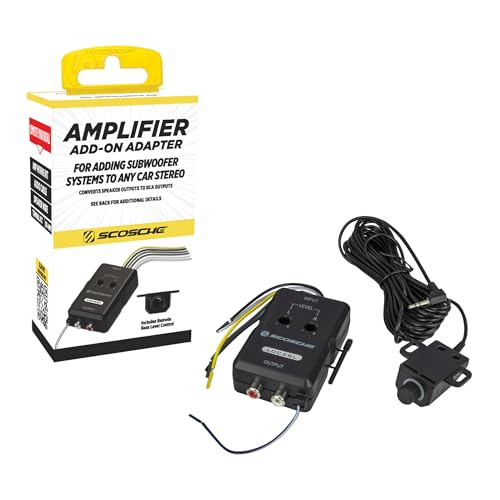
The Scosche LOC2SL includes a remote control knob, making it the distinct choice for someone who wants adjustment at a separate control rather than only at the amplifier. Like the LOC80, it is a 2-channel speaker-to-RCA converter suited to integrating a factory stereo with an aftermarket amplifier. The measurements are 13.25 inches high, 6.63 inches wide, and 2.13 inches long; measure the intended mounting space before installation.
Bottom line: Choose it when separate remote-knob adjustment is the priority.
How to choose a high to low converter
Start with the stereo’s output and the amplifier’s input needs: a passive high-to-low converter must accept the speaker-level signal and provide RCA line-level output. The KISLOC2’s ceiling is 55 watts and 16 volts, so compare those limits with the radio output rather than assuming every converter accepts the same signal. Next, decide whether the installation needs a remote turn-on signal; some amplifiers need that 12-volt trigger wire to switch on with the stereo. If the stereo’s output exceeds a converter’s limit, choose a converter with a higher suitable input rating instead of risking poor signal behavior.
Remote turn-on and signal sensing
Remote turn-on options determine how an amplifier receives its on signal. A 12-volt remote wire, such as the KISLOC2’s 100 mA output, can provide a trigger from speaker-wire signal through DC offset. Signal-sensing converters instead activate when they detect audio, as the DS18 V2HL.V2 feature specifies; a trigger output is not the same as signal sensing. Before installation, confirm whether the amplifier requires a remote terminal signal and whether the chosen converter provides that function. Keep wiring connections insulated and secure, and disconnect the vehicle battery before working on powered audio wiring.
Converter features compared
Use the feature that solves an actual installation constraint rather than treating every high-to-low converter as interchangeable. The table compares the documented distinction that most affects setup.
| Installation need | Feature to seek | Match |
|---|---|---|
| Amplifier remote wire | Remote turn-on output | Kicker KISLOC2 |
| OEM amp speaker emulation | Speaker emulator | DS18 V2HL.V2 |
| Adjust bass from the converter | Level gain adjustment | NuIth 2-Channel Converter |
| Separate control location | Remote control knob | Scosche LOC2SL |
| Basic speaker-to-RCA conversion | 2-channel conversion | Scosche LOC80 |
Plan placement and wiring safely
Measure the mounting location and leave room for the converter’s connectors and wire bends; a device that fits on paper can still be difficult to wire in a tight dash. Confirm left and right speaker polarity before tapping factory wiring, since reversing one channel can affect how a subwoofer sums bass. Route signal wiring away from power wiring where practical to reduce noise pickup, and protect connections from abrasion. Do not connect an amplifier until the vehicle wiring diagram and the amplifier’s input and remote-terminal requirements agree with the converter’s connections.
Frequently Asked Questions
What does a high to low converter do in a car?
A high-to-low converter changes speaker-level output from a car stereo into lower-level RCA output for an amplifier. A 2-channel converter handles a left and right signal pair.
Does every line output converter turn on an amp?
No; some converters provide a remote turn-on output or signal sensing, while others are specified only for speaker-to-RCA conversion. Confirm the amplifier’s remote-terminal requirement before wiring.
What does a speaker emulator do in a car stereo?
A speaker emulator can help a converter work with selected factory amplifiers that expect to see a speaker load. Compatibility is system-specific, so confirm that the vehicle’s OEM audio setup is supported.
How do I know if a converter can handle my stereo output?
Compare the radio’s maximum speaker output with the converter’s input rating in matching units. The KISLOC2 accepts up to 55 watts and 16 volts; an output beyond a converter’s rated limit calls for another suitable model.
Should a line output converter connect before or after an amplifier?
A high-to-low converter typically takes the stereo’s speaker-level output before it reaches an aftermarket amplifier and sends RCA signal to that amp. Do not connect an amplifier’s amplified speaker output to a converter unless the converter is rated for that signal.