
Ozark Tent for 12 People: 5 Alternatives Compared

The Ozark tent for 12 people is not among these options, so the closest alternatives are large family tents distinguished by layout, room dividers and setup method. Choose CORE 12 Person Instant Cabin Tent if quick setup matters most; choose another model if its floor dimensions or room arrangement better matches your group.
We earn a commission if you buy through links on this page. As an Amazon Associate I earn from qualifying purchases. Products are compared on manufacturer specifications, not hands-on testing.
- Best overall: CORE 12 Person Instant Cabin Tent – Its pre-attached poles are designed for setup in 2 minutes or less, with an 18-by-10-foot floor.
- Best for standing room: CORE 12 Person Family Cabin Tent – The 86-inch center height and 16-by-11-foot floor offer substantial headroom.
- Best for a shaded entry: LET’S CAMP 12 Person Tent with Canopy – A front door cover can be raised into a canopy with included steel poles.
| Product | Best for | Floor dimensions | Center height | Room dividers | Shop |
|---|---|---|---|---|---|
| CORE 12 Person Instant Cabin Tent | Fast setup | 18 × 10 ft | 80 in | 2; up to 3 spaces | Check Price on Amazon |
| CORE 12 Person Family Cabin Tent | Tall campers | 16 × 11 ft | 86 in | 1 divider; 2 spaces | Check Price on Amazon |
| LET’S CAMP 12 Person Tent with Canopy | Shaded entry | 16 × 11 ft | 86 in | 2; up to 3 spaces | Check Price on Amazon |
| CAMPROS CP 12 Person 3-Room Tent | Mattress flexibility | 20 × 9 ft | 72 in | 2 curtains; 3 spaces | Check Price on Amazon |
| 8–12 Person Inflatable Tent with Stove Jack | Inflatable setup | 15.75 × 11.81 ft | 7.2 ft | — | Check Price on Amazon |
12-person family tents
Compare floor size, headroom, room layout and setup style before choosing a large group tent.
CORE 12 Person Instant Cabin Tent
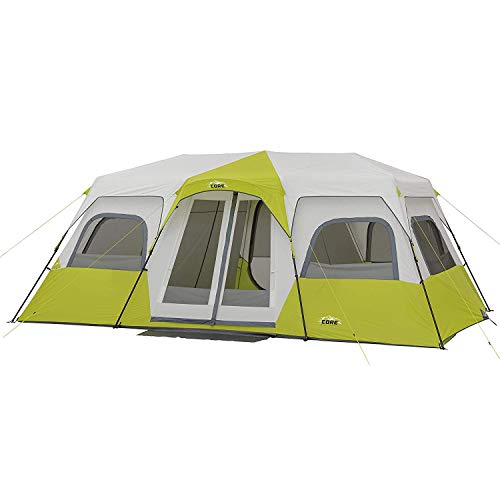
CORE 12 Person Instant Cabin Tent stands out for its pre-attached poles, which the maker says lock into place in 2 minutes or less. Its 18-by-10-foot floor and 80-inch center height are paired with two dividers that create up to three separate spaces. The maker says it fits four queen air beds, or up to 12 people without gear and six with gear. Fully taped rainfly, sealed seams, guylines and steel stakes address weather protection and stability. The 47.8-pound weight is worth considering if you need to carry the tent far from a vehicle.
Bottom line: Choose it when a fast pitch and three-space layout matter more than a lighter carry.
CORE 12 Person Family Cabin Tent
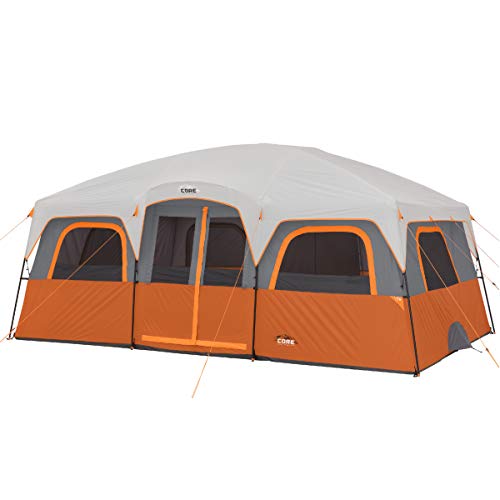
CORE 12 Person Family Cabin Tent differs from the other CORE option with its 86-inch center height and a single divider for two spaces. The 16-by-11-foot floor fits four queen air beds; the maker gives a more realistic capacity of six people with gear or up to 12 without gear. H20 Block Technology includes 1200 mm fabric, a fully taped rainfly, sealed seams and fully zipped windows; guylines and steel stakes are included. Storage pockets help keep small items off the floor. Since setup is not described as instant, allow more pitching time than for a pre-attached-pole design.
Bottom line: Choose it for extra headroom and a two-space layout with four queen-bed capacity.
LET’S CAMP 12 Person Tent with Canopy

LET’S CAMP 12 Person Tent with Canopy adds a raised canopy over the front door, creating shaded covered space at the entrance when supported by the included steel poles. The 16-by-11-foot floor provides 176 square feet, with an 86-inch center height and two detachable dividers for up to three rooms. Six large mesh windows and a double-layer construction are useful features for group camping. Its weather resistance is described broadly, so this is a less specific match for buyers who need a waterproof rating or seam construction. At 46 pounds, it is better suited to car camping than long carries.
Bottom line: Pick it when an entry canopy and up to three partitioned spaces are priorities.
CAMPROS CP 12 Person 3-Room Tent
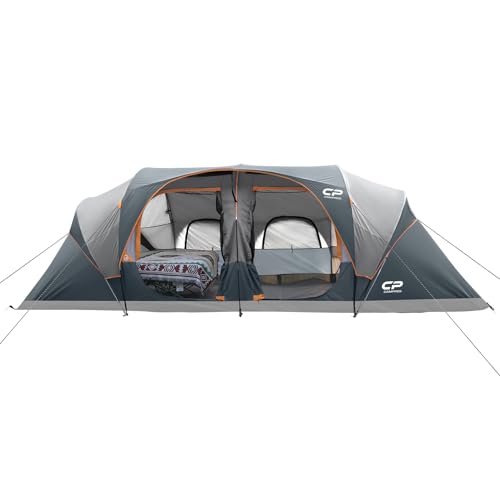
CAMPROS CP 12 Person 3-Room Tent has the longest floor of these options at 20 feet, but its 72-inch center height is lower than the other cabin tents. Two divider curtains provide three rooms, and the maker says the floor fits three queen or five full air mattresses. Color-coded poles are designed for a setup under 10 minutes with two people. The 185T polyester has a PU1000 mm rating, sealed seams and rain strips; a mesh roof, door and windows support airflow. The lower center height may matter to campers who want to stand comfortably throughout the interior.
Bottom line: Choose it for a 20-foot floor and the option to use three queen or five full mattresses.
8–12 Person Inflatable Tent with Stove Jack

8–12 Person Inflatable Tent with Stove Jack uses an inflatable frame rather than separate conventional poles, and includes a hand pump. Its floor measures 15.75 by 11.81 feet, with a 7.2-foot height, and the maker says setup takes 5 to 10 minutes. The two-room layout and included rainfly distinguish it from the multi-divider cabin tents. A stove jack is intended for a compatible outdoor stove, but using a stove inside a tent creates serious fire and carbon-monoxide hazards; use only equipment and ventilation specifically approved for tent use. The maker’s claimed 12-person capacity leaves little room for gear at full occupancy.
Bottom line: Consider it if an inflatable frame, two rooms and a stove jack match your camping plans.
How to choose a 12-person tent
For a group tent, compare realistic sleeping capacity, floor dimensions and room layout rather than relying on the largest headcount. Manufacturers commonly state capacity for people packed closely without luggage; these models illustrate the difference, with the CORE tents specifying six people with gear but up to 12 without it. A queen air mattress is roughly 60 by 80 inches, so four beds need a 10-by-13.3-foot rectangle before allowing for walking lanes or bags. As a practical rule, if six campers need floor space for gear and changing, prioritize a model that explicitly lists six people with gear rather than one that only claims 12 sleepers.
| Need | Compare |
|---|---|
| Fast pitch | Pre-attached poles |
| Private sleeping areas | Number of dividers and resulting rooms |
| Standing room | Center height, plus wall shape |
| Gear space | Capacity with gear and floor dimensions |
Floor size and sleeping layout
Queen mattresses measure about 60 by 80 inches, but a tent’s floor plan needs extra room for access and gear. Four queens laid in a rectangle need at least 10 by 13.3 feet before adding a walkway; the shape and door position can make the same floor area feel more or less usable. A 16-by-11-foot footprint is 176 square feet, while 18 by 10 feet provides 180 square feet, so compare dimensions as well as total area. Center height is not standing height at every wall: cabin-style straight walls preserve more usable space near the perimeter than sloped walls. Measure bulky gear and check its placement against the intended mattress arrangement.
Room dividers and privacy
Dividers create visual separation, not soundproof rooms or separate weatherproof compartments. A tent with two dividers may form three zones, while one divider generally forms two; check whether each partition is detachable or fixed if the open-floor layout matters. For families with children, plan sleeping zones near the doors and keep exit paths clear rather than placing beds across an aisle. Mesh windows and doors support airflow, but privacy depends on their covers and the divider layout. Count the actual rooms, then sketch the bed footprint and a clear route to an exit before committing to a large group arrangement.
Weather protection and tent safety
A fabric waterproof rating in millimeters describes the hydrostatic head the material withstands in a test, not a guarantee against every storm; seam sealing, rainfly coverage, pitch and wind exposure matter too. A 1,200 mm rating is a light-to-moderate rain specification, while a 1,000 mm rating is lower, so inspect construction details and avoid pitching in low spots where water collects. Secure guylines and stakes, and never use a tent stove unless the stove and tent are designed for that use; combustion can produce carbon monoxide, which is odorless and potentially fatal. Keep flames away from fabric and maintain an unobstructed exit.
Frequently Asked Questions
How many people fit comfortably in a 12-person tent?
A 12-person capacity usually means tightly packed sleepers without much room for gear. For a more usable family layout, look for a capacity with gear, and count mattress footprints and walkways before deciding.
How many queen air mattresses fit in a large tent?
A queen air mattress is about 60 by 80 inches, or 5 by 6 feet 8 inches. Four need a minimum 10-by-13.3-foot rectangle before an aisle, bags or door clearance.
What does a 1200 mm tent rating mean?
A 1,200 mm hydrostatic-head rating measures resistance to water pressure on fabric, not the performance of the whole tent in every storm. Rainfly coverage, sealed seams, wind and campsite drainage also affect whether water gets inside.
Are tent dividers separate rooms?
Tent dividers create visual zones, not sealed or soundproof rooms. Two dividers can split one interior into three areas, but doors, airflow and exit routes remain shared.
Can I safely use a stove inside a tent?
Only use a stove in a tent when the stove and tent are specifically designed and approved for that setup. Burning fuel can produce odorless carbon monoxide and ignite fabric, so keep ventilation and a clear exit essential.