
Mossy Oak Hunting Knives: 5 Models Compared by Use

For a straightforward Mossy Oak hunting knife set, choose Mossy Oak 2-Piece Game Processing Set for its separate straight-edge and gut-hook blades, each sized for game processing. Pick another model if you need a larger field dressing kit, a long Bowie blade, or a smaller caping knife.
These fixed-blade knives and kits are intended for outdoor cutting tasks; the right choice depends on the blade shape and tools you expect to carry.
We earn a commission if you buy through links on this page. As an Amazon Associate I earn from qualifying purchases. Products are compared on manufacturer specifications, not hands-on testing.
- Best overall: Mossy Oak 2-Piece Game Processing Set – Includes both a straight-edge blade and a gut-hook blade, with a dual-carry sheath.
- Best for a full kit: Mossy Oak 8-Piece Field Dressing Kit – Combines eight game-processing tools, gloves and a plastic case.
- Best for compact field dressing: Mossy Oak 4-Piece Camo Field Dressing Set – Pairs a caping knife and gut-hook skinner with a saw and sharpener in a carry bag.
| Product | Best for | Blade configuration | Blade length | Carry setup | Shop |
|---|---|---|---|---|---|
| Mossy Oak 2-Piece Game Processing Set | Two-blade processing | Straight edge and gut hook | 5.125 in; 4.25 in | Nylon dual-carry sheath | Check Price on Amazon |
| Mossy Oak 8-Piece Field Dressing Kit | Complete processing kit | Gut hook, caping, boning, saw | 7.5–10 in; tools vary | Plastic case | Check Price on Amazon |
| Mossy Oak 4-Piece Camo Field Dressing Set | Portable field dressing | Gut hook, caping, saw, sharpener | 3.4 in caping blade | Belt-carry bag | Check Price on Amazon |
| Mossy Oak 14-Inch Bowie Knife | Long single blade | Clip point Bowie | 8.5 in | Leather sheath with belt loop | Check Price on Amazon |
| Mossy Oak 2-Piece Bowie Knife Set | Two clip-point blades | Two clip points | 6 in; 4 in | Two nylon sheaths | Check Price on Amazon |
Mossy Oak Hunting Knives Compared
Match the blade shapes and included carry gear to the cutting and field dressing tasks you expect to handle.
Mossy Oak 2-Piece Game Processing Set

The two distinct blade shapes are the key difference: this set pairs a straight-edge hunting knife with a gut-hook knife. Their overall lengths are 10.375 and 9.375 inches, respectively, and the blades are 5.125 and 4.25 inches. Mossy Oak says the stainless steel blades have a black finish, and the full-tang handles have a camouflage pattern, grip grooves and lanyard holes. The nylon sheath supports dual carry. This set suits hunters who want two dedicated blades; buyers seeking a saw or sharpener should choose a larger kit instead.
Bottom line: Choose this set if you want separate straight-edge and gut-hook blades in one sheath.
Mossy Oak 8-Piece Field Dressing Kit
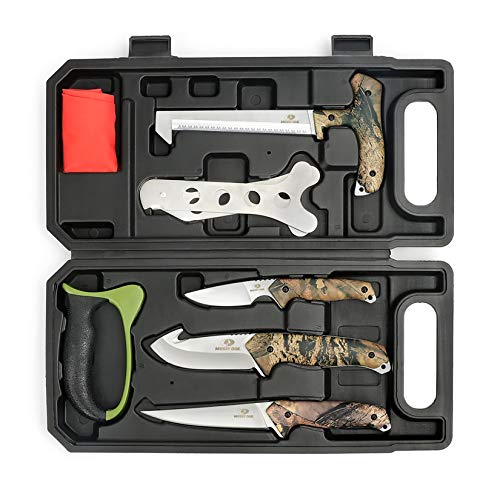
The eight-piece kit provides more than knives: it includes a wood-and-bone saw, steel spreader, carbide sharpener, game-cleaning gloves and a plastic case. The knife tools include a 7.5-inch caping knife, 9.5-inch gut-hook skinner and 10-inch boning knife; the saw is 8.7 inches. Mossy Oak says the stainless steel tools use full-tang construction and camouflage handles. This suits hunters who want several processing tools together. Its larger collection is less suited to someone who only needs one or two blades to carry.
Bottom line: Choose this kit when you want several processing tools and a case together.
Mossy Oak 4-Piece Camo Field Dressing Set

The belt-carry bag sets this four-piece kit apart for hunters who want the tools close at hand. It includes a gut-hook skinner, caping knife, bone saw and sharpener; the caping knife has a 3.4-inch blade and an 8.25-inch overall length. The compact caping blade is suited to finer, controlled cuts, while the other tools cover broader field dressing tasks. This kit suits buyers prioritizing a portable group of essentials. It does not include the spreader, gloves or plastic case found in the larger kit.
Bottom line: Choose this set for a portable group of field dressing essentials.
Mossy Oak 14-Inch Bowie Knife

The 8.5-inch clip-point blade makes this a longer single-knife option than the compact processing blades in the other sets. The full-tang knife measures 14 inches overall, weighs 14 ounces and has a 3.7 mm-thick 3CR13 blade with a rosewood handle and brass guard and pommel. Mossy Oak says the blade is intended for piercing, detail work and cutting in tight places. The leather sheath has a snap fastener and belt loop. This suits someone who wants one substantial knife; its blade length is less convenient for fine caping work.
Bottom line: Choose this knife if you prefer one long clip-point blade and a leather sheath.
Mossy Oak 2-Piece Bowie Knife Set

The two clip-point knives offer different blade lengths, rather than the gut-hook and straight-edge combination of the other two-knife set. The larger knife measures 10.5 inches overall with a 6-inch blade and weighs 7 ounces; the smaller measures 8 inches overall with a 4-inch blade and weighs 3 ounces. Mossy Oak says the stainless steel blades have full-tang construction, grooved handles and cloud-patterned grips. Each knife comes with a nylon sheath. This set suits buyers who want two clip-point sizes, but it lacks a gut hook for that specific task.
Bottom line: Choose this set if two clip-point blades matter more than a gut hook.
How to Choose a Hunting Knife Blade
Choose the blade shape by the cut, not by the knife’s overall length. A drop-point or clip-point blade offers a controllable point for general cutting; a gut hook is designed to open hide with its curved sharpened edge, while a caping knife’s smaller blade helps with close, detailed work. A bone saw handles bone and wood that a knife edge is not designed to cut. For finer work, a blade around 3 to 4 inches is easier to control than an 8-inch blade; for broader cuts, prioritize the intended task over blade length alone. A fixed blade has no folding joint to clean or lock, but it needs a sheath that fully covers the edge.
Field Dressing Kit Contents and Carry
Count the tools you will actually use before choosing a kit. A basic arrangement may pair a skinner with a caping knife; a fuller field dressing setup can add a saw, sharpener, spreader, gloves and a case. A belt bag keeps frequently used pieces close, while a case keeps several tools together when carried as a group. Match the sheath or bag to the knife dimensions, and make sure the cutting edge cannot contact the carrier when secured. Keep knives separate from loose gear so edges do not strike one another. A larger tool count adds options, but it also means more pieces to keep organized and clean after use.
Safe Knife Handling During Game Processing
Cut away from your body and keep your free hand out of the blade’s path; a sharp knife can slip when a cut is forced or the material shifts. Use a stable work surface when possible, and stop to reposition the game rather than cutting toward a hand or leg. A gut hook still has a sharp edge, so control its entry and keep the point directed away from organs and the opposite side of the hide. Wear cut-resistant gloves if available, and do not treat ordinary game-cleaning gloves as cut protection unless they are specifically rated for it. Sheath each knife before walking or passing it to another person.
Cleaning and Maintaining Hunting Knives
Clean a hunting knife promptly after use: remove residue with warm water and dish soap, rinse, and dry the blade and handle thoroughly. Moisture left around a handle junction or sheath can encourage corrosion, including on stainless steel. Keep a sharpening tool available; honing aligns an edge between sharpening sessions, while sharpening removes metal to restore a dull edge. Use a stable surface and move the blade away from your fingers during maintenance. Store knives dry and sheathed only after they are clean and completely dry. Leather and nylon sheaths can retain moisture, so let a damp sheath air-dry separately from the knife.
Frequently Asked Questions
What blade length works for caping game?
A blade around 3 to 4 inches gives more control for close, detailed cuts than a long hunting blade. Point shape and a secure grip also matter when working near hide or joints.
Can a gut hook replace a skinning knife?
A gut hook is useful for opening hide, but it does not replace a general-purpose blade for every cut. Many hunters carry a separate straight-edge skinner or processing knife for broader work.
How often should a hunting knife be sharpened?
Sharpen when the edge no longer cuts cleanly with light pressure; there is no fixed mileage or use count because hide, bone contact and cutting technique change wear. A honing rod can realign an edge between sharpening sessions.
Should a hunting knife go in its sheath wet?
No; dry the blade and handle fully before sheathing to reduce trapped moisture and corrosion risk. Let a wet sheath dry separately, since leather and fabric can hold dampness against the blade.