
Refresh Plus Pool Shock: Compare 5 Chlorine Options

Refresh Granular 68% Active Chlorine is the closest match for shoppers seeking Refresh Plus pool shock, with 68% active chlorine in a 25-pound bucket. Choose a different option if you want premeasured one-pound bags or a smaller package.
Pool shock is a concentrated chlorine treatment used to raise sanitizer levels; match the dose to pool volume and the product label.
We earn a commission if you buy through links on this page. As an Amazon Associate I earn from qualifying purchases. Products are compared on manufacturer specifications, not hands-on testing.
- Best overall: Refresh Granular 68% Active Chlorine – It is the named Refresh product and has 68% active chlorine in a 25-pound bucket.
- Best for smaller bags: Re-Fresh Chlorine Pool Shock – The package contains twelve one-pound bags for individual dosing.
- Best for measured dosing: Doheny’s Super Pool Shock – The maker gives a dose of one pound per 10,000 gallons.
| Product | Best for | Chlorine strength | Package total | Shop |
|---|---|---|---|---|
| Refresh Granular 68% Active Chlorine | Large pool supply | 68% active chlorine | 25 lb | Check Price on Amazon |
| Re-Fresh Chlorine Pool Shock | Single-pound portions | — | 12 lb | Check Price on Amazon |
| Doheny’s Super Pool Shock | Dose guidance | 68% calcium hypochlorite | 24 lb | Check Price on Amazon |
| Leslie’s Power Powder Plus 73% | Higher concentration | 73% calcium hypochlorite | 6 lb | Check Price on Amazon |
Refresh Plus Pool Shock and Alternatives
Compare the closest Refresh matches and other granular chlorine shocks by strength, package format and dosing guidance.
Refresh Granular 68% Active Chlorine

Refresh Granular 68% Active Chlorine is the named Refresh match and comes as a 25-pound bucket rather than individual dose bags. The product contains 68% active chlorine and is described as suitable for vinyl, fiberglass and plaster pools. That large package may suit regular pool maintenance or owners who prefer storing one container. Its main tradeoff is bulk: people who want a premeasured dose or only need a small amount may prefer the 12-pound bagged option. Calculate the required amount from pool volume and the package directions before adding any shock.
Bottom line: Choose it if you want the Refresh product in a 25-pound bucket.
Re-Fresh Chlorine Pool Shock

Re-Fresh Chlorine Pool Shock is the smaller-pack alternative, with twelve one-pound bags instead of one 25-pound bucket. Individual portions can make it easier to measure a dose without weighing loose granules, especially when a treatment calls for about a pound. The 12-pound total is also less product for buyers who want to stock up.
Bottom line: Pick it if you prefer twelve separate one-pound portions.
Doheny’s Super Pool Shock

Doheny’s Super Pool Shock stands out for its clearly stated dosing guidance and 24 premeasured one-pound bags. The maker identifies it as 68% calcium hypochlorite with 65% available chlorine and recommends one pound per 10,000 gallons; it says to apply two to three doses for spring openings or heavy algae blooms. That guidance is useful when calculating a treatment for a known pool volume. Its format requires more individual packages than a bucket, and the dose should not be transferred to a different shock product with another concentration.
Bottom line: Choose it if you want one-pound bags and a pool-volume dose.
Leslie’s Power Powder Plus 73%
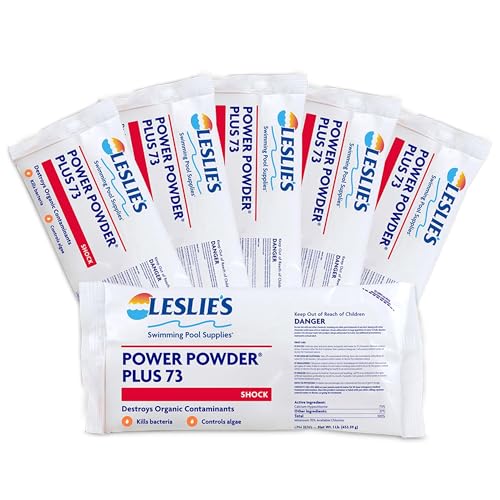
Leslie’s Power Powder Plus 73% has the highest calcium hypochlorite concentration among these alternatives, at 73%, and is sold as six one-pound bags. The compact total can suit someone who wants a smaller quantity than a 24- or 25-pound package. The maker describes it as fast-dissolving and low-residue, and says it kills bacteria, controls algae and destroys organic contaminants. A higher concentration does not mean using the same scoop or dose as a lower-strength shock; follow this product’s own label and measure for the pool’s gallons.
Bottom line: Pick it if you want 73% calcium hypochlorite in a small multi-bag pack.
How to Choose Pool Shock Strength
Match pool shock strength and dose to the product label, not just the bucket size. The options here range from 65% available chlorine to 73% calcium hypochlorite, and those percentages describe different measures; do not treat them as interchangeable dosing instructions. For routine residential pools, the CDC recommends maintaining free chlorine at 1–4 ppm and pH at 7.0–7.8. A decision rule: if the package gives a dose per 10,000 gallons, calculate your pool volume first and scale that dose proportionally, rather than guessing by pool appearance. Test chlorine and pH with a reliable pool test kit before returning to swimming.
Packaging also matters: premeasured bags reduce weighing, while a large bucket holds more total product. Compare concentration and directions together before changing brands.
Pool Shock Package Sizes and Dosing
Calculate pool volume before choosing a package or dose. A rectangular pool’s gallons are length × width × average depth × 7.5; a circular pool’s gallons are diameter × diameter × average depth × 5.9. Keep all measurements in feet for those formulas. That calculation is product-specific, not a universal shock dose; never apply the Doheny’s rate to another formulation without checking its label.
The table compares package totals and dosing only where a maker rate is given. A 25-pound bucket means more total product, not a larger single treatment.
| Need | Choose | Reason |
|---|---|---|
| Bulk Refresh supply | Refresh Granular 68% Active Chlorine | 25-pound bucket |
| Premeasured portions | Re-Fresh Chlorine Pool Shock | Twelve one-pound bags |
| Known maker dose | Doheny’s Super Pool Shock | One pound per 10,000 gallons |
| Smaller cal-hypo package | Leslie’s Power Powder Plus 73% | Six one-pound bags |
Safe Pool Shock Handling
Never mix pool shock with another pool chemical, especially acids or other chlorine products; contact can release hazardous gases or cause a fire. Keep granules dry, in their original closed container, and away from children, pets, heat and moisture. Use chemical-resistant gloves and eye protection when handling concentrated pool chemicals, and avoid breathing dust. Follow the specific package directions for adding the product because formulations and application methods differ.
Do not combine leftover chemical from one container with another, even if both are chlorine products. Keep swimmers out until the label’s waiting conditions are met and testing confirms safe water chemistry; no single waiting time applies to every shock formula.
Frequently Asked Questions
How much pool shock should I use per gallon?
Dose depends on pool volume and the particular product. For example, the maker of Doheny’s Super Pool Shock recommends one pound per 10,000 gallons, so use that rate only for that product and scale it to measured pool gallons.
What chlorine level should a swimming pool have?
The CDC recommends free chlorine of 1–4 ppm and pH of 7.0–7.8 for residential pools. Test the water before swimming, since shock treatment can temporarily raise chlorine beyond its normal range.
Can I swim right after adding pool shock?
Do not swim until the product label permits re-entry and a test shows chlorine is within the normal operating range. A fixed waiting time is not reliable across products because strength, dose and pool volume differ.
Can I mix two different pool shocks together?
No. Never combine pool chemicals, including different chlorine shocks; mixing can cause heat, fire or hazardous gas. Store each product in its original container and use it separately according to its label.
How do I calculate gallons in a rectangular pool?
Multiply length by width by average water depth, all in feet, then multiply by 7.5 for approximate gallons. For a pool with a sloped floor, average the shallow and deep water depths before calculating.