
Best Liquid Floor Wax for Wood Floors: 5 Options Compared

For a true liquid wax, choose Lundmark Liquid Paste Wax with Carnauba: it is the only option here explicitly identified as wax with carnauba. If your floor has a polyurethane finish, consider a compatible polish instead, because wax can interfere with future recoating.
Liquid floor wax leaves a surface coating, while wood floor polishes and restorers renew appearance with different formulas. Confirm your floor’s finish before applying any coating.
We earn a commission if you buy through links on this page. As an Amazon Associate I earn from qualifying purchases. Products are compared on manufacturer specifications, not hands-on testing.
- Best overall: Lundmark Liquid Paste Wax with Carnauba – Its name and features identify it as a ready-to-use liquid paste wax with carnauba.
- Best for polyurethane floors: Bona Hardwood Floor Polish, High Gloss – It is designed for unwaxed, unoiled, polyurethane-finished wood floors.
- Best for plant-derived polish: Quick Shine Hardwood Floor Luster – Its formula includes plant-based carnauba and is identified as a polish.
| Product | Best for | Product type | Size | Floor compatibility | Shop |
|---|---|---|---|---|---|
| Lundmark Liquid Paste Wax with Carnauba | Traditional liquid wax | Liquid paste wax | 32 fl oz | Floors; multiple surfaces | Check Price on Amazon |
| Bona Hardwood Floor Polish, High Gloss | Polyurethane floors | Floor polish | 32 fl oz | Unwaxed, unoiled polyurethane | Check Price on Amazon |
| Quick Shine Hardwood Floor Luster | Plant-based polish | Hardwood floor polish | 27 fl oz | Hardwood floors | Check Price on Amazon |
| Scott’s Liquid Gold Wood Floor Restore | Dull natural hardwood | Floor restorer | 24 fl oz | Natural hardwood floors | Check Price on Amazon |
| Scott’s Liquid Gold Floor Restore, 2-Pack | Two-bottle supply | Floor restorer | 2 × 24 fl oz | Hardwood and laminate | Check Price on Amazon |
Liquid Floor Wax and Wood Floor Polishes
Start by matching the product’s purpose to your floor’s finish; wax and polish are not interchangeable.
Lundmark Liquid Paste Wax with Carnauba

Unlike the other options, this is explicitly a liquid paste wax with carnauba. Lundmark says it can be applied with a clean, soft cloth and that its wax-and-cleaner combination leaves no oily or greasy film. Its uses include floors, woodwork, cabinets, doors, ceramic tile, appliances, miniblinds, and metal. The broad surface list makes it worth considering for buyers seeking one wax for several household surfaces. The specifications do not identify a specific wood floor finish, so confirm compatibility before applying it to finished hardwood.
Bottom line: Choose this if you specifically want a carnauba liquid wax and have confirmed it suits your floor finish.
Bona Hardwood Floor Polish, High Gloss

Unlike the waxes, this polish is specifically designed for unwaxed, unoiled, polyurethane-finished wood floors. Bona says it adds a protective layer, fills micro-scratches, and provides a high gloss appearance; it is not a floor cleaner. The 32-fluid-ounce size is stated to cover 500 square feet, a useful planning figure for estimating how much product a room needs. This is the clearest match here for a compatible polyurethane floor, but it is not a liquid wax and should not be treated as a substitute for cleaning.
Bottom line: Choose this for an unwaxed, unoiled polyurethane floor when you want a high gloss polish.
Quick Shine Hardwood Floor Luster
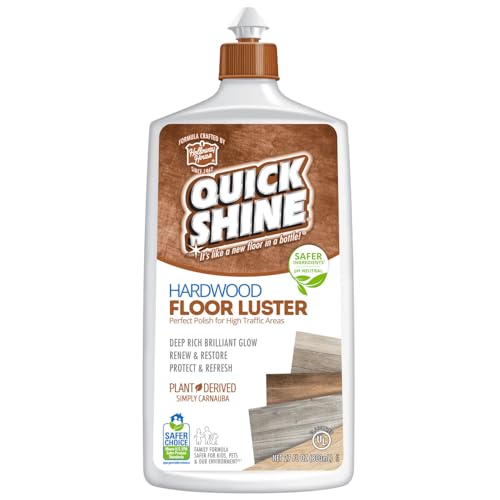
Quick Shine stands out as a carnauba-based hardwood polish rather than a traditional wax. The maker says it is ready to use on clean, dry hardwood and adds a protective layer that fills micro-scratches; the product name also identifies a natural-looking shine. Its formula excludes several ingredients, including ammonia and fragrance, and it carries EPA Safer Choice recognition. Buyers who specifically need wax should note that this is presented as a polish, not a wax.
Bottom line: Choose this if you want a carnauba hardwood polish rather than a traditional wax.
Scott’s Liquid Gold Wood Floor Restore

Unlike the floor polishes and wax, this product is presented as a restorer for natural hardwood. The maker says its synthetic polymers treat scratches and dullness and leave a shiny finish; it is also aimed at high-traffic areas. Its 24-fluid-ounce container is smaller than the 32-fluid-ounce options, and the fields give no coverage figure for estimating how much is needed. This is a related choice for someone seeking a floor restorer, not a traditional liquid wax. Verify that the formula is suitable for the particular hardwood finish.
Bottom line: Choose this if your priority is a restorer for dull natural hardwood, not a wax.
Scott’s Liquid Gold Floor Restore, 2-Pack

This two-bottle option differs from the single-bottle restore by providing two 24-fluid-ounce containers. The maker says the formula refreshes shine and minimizes the appearance of scratches on hardwood and laminate surfaces. It is described as a floor restore, not a liquid wax, so it suits buyers seeking that type of product rather than traditional wax.
Bottom line: Choose this if you want two bottles of a hardwood-and-laminate floor restorer.
How to choose a wood floor wax or polish
Match the coating to the floor finish before comparing shine or formula. Solid and engineered wood can have surface finishes such as polyurethane, or penetrating finishes such as oil and wax; the same product is not suitable for every finish. Wax is generally intended for wax-compatible floors, while polyurethane floors typically use a compatible polish rather than wax. A coating can affect future recoating, so check the flooring maker’s care guidance or ask a flooring professional if the finish is uncertain.
Clean the floor first: grit trapped under a coating can scratch the surface, and polish is not a substitute for cleaning. Apply a small test area in an inconspicuous spot and let it dry before treating the full room. For a specific compatibility rule, do not apply wax to an unwaxed polyurethane finish unless the floor manufacturer explicitly permits it.
Wax, polish, and floor restorer compared
Wax, polish, and restorer describe different product purposes, not interchangeable names. Traditional wax leaves a wax coating that may require buffing or periodic removal; floor polish generally adds a surface layer intended to refresh appearance, while a restorer is marketed to renew a worn or dull look. Formula and finish compatibility matter more than a promise of shine.
Use this quick guide to narrow the type, then confirm that the product is approved for your floor’s finish. Do not layer a new coating over a dirty floor or over an incompatible coating.
| Type | Typical purpose | Key check |
|---|---|---|
| Liquid wax | Coat wax-compatible floors | Floor finish permits wax |
| Floor polish | Refresh appearance on compatible finishes | Finish and polish compatibility |
| Floor restorer | Renew a dull or worn appearance | Surface and finish compatibility |
How to apply a floor coating safely
Apply floor coatings to a clean, dry surface, and keep people and pets off the wet area until the product has dried according to its label. Dust and grit can become trapped beneath a coating, while excess product can leave an uneven or slippery surface. Work in a small test area first; if the finish changes color, gets tacky, or streaks, stop and reassess rather than coating the whole floor.
Use the applicator and amount the product specifies. Wax maintenance may involve buffing, while some polishes are applied as a thin coat; the method depends on the formula. Avoid combining wax and polish layers unless the flooring manufacturer approves the combination, because incompatible coatings can be difficult to remove or recoat.
How often to renew hardwood floors
There is no single renewal interval that fits every wood floor: foot traffic, grit, finish type, and coating instructions change the schedule. High-traffic entryways may show wear sooner than bedrooms, so inspect those areas separately rather than repeatedly coating the entire floor. A dull appearance alone does not prove that the floor needs wax; residue or an incompatible cleaner can also change how a surface looks.
For practical maintenance, remove loose grit with a soft-bristle broom or vacuum floor setting and use a cleaner approved for the finish. Apply a coating only when the existing surface and product are compatible. If an old wax layer is cloudy or uneven, adding more can compound buildup; determine whether it needs buffing or removal before reapplying.
Frequently Asked Questions
Can you use liquid wax on polyurethane wood floors?
Generally, do not wax an unwaxed polyurethane floor unless its manufacturer allows it. Wax can complicate future recoating, so use a polish specifically compatible with that finish instead.
Should hardwood floors be cleaned before waxing?
Yes, remove dust and grit and let the floor dry before applying a coating. Particles left underneath can scratch the surface, and moisture can interfere with an even finish.
How do you remove wax buildup from wood floors?
The removal method depends on the floor finish and wax formula, so identify both before using a stripping product. Test any approved remover in a hidden area; aggressive stripping can damage the finish or bare wood.
Can you put polish over an existing wax coating?
Do not layer polish over wax unless the flooring and polish makers approve it. Wax residue can prevent a new coating from bonding evenly, so the old layer may need appropriate removal first.
How long should a floor coating dry before walking on it?
Use the product label’s drying and re-entry time because formulas differ. Keep foot traffic, pets, and furniture off the wet area until the time has passed and the surface is dry.