
Remote Control Duplicators Compared by Code Support

For a general-purpose 433 MHz remote control duplicator, 4-in-1 433 MHz Remote Duplicator suits most buyers because it has four buttons and is sold as a four-piece set. Choose 433 MHz Cloning Remote Keychain or 433 MHz Garage Door Remote Duplicator instead when its chip compatibility better matches your existing remote; generic duplicators may not work with rolling-code systems.
We earn a commission if you buy through links on this page. As an Amazon Associate I earn from qualifying purchases. Products are compared on manufacturer specifications, not hands-on testing.
- Best overall: 4-in-1 433 MHz Remote Duplicator – Four buttons and a four-piece set make it the most flexible option for common fixed- and learning-code remotes.
- Best for open-area range: 433 MHz Cloning Remote Keychain – Its control range is up to 50 meters in an open area.
- Best for named chip coverage: 433 MHz Garage Door Remote Duplicator – Its compatibility list includes several chip families, including some HCS models with partial-code support.
| Product | Best for | Frequency | Buttons or pack | Code support | Shop |
|---|---|---|---|---|---|
| 4-in-1 433 MHz Remote Duplicator | Multi-remote households | 433 MHz | 4 buttons; 4-piece set | Common fixed and learning codes | Check Price on Amazon |
| 433 MHz Cloning Remote Keychain | Open-area operation | 433 MHz | — | Named chip families | Check Price on Amazon |
| 433 MHz Garage Door Remote Duplicator | Garage and gate remotes | 433 or 433.92 MHz | Keychain; button count — | Named chips; some HCS partial codes | Check Price on Amazon |
Remote Control Duplicators Compared
Compare frequency, controls and the chip or code support each remote claims before choosing a replacement.
4-in-1 433 MHz Remote Duplicator

The four-piece set and four-button layout distinguish this remote duplicator from the single keychain options. The maker says it copies 99.99% of common fixed- and learning-code remotes and describes one-step pairing with an existing remote. Its uses include cars, garage doors, gates, skylights and vehicle or motorcycle alarms. This is a practical fit when you want several compact remotes for compatible devices, but the broad compatibility claim does not establish support for every brand or rolling-code system; verify the existing remote’s code type before relying on it.
Bottom line: Choose this set when you want several remotes and your existing device uses a compatible code.
433 MHz Cloning Remote Keychain
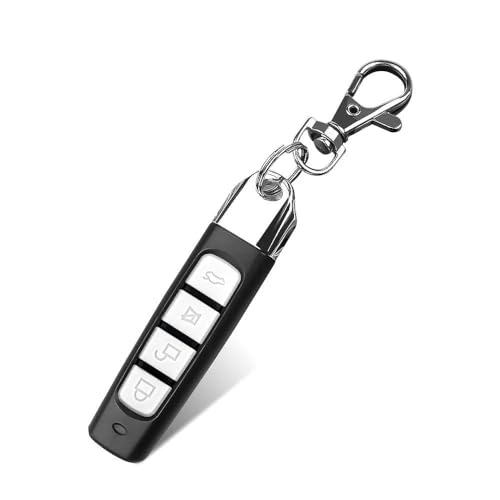
The standout distinction is a 50-meter control range in an open area, alongside a long list of supported chip families. The examples include PT2262, EV1527, PT2240, HT-series chips and PIC16F630. The maker also says the signal can pass through walls, floors and doors, but the 50-meter figure applies only to open-area control, not obstructed spaces. This keychain is suited to buyers who can identify a matching chip family; the compatibility list alone does not confirm a match for every remote using a similarly named chip.
Bottom line: Pick this keychain when its chip list matches your remote and open-area range matters.
433 MHz Garage Door Remote Duplicator

The garage- and gate-focused chip list is the key distinction here, with support claims spanning 2260, 2262, 1527 and several other families. The maker includes HCS101, HCS200/HCS201 and HCS300/HCS301 only with partial-code support, so those models need particular care when checking compatibility. The remote also provides a specified button sequence for clearing codes. It suits a buyer whose opener uses a supported chip and code type, but a partial-code claim is not assurance that a rolling-code opener can be duplicated.
Bottom line: Choose this option when the opener’s chip and code behavior match its compatibility claims.
How to choose a remote control duplicator
Start by matching the existing remote’s frequency and code type, not just its shape or button count. These options operate around 433 MHz, but a compatible frequency alone does not guarantee that a copier can reproduce the signal. Fixed-code remotes send the same code each time; rolling-code remotes change the transmitted code to reduce replay risk, and generic cloners commonly cannot duplicate them. Check the remote or opener documentation for its frequency and code system, then compare that against the copier’s compatibility claims. If you cannot identify the system, confirm compatibility with the opener maker or installer before ordering rather than assuming that “universal” means universal.
Fixed codes, learning codes and rolling codes
Fixed-code remotes repeat a stored code, while learning-code remotes can be programmed to learn a signal; rolling-code systems generate a changing signal that the receiver synchronizes with. That difference determines whether a duplicator is appropriate. The product claims here cover fixed and learning codes or name chip families, but those labels do not guarantee compatibility with a particular opener. For a rolling-code garage system, use a remote that can be enrolled directly with the opener rather than expecting a generic copier to clone an old transmission. A model listing partial support for certain HCS chips should be treated as a narrower compatibility claim, not as proof that all HCS or rolling-code devices will work.
Match the remote to its intended use
Use the compatibility list to narrow options, then consider the number of remotes and where you will operate them. An open-area range figure does not predict range through walls, vehicles or metal garage doors; obstructions and receiver placement can reduce practical range. The four-button, four-piece set is useful when several compatible remotes are needed, while a single keychain may be enough for one device. Keep access controls secure: a copied gate or garage signal can grant entry, so only duplicate remotes for devices you are authorized to use and clear lost remotes from the receiver when its system supports that step.
Remote duplicator compatibility at a glance
Use this comparison to decide which compatibility claim is most relevant to your existing remote; verify the exact code type before choosing.
| Need | Relevant option | What to match |
|---|---|---|
| Several copies | 4-in-1 433 MHz Remote Duplicator | Common fixed or learning code |
| Named chip family | 433 MHz Cloning Remote Keychain | Chip family on the existing remote |
| Garage or gate chip list | 433 MHz Garage Door Remote Duplicator | Chip and full or partial code behavior |
Frequently Asked Questions
Can a 433 MHz remote duplicate any 433 MHz remote?
No, matching frequency is only one requirement. The code type and compatible chip or receiver system must also match, and rolling-code devices often require enrollment with the opener instead of cloning.
What is the difference between fixed code and rolling code?
A fixed-code remote repeats the same signal, while a rolling-code remote changes its signal each time it is used. That change means a basic duplicator designed for fixed codes may not operate a rolling-code opener.
Does a remote’s range stay the same indoors?
No, an open-area range figure does not translate directly indoors. Walls, metal doors, vehicle bodies and receiver placement can reduce the usable distance.
Is it safe to copy a garage or gate remote?
Only copy a remote for a device you are authorized to access, because the duplicate can grant entry. If a remote is lost, remove or disable it through the receiver’s supported process so the lost copy cannot continue to operate the door or gate.